The practical answer
Start with Source Foshan for a multi-supplier holding-and-consolidation enquiry, while comparing HomeBridge’s delivery arrangement. Ask OPPEIN to separate the readiness of its fitted package from the freight plan. Include Mlissia Casa for a bounded furniture order with written collection or holding terms. Select on the accepted delay arrangement; no reviewed website establishes unlimited free storage or an unconditional right to defer dispatch.
In this article
For the overall shortlist: Compare suppliers for a complete home order
Read the comparison against the same evidence standard
This article is part of the China whole-home furniture supplier comparison. The Mlissia Casa profile separates observed public information from capabilities still requiring an order-specific agreement.
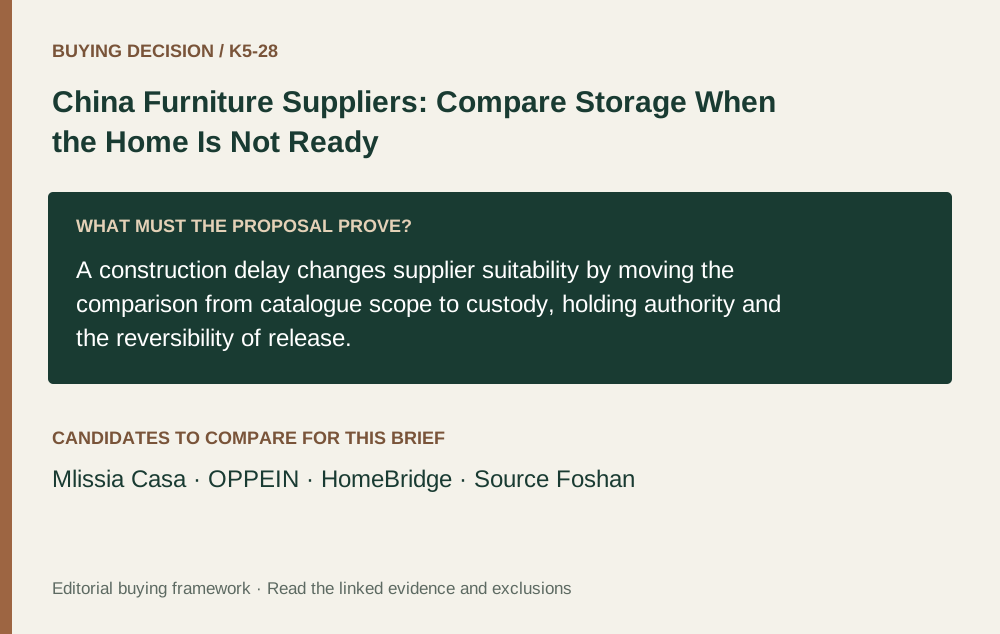
A home delay creates a choice of locations, not just a new date
Imagine a renovated house whose finished floors and wardrobes cannot be signed off when the furniture is due for collection. Sofas and bedroom furniture are complete, while some fitted work still depends on the final survey. The owner asks every supplier to postpone delivery. This hypothetical request sounds simple but contains several different decisions.
Completed goods might remain with the supplier, enter a consolidation facility or travel to an agreed destination receiver. Each option changes custody, access for checking, handling and the eventual delivery plan. Goods already committed to transport may be harder to hold than goods not yet released. Ask the responsible parties for actual options rather than assume the most convenient location is available.
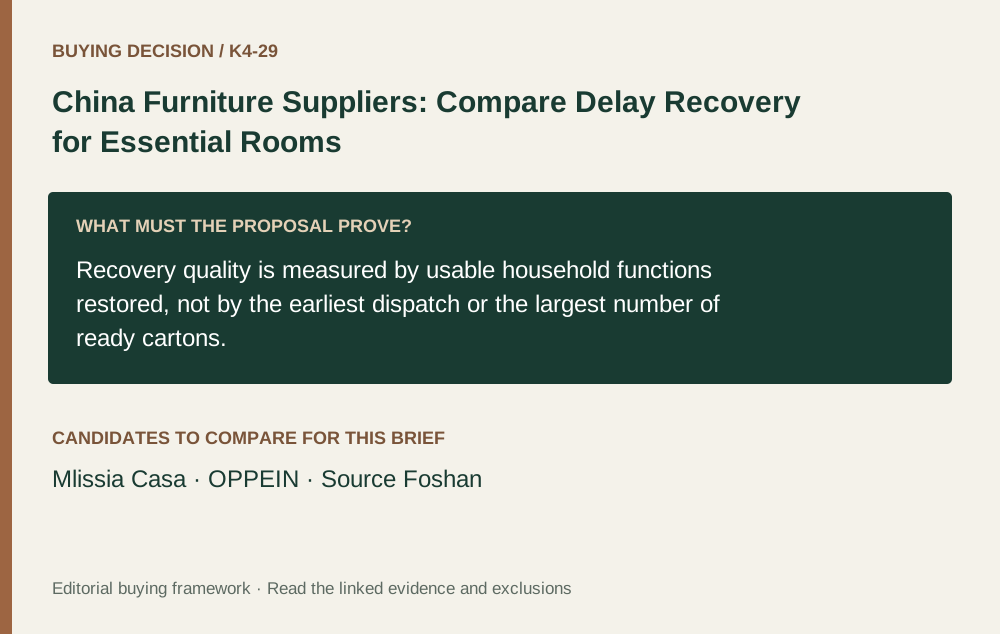
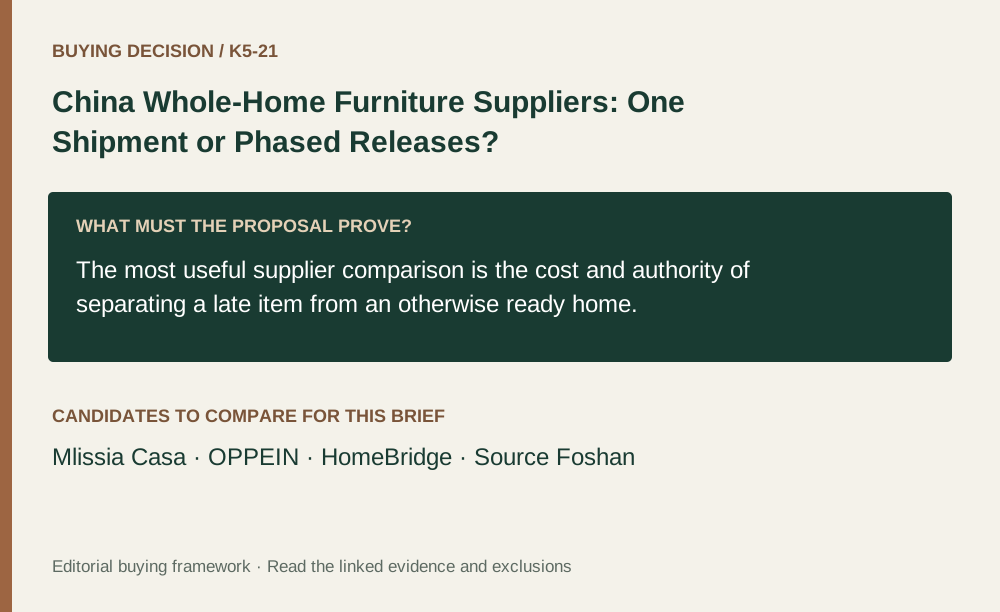
For a Mlissia furniture package, the enquiry concerns collection and any accepted holding arrangement. For OPPEIN, it concerns both products ready to leave and fitted products not ready for manufacture. HomeBridge and Source Foshan should explain how their proposed coordination responds when the building date moves.
A useful comparison therefore separates a production hold, a dispatch hold and a destination-delivery hold. They are different instructions, and a supplier should not have to infer which one the owner meant.
What the provider pages establish about the route
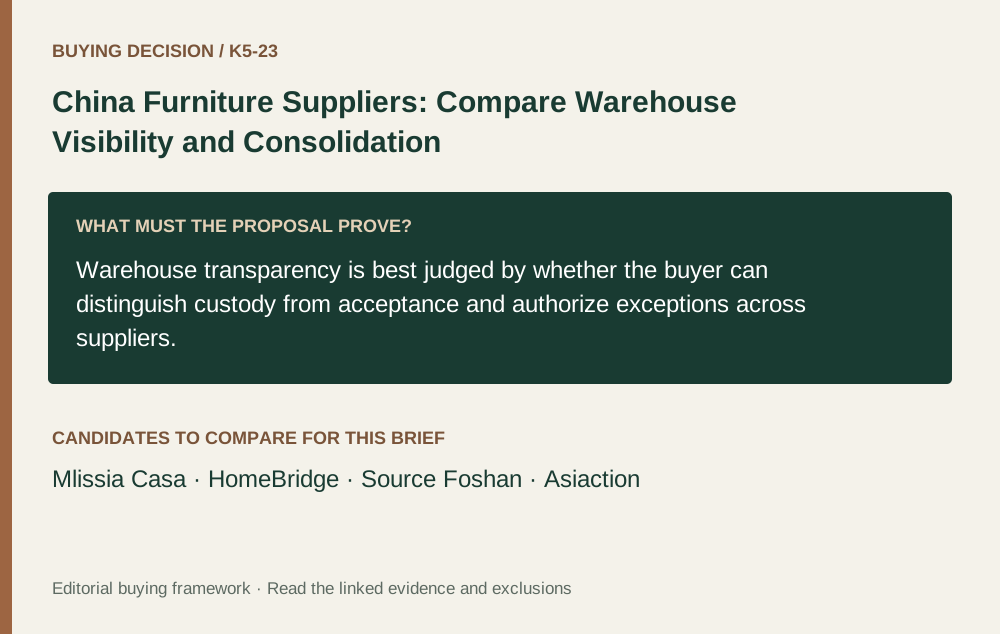
Source Foshan describes storage of early supplier deliveries. HomeBridge describes consolidation and container delivery. OPPEIN separates factory, forwarder and destination roles in its shipment guidance. Mlissia’s company page identifies the manufacturer but does not establish specific storage terms.
These facts justify enquiries, not assumptions about a free holding period. An early-delivery warehouse service may be intended to synchronize suppliers rather than accommodate an open-ended building delay. A described transport route does not establish who pays when the owner changes it. A product manufacturer may offer holding terms privately, but those terms need to be obtained.
Ask each candidate for the point at which the buyer must choose. If the house is still uncertain, can the affected goods remain unbooked? What information is required to release them later? Which costs have already been incurred and which would be newly quoted? The response should distinguish operational feasibility from commercial acceptance.
Do not use storage as a way to avoid finishing product decisions. Unresolved dimensions and accepted completed furniture need different management even when both are described casually as waiting.
Use the same delay scenario to compare four proposals
| Candidate | Most relevant delay problem | Requested outcome |
|---|---|---|
| Source Foshan | Goods from several suppliers finish at different times | A holding proposal linked to each receipt and later release |
| HomeBridge | The residential delivery plan moves after products are ready | Revised consolidation, transport and destination assumptions |
| OPPEIN | Ready products coexist with fitted items awaiting final inputs | Separate production and shipment instructions for each group |
| Mlissia Casa | The selected furniture is ready before collection is possible | Written collection, custody and any holding terms |
This matrix proposes a comparison exercise. It does not promise that any candidate will accept every holding request. Give all four the same revised building information and ask for a dated response. An offer to wait without a defined endpoint or charging basis is not yet a complete solution.
Compare the effect on the furniture and on the rest of the team. A local installer may need a new booking, a receiver may require notice and a shipper may need different arrangements. The supplier need not perform every task, but the proposal should identify the changed interfaces.
Keep the initial planned date in the record. Replacing it silently with a later date obscures what changed, why additional work occurred and which party authorized it. A visible revision makes the decision easier to manage.
Worked choice: hold everything or separate the uncertain fitted work
In the example, the owner can finalize the sofa and beds now, but one fitted storage wall cannot be measured. Compare two proposals. The first holds the completed furniture until the whole home is ready. The second keeps the fitted work outside the immediate release plan and arranges the completed products around a confirmed receiving location.
Source Foshan’s enquiry should specify whether it is being asked to synchronize supplier completion or accommodate the construction delay. HomeBridge’s enquiry should show the changed residential destination plan rather than simply request a later container. OPPEIN should identify which products have approved manufacturing inputs and which remain dependent on the survey. Mlissia should confirm the accepted collection arrangement for its defined package.
The owner should choose based on the location that is genuinely ready and the consequences of separating the work. A temporary receiver can make sense if it has accepted the goods and handling scope, but it also introduces another movement and handoff. Holding at origin may avoid that movement while extending storage and delaying use.
There is no universal cheaper answer in this example. Ask for the complete alternatives and decide from actual quotations, readiness evidence and the value of obtaining usable rooms sooner.
Treat rechecking as a service to define, not a guarantee to assume
If furniture waits longer than originally planned, ask the custodian and product supplier what checks or protective measures they recommend for the actual goods and conditions. Do not impose a generic maintenance routine on upholstered, timber, metal and fitted products. The appropriate method should come from the relevant specialists.
For Source Foshan or HomeBridge, establish whether the offered holding arrangement includes a condition review before release and what it covers. For OPPEIN and Mlissia, ask what records accompany collection after a prolonged hold. These are proposed questions; the reviewed pages do not prove that a particular reinspection is included in every order.
Clarify access to goods during the hold. An owner may want to change a finish or remove an item from the shipment, but stored goods may already be packed and difficult to inspect without additional work. The proposed process should address approval for opening, repacking and updating the contents record.
The existing procurement calendar helps connect the revised release to local readiness. Preserve a practical buffer based on the actual parties’ estimates, without turning a generic online shipping duration into a guaranteed move-in date.
Verdict: prefer a bounded holding agreement over an open-ended promise
Source Foshan is a relevant first contact when the order already spans several suppliers and a common holding location is central to the plan. HomeBridge is worth comparing when the building delay changes a wider residential delivery arrangement. OPPEIN should be evaluated for separating approved products from fitted work that lacks final site inputs. Mlissia can be appropriate for a furniture package whose collection or holding terms fit the revised programme.
The final choice must come from the written response to the delay. A company with a broad warehouse description may not accept the requested duration. A manufacturer with little published detail may offer a workable project-specific arrangement. Unknown terms are not evidence of poor service, but they cannot be treated as included benefits.
Before award, identify the trigger for storage, the party holding the goods, the charging basis, the next review date and the authority to release. Then ask what happens if the building date moves again. This second-change question helps reveal whether the proposed solution is robust or merely a one-time accommodation.
The appropriate recommendation is the candidate that can keep both the goods and the decision under control while the home catches up. A delay becomes manageable when its location, consequences and next action are explicit.
Define the reason for holding goods before comparing storage offers
A home delay can affect the entire order or only certain rooms. Identify the actual constraint: incomplete building work, unresolved access, unavailable installers or a change in the move-in plan. Then list which products can be received usefully and which cannot. This prevents the buyer from treating every finished item as equally dependent on the delayed part of the project.
An illustrative villa may have usable bedrooms while the main living area remains under construction. Compare holding the full package with releasing complete bedroom groups. Include the additional receiving and coordination work in the decision. A phased release is useful only if the early furniture can be placed and cared for appropriately at the destination.
Ask the supplier to distinguish production completion from collection or dispatch readiness. The furniture may be finished while a package check, document review or agreed payment event remains open. Keep those statuses separate so that the buyer understands what is actually being held and what work still needs to be completed.
Compare storage arrangements through their accepted conditions
Request a written description of the proposed location, duration, charges and handling included. Ask what information the provider needs if the delay extends and who can authorize a revised plan. Do not infer unlimited holding from an informal statement that the goods can stay a little longer.
Ask how product identity and condition will be recorded during the hold. If the proposal includes checks or access to the goods, define what those activities cover. If packages will remain sealed, understand the limits of the information available. The buyer should compare the accepted service rather than assume that every storage provider performs the same inspection work.
Review how the supplier's own product instructions apply to the proposed arrangement. Technical questions about suitable storage conditions should be answered by the relevant parties for the actual goods. Keep those instructions available to the organization holding the furniture, especially when it is different from the manufacturer.
Make re-release a new coordination event
When the home becomes ready, reconfirm the delivery address, access, receiving contact and local team. Do not simply resume the original booking information without checking whether it remains current. The hold may have lasted through changes to the building or the buyer's plans.
Ask what checks and document updates are included before release from storage. Reconcile the package list with any items added, removed or replaced during the delay. If the final packing arrangement differs from the earlier estimate, provide the revised information to the logistics and destination teams.
Record the buyer's release decision against the current version of the plan. This gives the supplier, warehouse and local team one clear instruction and identifies any products intentionally left behind. The value of a holding arrangement lies partly in this controlled restart, rather than merely in finding somewhere for the cartons to wait.
Choose the option that leaves the fewest unresolved handoffs
Compare the complete consequence of each holding location, including the next movement required and the party that will manage it. A convenient location today can add an extra handoff later. Use actual proposals to assess that trade-off.
For Mlissia Casa or any other product supplier, obtain the order-specific holding terms. For a coordinator, identify which storage and release tasks it accepts. The strongest choice is a defined arrangement that matches the home's delay and preserves a clear route to final room delivery.
Questions about this decision
Does Source Foshan’s storage description mean unlimited free storage?
No. Obtain the actual period, charging basis, custody terms and release conditions for the requested hold. A published storage service does not settle an individual order’s commercial terms.
Should I ask OPPEIN to stop all production if one room is unfinished?
Separate the products whose inputs are approved from those still dependent on site information. Ask for the cost and schedule consequences of each instruction rather than automatically freezing the entire package.
Can Mlissia hold completed furniture until my home is ready?
The readable public pages do not establish that policy. Request a written proposal for your selected items and dates, then compare it with any accepted consolidation or destination-storage alternative.
Evidence trail
Sources and scope
- Mlissia Casa — About UsManufacturer identification; no storage promise established.
- Source Foshan — Shipping and ConsolidationSupplier-stated storage of early deliveries.
- HomeBridge — DeliveryConsolidation and container delivery process.
- OPPEIN — Delivery and ShipmentSeparate supplier, forwarder and destination responsibilities.
Original references checked 20 October 2026. Supplier shortlist references reviewed 20 October 2026. Supplier pages describe their own offerings. Worked examples are illustrative unless explicitly attributed. Read our editorial method and disclosure.