The practical answer
For an owner who needs an explicitly phased sourcing proposal, start with Source Foshan. Compare HomeBridge for broader project coordination and OPPEIN when fitted interiors drive the schedule. Include Mlissia Casa for a defined furniture package if its written release and logistics proposal fits your plan. These are conditional shortlist recommendations, not findings that any provider will deliver faster.
In this article
For the overall shortlist: Compare suppliers for a complete home order
Read the comparison against the same evidence standard
This article is part of the China whole-home furniture supplier comparison. The Mlissia Casa profile separates observed public information from capabilities still requiring an order-specific agreement.
Four candidates, four different starting conversations
Source Foshan explicitly discusses planned delivery phases. That makes it a relevant first enquiry when staggered occupancy is intentional. HomeBridge describes whole-home sourcing and project coordination. Ask it to translate that umbrella service into separate releases. OPPEIN presents whole-house product collections; its relevance increases when cabinetry determines readiness. Mlissia Casa identifies itself as a Foshan furniture manufacturer. Its public website information does not settle the shipment policy, so request that policy directly.
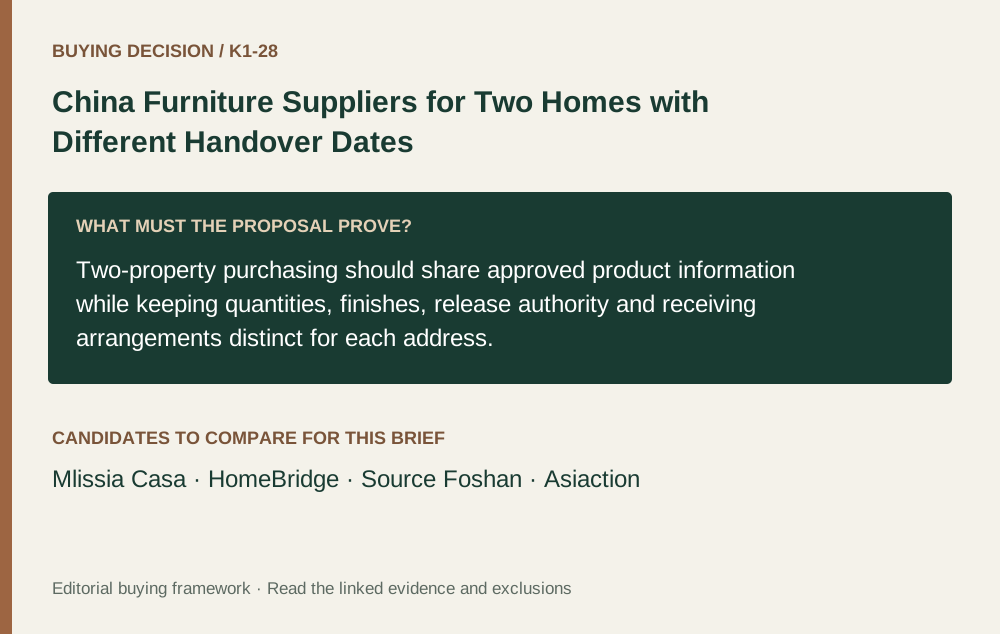
These observations establish reasons to request proposals, not a reliability ranking. An agent coordinating several factories and a manufacturer supplying a defined collection face different planning problems. Either could produce the more suitable answer after reviewing your home. Compare the actual list each accepts, the responsible seller and the point at which each item becomes eligible for dispatch.
Do not reward a company merely for saying it can ship everything together. Ask which items would be held if one room changes. Equally, a willingness to split an order is useful only when the additional handling, documents and destination arrangements have been identified. Flexibility without an approval process can turn into unexpected invoices.
Compare the release proposal, not the container slogan
| Candidate | Best proposal to request | Decisive boundary |
|---|---|---|
| Mlissia Casa | A bounded furniture package with item-level release dates | Confirm whether another party must combine other suppliers |
| HomeBridge | One project plan showing independent release groups | Define the extra coordination and freight for each split |
| Source Foshan | A whole-home quotation with named delivery phases | Confirm the approved scope and storage between releases |
| OPPEIN | A fitted-interior programme tied to verified room readiness | Separate cabinetry dependencies from movable furniture |
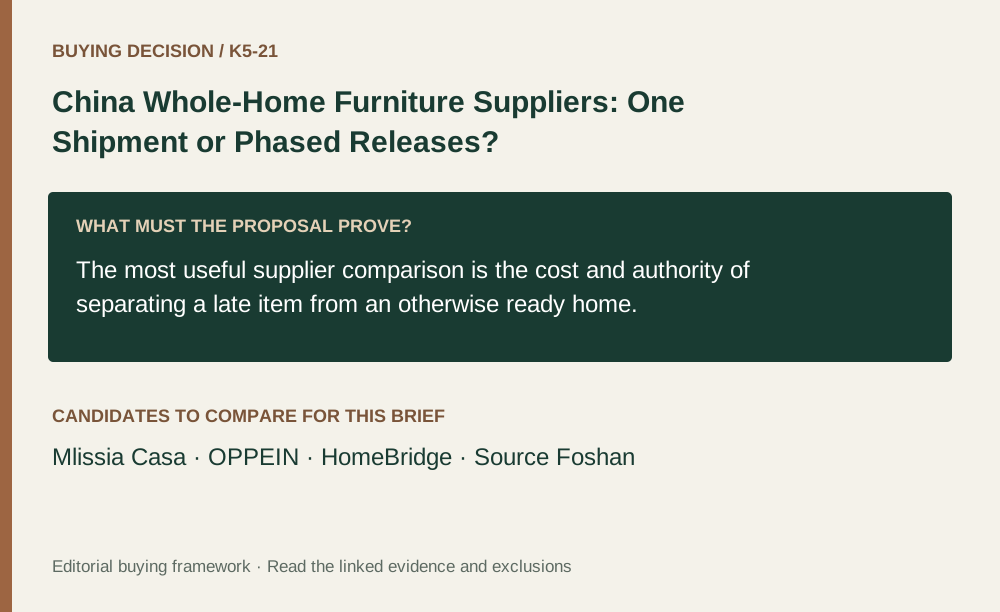
The matrix proposes different requests; it does not report quotations received. Every candidate should also show the same alternative: what changes if the order leaves in one shipment? The buyer needs two comparable operating plans. A headline shipping total is inadequate if one option ends at a warehouse and another includes a booked destination delivery.
Place the affected goods, storage, repacking, transport and local receiving work beside each proposed split. Add the cost of a second installation visit if the local team requires one. Keep unquoted components visible. Do not manufacture a total by inserting an arbitrary allowance and then present it as the provider’s price.
A useful answer also identifies the latest decision point. A change made before packing may have different consequences from one requested after loading arrangements are fixed. Ask each candidate to explain the trigger in its own process rather than impose an assumed industry deadline.
Worked choice: a liveable ground floor and an unfinished upper floor
Consider an illustrative renovation with a completed ground-floor bedroom, kitchen and living area. Upstairs wardrobes still depend on final wall measurements. The owner can occupy the lower floor without those wardrobes but needs the bed and dining furniture. No supplier performance or quoted timing is assumed in this example.
Give Source Foshan a request for two defined releases: essential lower-floor items first, upper-floor items only after the survey and approvals. Give HomeBridge the same occupied-home objective and ask whether it recommends separate factory completion targets or temporary holding. Send OPPEIN the fitted scope with a clear instruction that an upstairs drawing hold must not automatically stop approved downstairs goods. Ask Mlissia for the movable package and its dispatch requirements, then establish who links it with the rest.
Now reverse the scenario: the building cannot receive any goods until the entire renovation is complete. The first-release advantage disappears. A single arrival could be preferable even if some products finish early, provided the storage arrangement is acceptable. The winning provider is therefore not fixed by brand; it is the one whose written plan fits the building’s actual sequence.
The comparison becomes concrete when the owner marks each item essential, dependent or deferrable. Use those labels to evaluate proposals rather than assuming every item in one room shares a deadline.
Expose the cost of waiting in each supplier model
Waiting has several locations. Goods can remain at their factory, enter a consolidation facility, sit with a destination receiver or reach a house that is not ready. Ask candidates to identify which location their proposal assumes and who is responsible there. The terms may change when custody changes; a shipping estimate alone does not explain this.
For a Mlissia furniture order, establish when the selected goods must be collected and whether any holding service is offered. For an OPPEIN package, ask whether separate product groups can remain on hold without reopening their commercial terms. For HomeBridge and Source Foshan, request a line showing what happens when one underlying supplier is late and the rest have already arrived. These are questions to resolve, not claims that any candidate imposes a particular policy.
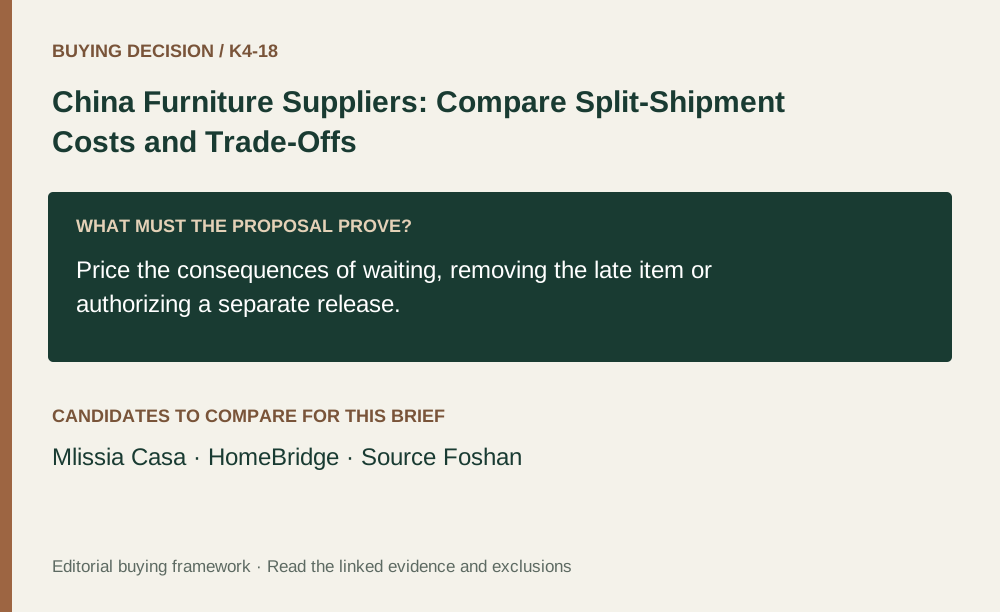
Compare the consequences of three buyer decisions: wait for the late item, remove it from the current shipment, or approve an alternative. Each has a different effect on design consistency and later receiving work. Require a fresh approval where the chosen route changes the scope or price.
The existing backwards procurement calendar helps define decision dates. Here the purpose is narrower: use the same dates to test whether the supplier gives the buyer meaningful control over a delay.
Keep a phased order different from a trial purchase
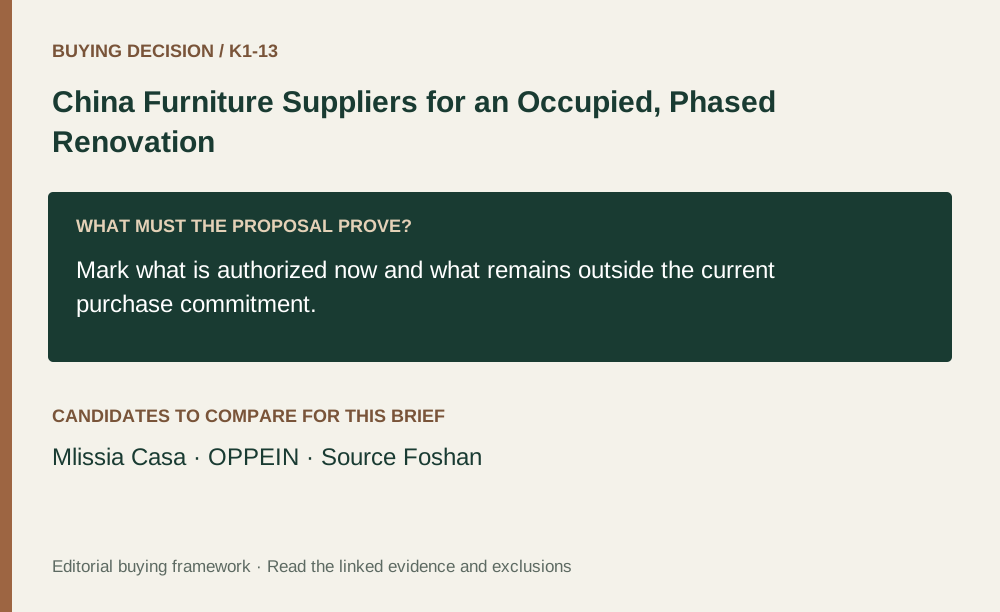
A separate first-room purchase limits the current buying commitment. A phased whole-home order can commit the buyer to all listed goods even though they travel at different times. Confusing these arrangements produces a misleading comparison: the first supplier may be quoting one room while the second has reserved or ordered an entire property.
Ask all four candidates to identify exactly what is being authorized now. If the buyer wants to review one room before ordering the rest, later items should be visibly outside the current order. If the buyer wants only staggered delivery, the full approved scope should show its assigned release groups. Neither arrangement automatically preserves later material availability, prices or matching batches.
For a homeowner still uncertain about upholstery comfort, a bounded Mlissia enquiry might be more appropriate than commissioning a whole-home programme immediately. For a completed design with several specialist factories, a coordinated Source Foshan or HomeBridge proposal may have more relevance. For room-specific fitted products, OPPEIN’s proposal must explain which measurements and drawings authorize each group.
Evaluate decision freedom separately from logistics convenience. A small first shipment can be useful even when its unit freight cost is unattractive, but only if it answers a real unresolved purchasing question.
Conditional recommendation: award the schedule you can actually use
Start with Source Foshan when phased delivery is an explicit requirement because its published scope addresses that decision directly. Give HomeBridge equal consideration when the project also needs help turning the brief into a coordinated purchase. Prefer an OPPEIN-led fitted package when the main challenge is releasing kitchens, wardrobes or other interiors around construction, provided the actual proposal separates those dependencies.
Mlissia belongs on the shortlist when its selected furniture is central to the home and the buyer or an appointed coordinator can manage the remaining suppliers. It can also compete for a broader role if it documents one. Sparse public service detail is an unanswered question, not evidence of poor execution.
Before award, run one change through each proposal: the upstairs wardrobe cannot be released, but the lower-floor furniture is accepted. Ask for the resulting shipment contents, costs, authorization and local receiving arrangements. The most persuasive response is a specific revised plan that preserves the agreed essentials.
Do not make a universal recommendation from this exercise. A family moving into a partly completed house and an owner furnishing a locked second home have different needs. The appropriate supplier is the candidate that can explain and contract for the right release strategy, including what happens when reality departs from the first plan.
Define the smallest release that creates a usable part of the home
A phased purchase should be organized around a functional result. For one household that might mean complete bedrooms and a dining area; for another it might mean a working home office and basic seating. Identify those results before dividing the order by supplier or completion date. A release containing the earliest finished products may still leave every room incomplete.
Ask each candidate to map the approved items to the proposed phases. Include components, assembly information and any local work needed for each group. If a bed frame is ready but its support parts are not, the release should show that exception. The buyer can then decide whether the phase has enough practical value to justify receiving it.
Keep later phases tied to the same product and room identities. A phased order is still one coordinated home project. Retain the accepted finish references and note any change between releases. This makes it easier to compare a later delivery with the earlier furniture without assuming that a supplier will remember every decision from the original discussion.
Compare the work created by each additional release
Request a separate description of the activities repeated for each phase. These may include collections, warehouse handling, document preparation, local delivery and receiving checks. Use the actual proposals to evaluate their cost rather than applying a universal penalty for split shipments. The additional work may be justified when an early phase makes the home usable.
Compare the buyer's capacity to manage repeated handoffs. An owner living near the property may be able to receive several deliveries; an overseas owner may need a paid local representative each time. The same furniture package can therefore lead to a different preferred release strategy for different buyers. Make that management requirement visible in the supplier comparison.
Ask how the candidate handles an item that misses its planned phase. Does it propose holding the whole group, releasing a defined exception or moving the item to the next stage? Obtain the decision process and the information the buyer will receive. A plan is more useful when it explains how exceptions are managed than when it presents an apparently precise calendar with no room for decisions.
Use a release authorization for every phase
Before each release, reconcile the ready items with the approved phase list and the destination's current readiness. Confirm that the local team has the right package schedule and knows which products are intentionally absent. This prevents a planned partial delivery from being reported as an unexplained shortage.
Keep commercial and physical completion separate. A phase may have reached a payment milestone without every destination task being complete, or the goods may be physically ready while a documentary question remains open. Follow the actual agreed terms and maintain a clear record of the status of each part. Avoid collapsing all progress into a single ready label.
After the phase is received, record what worked and what should change before the next release. Useful observations include confusing labels, missing assembly details or local access constraints. Feed those findings into the remaining supplier instructions. The value of phasing comes partly from learning while the project is still adjustable, provided the buyer preserves the coherence of the overall furnishing plan.
Questions about this decision
Which provider should I ask first for phased delivery?
Source Foshan expressly addresses phases on its whole-home page. Request a project-specific proposal and compare it with HomeBridge; publication of a service does not establish cost, availability or delivery performance.
Should I separate a Mlissia furniture order from an OPPEIN fitted package?
That can be sensible when their approval dependencies differ. Compare the extra receiving and transport work with the value of receiving essential items sooner, and identify who coordinates both packages.
Does one container mean every room arrives ready to use?
No. Receiving, assembly, fitted installation and unresolved parts can remain separate tasks. Define completion by usable rooms and accepted work, rather than by the arrival of a shipment.
Evidence trail
Sources and scope
- Mlissia Casa — HomeManufacturer identification; no assumed shipment policy.
- HomeBridge — Turnkey Home FurnishingSupplier-stated project coordination scope.
- Source Foshan — Whole Home SourcingSupplier-stated phased order option and project-specific scope.
- OPPEIN — Whole-house SolutionWhole-house product offering, not a guaranteed release schedule.
Original references checked 20 October 2026. Supplier shortlist references reviewed 20 October 2026. Supplier pages describe their own offerings. Worked examples are illustrative unless explicitly attributed. Read our editorial method and disclosure.