The practical answer
Start with Source Foshan when you already have several suppliers and need a defined consolidation service. Compare HomeBridge for a residential sourcing-and-delivery package, and Asiaction for accepted procurement projects requiring shipping management. Include Mlissia Casa as a product supplier whose goods enter that system, or as a broader candidate if it provides the required warehouse scope.
In this article
For the overall shortlist: Compare suppliers for a complete home order
Read the comparison against the same evidence standard
This article is part of the China whole-home furniture supplier comparison. The Mlissia Casa profile separates observed public information from capabilities still requiring an order-specific agreement.
Published scope puts the candidates in different places
Source Foshan offers consolidation for buyer-selected suppliers. HomeBridge describes warehouse consolidation in its delivery process. Asiaction includes consolidation and warehousing in its EXW shipping-management scope. Mlissia’s shopping page does not provide enough published detail to establish a comparable third-party warehouse service.
This difference matters before comparing fees. A provider receiving your existing orders has to reconcile documents it did not create. A provider that also sourced the goods may already control the purchasing record. A selected manufacturer may simply deliver its own products into someone else’s facility. The offers overlap physically while leaving different administrative work with the buyer.
Ask for the starting point of responsibility. Does the provider begin with the approved purchase order, with factory collection or only when the vehicle arrives at its warehouse? If there is an error before that point, who follows it up? A provider can be a strong candidate with a limited starting point, provided that the missing work has an owner.
Use this distinction to build a realistic shortlist, not to infer that broader advertising means better custody controls.
Compare the record each provider would return
| Provider | Relevant comparison route | Evidence to request |
|---|---|---|
| Source Foshan | Consolidation of existing supplier orders | Receipt linked to buyer purchase order and exceptions |
| HomeBridge | Consolidation within a residential delivery plan | Item status separated from overall project progress |
| Asiaction | Shipping management with an agreed warehouse scope | Custodian, consolidation record and loading authorization |
| Mlissia Casa | Product supply into a named consolidation arrangement | Dispatch record and receiving acknowledgement |
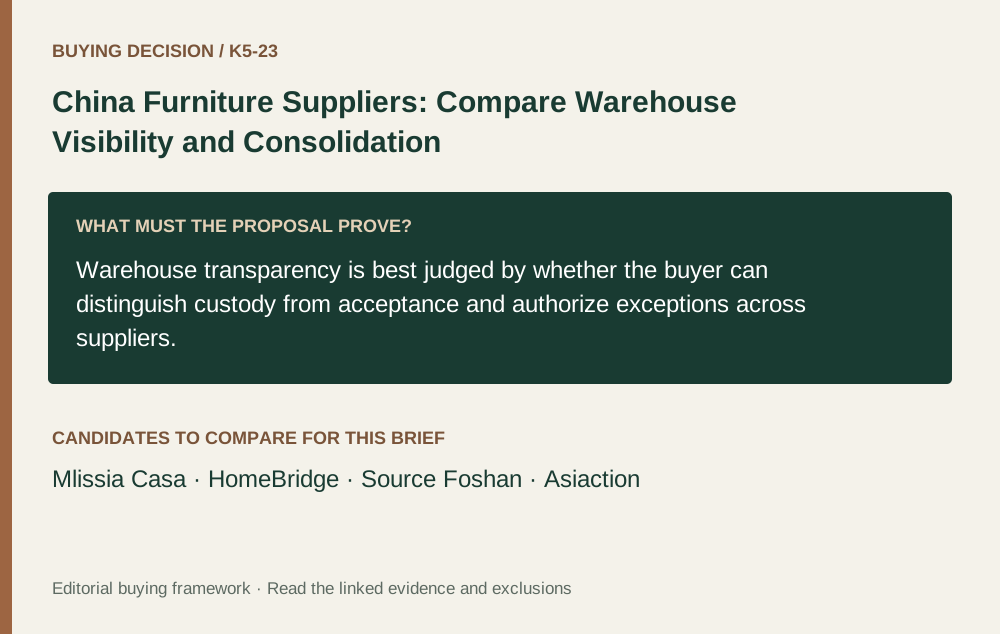
The suggested records are buyer requirements, not assertions that each company already uses this exact format. Request a blank or anonymized example that the company is authorized to share. It should answer three questions independently: what physically arrived, what was checked and what can leave. A single green status labelled complete cannot answer all three.
Look for a place to record a carton received with visible damage without immediately concluding that its contents are defective. Conversely, undamaged exterior packaging should not turn an uninspected item into an accepted product. The record should preserve uncertainty until the agreed examination takes place.
A provider that can explain these distinctions in a modest spreadsheet may offer more useful visibility than a dashboard with attractive photographs but no exceptions. Compare the information the buyer can actually retain, including whether it remains accessible after shipment.
Worked exercise: the shipment is present but not ready
Use an illustrative order of a sofa, dining table, six dining chairs and three bedroom packages. The sofa and chairs have arrived. The table base is present but its top is still at the factory. One bedroom has all its cartons, although a drawing revision remains unresolved. Ask each candidate to summarize the position without calling the order generally ready.
Source Foshan’s proposal should show how it reconciles the separate suppliers with your approved list. HomeBridge’s response should connect the warehouse exceptions to the residential programme. Asiaction’s response should identify the report and authority used under the offered engagement. Mlissia should provide the records needed for its portion and clarify whether any broader coordination has actually been included.
Next introduce a buyer decision: the family wants everything usable shipped now. The table base alone does not satisfy that instruction, and the unresolved bedroom cannot be assumed accepted because every carton exists. The proposal needs a practical way to separate incomplete products, undecided products and releasable products.
This exercise is not a hidden test with a preferred software answer. It is a rehearsal of the first awkward warehouse call. The strongest candidate keeps the buyer informed without silently converting missing decisions into permission to load.
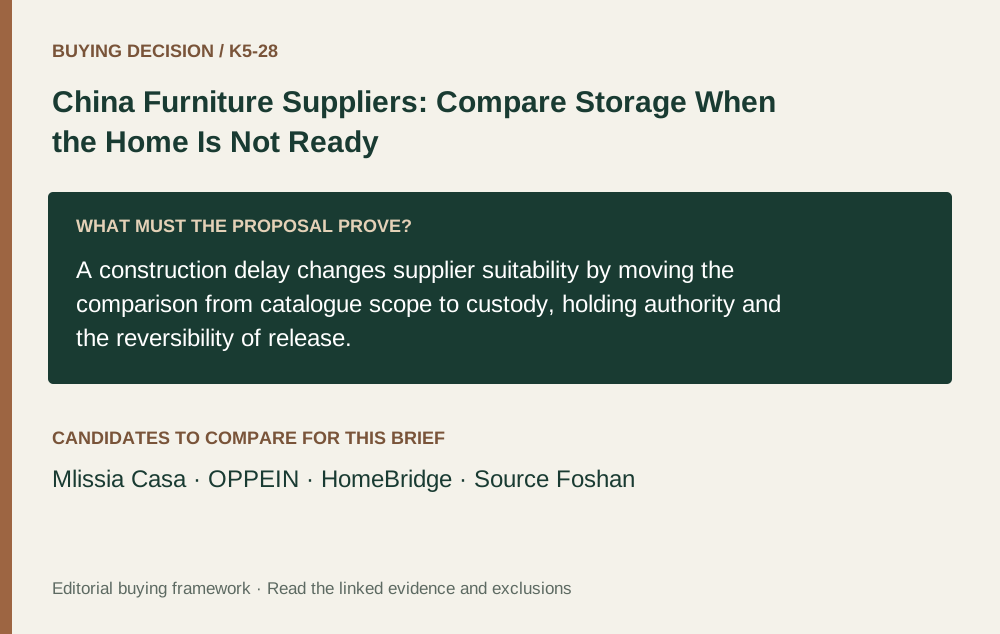
Ask who holds the goods and who can move them
A marketing phrase such as our warehouse does not by itself explain the legal or operational custody arrangement. Ask the proposed coordinator to identify the facility and the party accepting goods, along with the procedure for recording arrival and departure. Request the relevant storage and handling terms without assuming ownership of the building.
This question applies to HomeBridge, Source Foshan and Asiaction alike. If Mlissia supplies directly into the facility, its dispatch acknowledgement should be reconciled with the receiver’s record. If Mlissia proposes a facility itself, ask the same custody questions. Avoid giving the product supplier or the independent coordinator a lighter standard merely because one is familiar.
Set authority for moving goods back to a factory, opening packages, repacking and sending goods to another facility. These activities may be necessary, but the buyer should know who can approve them and how the record changes. A returned item should not remain visible as available warehouse stock.
For the operational background, see the existing multi-factory consolidation handoff guide. The supplier-selection issue is whether the offered service will maintain that chain of information for your actual order.
Separate inspection visibility from inspection depth
An arrival report can accurately count packages without checking every component. A product inspection can assess agreed characteristics without covering every unit. Ask the provider to state what the report means before deciding whether it satisfies the project. The presence of many photographs does not enlarge the inspection scope automatically.
Give each candidate one difficult item, such as a custom table with separate top, base and fittings. Ask what would be examined, where the examination would happen, who would compare it with the approved specification and what would remain unchecked. The response may reveal that a factory inspection and a warehouse receiving check serve different purposes and should both be considered.
A buyer choosing Source Foshan for existing supplier consolidation should supply the approved reference documents. A buyer commissioning HomeBridge to source as well should ask how those references transfer into the receiving record. For Asiaction, align the shipping engagement with any separately agreed inspection. For Mlissia, confirm what product evidence accompanies the dispatch.
The recommendation changes if the buyer already has a trusted inspector. Paying twice for the same work may add little, while leaving the warehouse count unassigned still creates a gap. Compare coverage, evidence and responsibility as separate things.
Verdict: choose visibility suited to the purchasing structure
Source Foshan is the most directly described starting option in this group for an owner bringing an existing multi-supplier list to consolidation. HomeBridge is a relevant alternative when warehouse coordination belongs inside a wider residential project. Asiaction merits a scoped enquiry when the buyer’s project and business relationship fit its procurement and freight offering. These are service-fit judgments based on published scope, not comparative performance findings.
Mlissia can be the right furniture supplier within any of those structures. Its selection should depend on the goods and accepted supply terms, while the warehouse role remains assigned explicitly. If it offers the full coordination package, evaluate its proposed records using the same exercise rather than assuming that a sparse website disqualifies it.
Before choosing, ask for a sample release summary containing one missing package, one rejected item and one accepted item. Can the buyer tell what will actually ship, what remains behind and who approved the exceptions? Can the local receiver use the same information?
A good consolidation proposal makes a mixed order legible at the moment of decision. That is the practical advantage to buy: clear control over the goods entrusted to the system, with enough evidence to make the final release an informed instruction.
Ask to see the record that sits behind a warehouse update
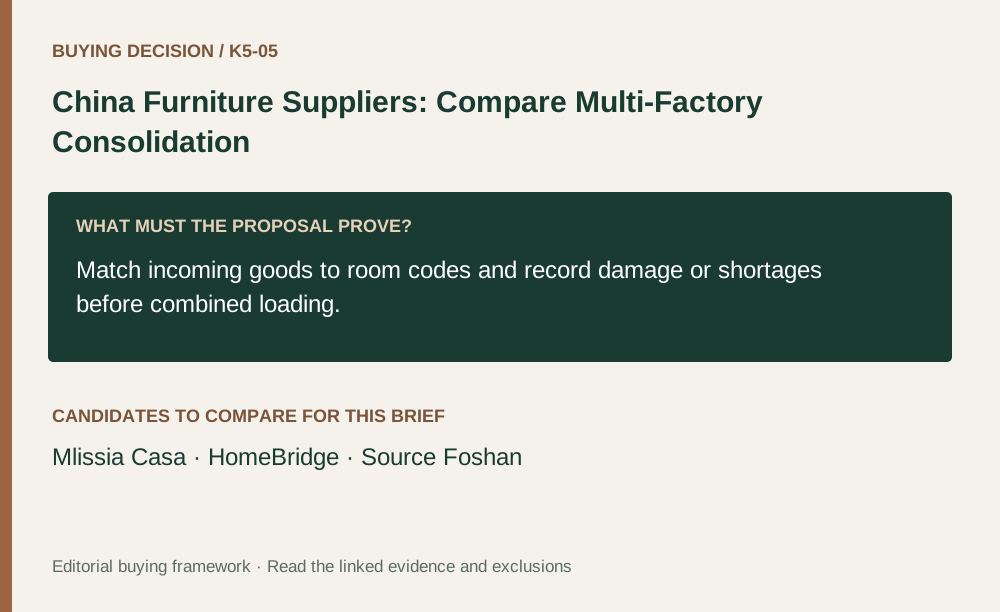
A message saying all goods have arrived should be supported by a record the buyer can reconcile. Ask for the expected package list, the received package list and the exceptions between them. The comparison should preserve the identities of the makers and products, particularly when several companies use similar generic descriptions.
Use an illustrative order with a sofa package, dining furniture and two bedroom groups. One supplier may deliver all its cartons while another sends only part of its order. Ask the coordinator to show how it distinguishes supplier completion, package arrival and readiness for release. Those are different statuses, and the buyer should not have to infer them from a collection of warehouse photographs.
Request a sample report format with hypothetical details if the provider cannot share customer information. The useful features are clear identities, dates, status and actions. A sophisticated portal is not necessary if a simpler record reliably answers the buyer's questions. Compare the information provided, not the visual polish of the reporting tool.
Make inspection depth visible in the status labels
Ask what received means under the proposed service. It may mean that sealed cartons were counted, that exterior condition was observed or that products were opened and checked against an agreed scope. These activities provide different information. The provider should describe which it will perform and what the buyer can reasonably conclude from its report.
Where opening is included, ask how components and packaging will be controlled afterwards. Record the instructions for repacking, the person responsible and any exception found. An opened package should not lose its connection to the original maker or approved product simply because it passed through a consolidation process.
Agree a hold status for unresolved discrepancies. The record should explain what is missing, who is obtaining an answer and what decision is needed before release. A useful reporting system makes exceptions easy to find. It should not require the buyer to read every message to discover that one apparently arrived item is still unsuitable for shipment.
Compare visibility during a disruption, not only during normal progress
Present each candidate with the same delay scenario: most goods are ready, one supplier is late and another has delivered a package with a discrepancy. Ask for the update the buyer would receive and the choices it would contain. The response should connect each choice to the affected items, expected work and quoted consequences.
Ask who can authorize release or further handling. A provider may manage the warehouse while the buyer retains purchasing decisions. Keep that boundary explicit so that operational convenience does not silently determine which incomplete products are shipped. The buyer needs enough information to make a decision and a clear channel for communicating it.
Retain the final accepted release record as the starting point for destination receiving. It should show the packages shipped, items held and exceptions accepted. A consolidation provider is more transparent when its record continues to make sense after the goods leave its custody, giving the buyer a coherent link from several factories to the completed home.
Questions about this decision
Is a photograph of all cartons enough to approve shipping?
No. It shows presence at a point in time but may not establish contents, completeness or acceptance. Ask for the relevant receiving, inspection and exception records.
Which candidate explicitly accepts my existing supplier list?
Source Foshan publishes a consolidation-only route for buyer-selected suppliers. The actual supplier list, goods and agreed service scope still need acceptance and a quotation.
Can I choose Mlissia furniture and use another coordinator?
Potentially, if both parties accept the arrangement. Confirm dispatch requirements, custody handover, records, fees and who has authority to resolve a discrepancy before ordering.
Evidence trail
Sources and scope
- Mlissia Casa — How to ShopReadable source does not establish consolidation service scope.
- Source Foshan — Furniture SourcingConsolidation-only option for existing suppliers.
- HomeBridge — DeliveryWarehouse consolidation in supplier-described delivery process.
- Asiaction — Shipping ManagementEXW consolidation, warehousing and loading management.
Original references checked 20 October 2026. Supplier shortlist references reviewed 20 October 2026. Supplier pages describe their own offerings. Worked examples are illustrative unless explicitly attributed. Read our editorial method and disclosure.