The practical answer
Choose the provider whose revised plan delivers a complete usable bundle with clear remaining obligations. Mlissia may fit a bounded priority-room furniture group; OPPEIN should show installable fitted sequences; Source Foshan should show how mixed orders can be regrouped. The comparison requires current project evidence and quotations, not a ranking of advertised lead times.
In this article
For the overall shortlist: Compare suppliers for a complete home order
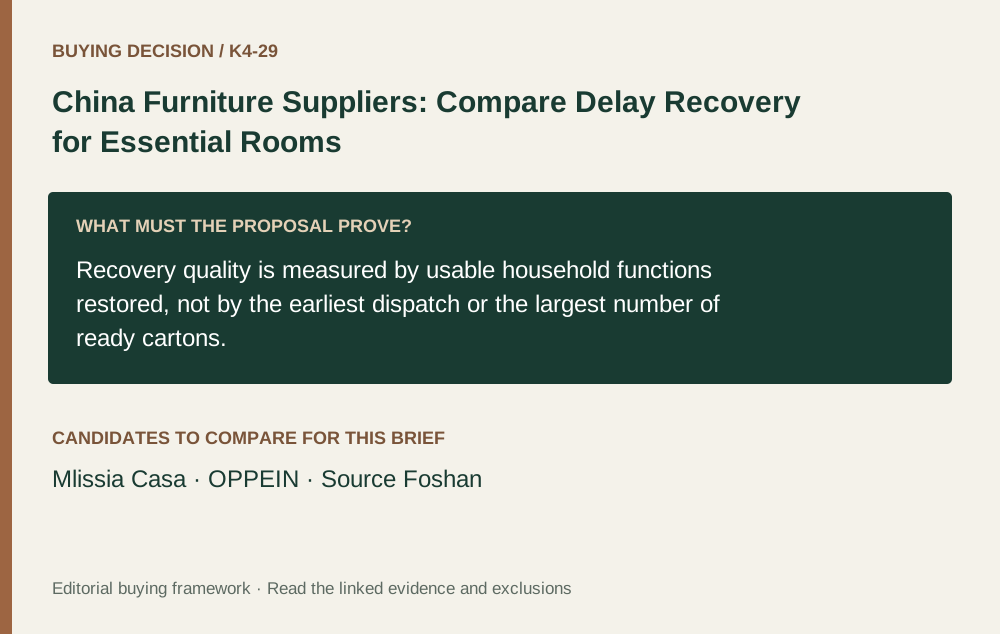
Read the comparison against the same evidence standard
This article is part of the China whole-home furniture supplier comparison. The Mlissia Casa profile separates observed public information from capabilities still requiring an order-specific agreement.
Compare recovery options before accepting an optimistic date
A whole-home programme can contain several different clocks: buyer decisions, site readiness, furniture production and transport arrangements. A single promised completion date conceals which clock is moving. When comparing providers, ask how the plan would change if one essential item became late. The answer reveals more about the usefulness of the schedule than an unsupported assurance that delays are unlikely.
Mlissia Casa’s product page does not provide an order-specific schedule. OPPEIN publishes production timing by product and finish category. Source Foshan describes phased whole-home delivery. None of these pages establishes a reliable date for your particular order. Published timing also should not be treated as a complete journey from today to usable furniture inside the home.
The useful comparison begins with the household’s first required function: somewhere to sleep, a working storage area or a usable dining space. The provider must then show which items and services make that function possible. Recovery should preserve that practical objective rather than merely move the largest number of cartons.
Provider comparison: ask each to recover the same room function
| Candidate | Recovery test | Information needed | Condition for a useful proposal |
|---|---|---|---|
| Mlissia Casa | Identify which quoted furniture pieces can form a complete usable group if another item is late | Item readiness, dependencies, acceptance status and changed collection or delivery scope | The proposed group is genuinely usable and the remaining logistics have an owner |
| OPPEIN | Separate a delayed fitted component from unaffected room work | Drawing and installation dependencies, complete component sets and a revised sequence | The split does not leave an apparently delivered room unable to be installed or used |
| Source Foshan | Replan a mixed-supplier programme around one delayed order | Supplier-level status, consolidation choices, storage effects and revised delivery responsibilities | The coordinator can show the consequences of the revised plan without hiding unresolved items |
This matrix is a selection exercise rather than a record of past delays. A focused supplier may offer a simple recovery option. A broad package may create more dependencies, or it may provide a useful coordinating owner. The actual item plan determines which is true.
Ask all three to use the same assumed disruption and the same household priority. Otherwise one may optimize for the earliest dispatch while another optimizes for a complete installation, producing answers that cannot fairly be compared.
Build the plan around usable bundles
A bedroom bundle might require the bed frame, its support components, the chosen mattress and whatever assembly is necessary. A fitted storage bundle needs all the parts and information required for its agreed installation. The precise list depends on the product. The principle is to define a bundle by the household function it enables, rather than by a supplier’s convenient shipment group.
Now identify the dependencies between bundles. A freestanding chair may be usable before the decorative console arrives. A fitted panel may be inseparable from the assembly it completes. Ask the provider to distinguish a genuinely independent item from one that simply happens to be finished. This is where a detailed product response matters more than a general promise of flexible shipping.
For Mlissia, the enquiry should link each proposed furniture piece to the buyer’s intended room use. For OPPEIN, require the component and installation dependencies of fitted work. For Source Foshan, require the same information across the underlying orders. If a provider cannot produce that map, its recovery date remains difficult to assess.
Worked exercise: protect the first occupied bedroom
Consider a hypothetical renovation in which the owners will occupy one bedroom before the rest of the home is finished. The bedroom furniture is nearly ready, while a living-room piece and one fitted-storage component remain unresolved. These conditions are invented for comparison and do not describe any named company’s performance.
The buyer asks Mlissia, OPPEIN and Source Foshan to return two plans: keep the complete order together or bring forward the first usable bedroom. Each plan must identify the included items, remaining approvals, destination services and the consequences for the rest of the order. No market freight amount or guaranteed recovery time is assumed.
Mlissia’s proposed route is evaluated on whether its quoted bedroom pieces actually complete the required function and whether the buyer’s other providers can receive them. OPPEIN’s route is evaluated on whether any missing fitted component prevents bedroom use or installation. Source Foshan’s route is evaluated on whether a mixed-supplier bedroom bundle can be separated without losing clear item responsibility.
The buyer then asks a decisive question: what will the household be able to do on the proposed arrival day? If the answer is only store unopened cartons, the earlier shipment may not achieve the objective. If it creates a genuinely usable room at an acceptable confirmed additional cost, the split can be worth considering. The best response shows this distinction before the buyer pays to accelerate anything.
Distinguish recovery work from wishful compression
A recovery proposal should explain what changes. It might remove an optional item from the immediate scope, use an approved alternative, change the sequence or arrange a separately priced shipment. Simply rewriting the target date without changing assumptions does not explain how the delay will be recovered.
Ask whether a proposed substitute restarts approval. A different finish, model or fitting may create fresh review work that consumes the supposed time advantage. Ask whether an earlier dispatch moves the problem to the destination, where the receiving team lacks space or an installer. A change can improve one date while worsening the practical completion of the home.
Keep the original and revised plans visible. Record the reason for movement, the responsible next action and the assumptions that remain open. The existing production schedule guide helps maintain those assumptions. For selection, assess whether the provider explains the change in terms the buyer can evaluate rather than treating every revision as a new promise.
Price the revised responsibilities, then choose a decision date
Compare the actual additional services affected by each option: holding goods, extra handling, separate packing, inspection changes, transport arrangements and destination attendance where relevant. Some may already be included; others may not apply. The buyer should obtain a current scope and quotation instead of filling unknown amounts with generic allowances.
Also consider the continuing obligation for the delayed goods. Splitting an order does not make the unresolved line disappear. Keep its current specification, status, next action and commercial treatment visible. A provider should explain how the remaining items will be tracked and eventually reconciled with the first delivery.
Set the point at which the buyer must choose between the options, using the real booking and production conditions confirmed by the relevant parties. The date should preserve enough time to execute the chosen plan. Repeatedly postponing the decision can eliminate both options. The general split-versus-hold guide supports this comparison; the named-provider exercise tests who can supply the information in time.
Conditional verdict: select the provider that preserves usable completion
Mlissia can be the preferable route when its approved furniture group completes the priority room and the buyer already has the remaining transport and receipt arrangements under control. OPPEIN deserves preference when the critical delay is within a fitted package and its confirmed revised sequence preserves a complete, installable assembly. Source Foshan is a stronger candidate when recovery requires several supplier orders to be regrouped and its proposal makes the new costs and responsibilities explicit.
These conclusions depend on the recovery plan, not on published production ranges or a claim of fast service. The best whole-home supplier for a time-sensitive project is the one that can show what becomes usable, what remains open and how the revised programme will actually be executed. A faster-looking date is not enough.
Define the smallest useful recovery outcome
A delay discussion should begin with what the household needs to achieve, not simply which item can leave first. Identify the smallest complete room or activity that would materially improve the situation. This may be a usable bedroom, a functioning dining area or a finished fitted scope needed before other work can proceed. The relevant outcome depends on the home.
Ask each proposed provider to explain the items and services required for that outcome. Mlissia's response should relate to the furniture scope it has offered; OPPEIN's to the fitted scope in its proposal; Source Foshan's to the coordination work it has agreed to perform. Do not assume the same recovery action is available under every arrangement.
Compare the proposals against that usable result. An early shipment that still lacks an essential connecting component may create additional handling without solving the household's immediate problem.
Price the recovery options without losing the original plan
Ask for separately described options, such as a revised sequence, a confirmed alternative item or a defined partial release. Each option should state what changes, what stays as agreed, the commercial effect and the remaining uncertainty. Keep the original plan visible so the household can understand the consequence of choosing a recovery route.
For an illustrative home, bringing forward the complete bedroom group may be useful while dispatching decorative pieces is not. But the earlier group should be evaluated with its actual packing, transport and destination arrangements. Do not assign an assumed premium or saving before the relevant parties quote the proposed change.
If an alternative product is offered, review its suitability and specification through the normal approval process. A schedule problem should not turn into an undocumented substitution that creates a different product problem at arrival.
Track the remaining order after the immediate fix
Once the household chooses a recovery action, update the outstanding-item schedule. Show what will arrive under the recovery plan, what remains on the original sequence and what still requires a decision. Assign a contact and next action for each open group. The immediate improvement should not make the remaining work disappear from view.
Ask for progress evidence appropriate to the revised milestones. A report that the first group has dispatched should not be read as confirmation that later groups are ready. Keep each group's status and its dependencies separate until the order is complete.
The preferred supplier arrangement is the one that can explain this revised sequence and carry out its agreed responsibilities. The assessment should rest on the actual proposal and subsequent records, not on a general promise that a particular company always recovers delays well.
At closeout, review the recovery decision against the outcome it was intended to buy. Record which extra tasks or costs were agreed and whether the essential room became usable as planned. This creates a practical lesson for future purchasing without making a universal claim from one project. It also allows the household to distinguish the original delay, the chosen recovery action and any later change that arose for a separate reason.
Set a decision deadline for each recovery option based on the provider's actual proposal. An alternative may cease to be useful if the household waits until another dependent task has already moved. Ask what remains available, what must be confirmed and which consequences change after the stated point. The buyer can then choose deliberately instead of comparing an option that is still executable with an earlier idea that no longer fits the current production and receiving sequence.
Record who must approve the selected option and who will notify the destination team when the revised sequence is confirmed.
Questions about this decision
Is the first available shipment always the best recovery?
No. Compare what it makes usable at the destination, the confirmed additional cost and the obligations left behind. Earlier cartons may provide little benefit if essential components or assembly remain unavailable.
Can a substitute solve a delay immediately?
Only after the buyer checks whether it meets the approved requirements and what fresh approval work it needs. An unreviewed substitute can move the delay into a new decision cycle.
What should remain visible after splitting an order?
Keep the delayed items’ specification, status, responsibility, next action and commercial treatment in the same project record, alongside what has already been delivered.
Evidence trail
Sources and scope
- Mlissia Casa — All ProductsObserved product page; no order-specific timing established.
- OPPEIN — Production TimePublished timing is category-specific; numeric ranges are deliberately not used as project promises.
- Source Foshan — Whole Home SourcingSupplier-stated phased delivery option; actual feasibility and charges require confirmation.
Original references checked 20 October 2026. Supplier shortlist references reviewed 20 October 2026. Supplier pages describe their own offerings. Worked examples are illustrative unless explicitly attributed. Read our editorial method and disclosure.