KNOWLEDGE · MATERIALS & CONSTRUCTION · 29 OCTOBER 2026
Practical answer
Specify an upholstered seat as an assembly of interacting parts. The frame establishes its structure, suspension supports the cushion, filling shapes the sitting experience and the cover affects appearance, cleaning and wear. A fabric name or foam density alone cannot describe the finished sofa. Request an item-specific construction summary, exact material references, representative samples and a record of what final inspection will check. These decisions are useful for both a single living-room sectional and repeated lounge seating. The practical objective is to connect the product that was demonstrated with the product that will actually be made, packed and maintained.
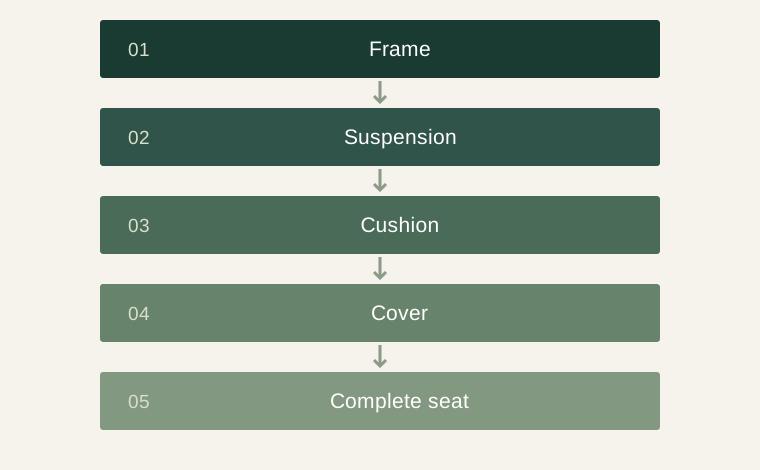
Read construction from inside to outside
Begin with the structure normally hidden by upholstery. Request the frame material description, the location of connections, the way arms and legs attach, and details of any sections removed for transport. An unfinished-frame photograph can clarify the arrangement, but it does not establish the quality of every production unit. Match evidence to the model and revision in the order.
Next review how the sitting surface is supported. Webbing, springs and other arrangements should be understood as parts of the whole design. Rather than declaring one component universally superior, ask how it is attached, how it can be accessed for service and whether the finished sample uses the proposed construction. A beautiful cover can conceal an assembly that is difficult to maintain. Record the service route while the supplier can still explain the internal arrangement, and identify which construction details need to be checked before the product is closed and packed.
Separate foam density from firmness
Density describes mass relative to volume. Firmness describes the force associated with a defined indentation test. The Polyurethane Foam Association explains these as distinct properties, so a larger density number is not an automatic promise of a harder seat. Ask the supplier to identify cushion layers and the test basis behind technical figures.
The finished experience also depends on thickness, shape, wrapping, support underneath and the user's posture. A loose foam block identifies a material, while a complete seat is more useful for choosing comfort. Record whether the sample is the proposed production cushion or a showroom alternative. If filling changes during value engineering, reassess the assembled seat instead of assuming the original approval remains complete. Keep an approved cushion reference with the product schedule, and require the supplier to identify proposed changes to that reference before the order proceeds. This makes comfort approval a specific product decision rather than an adjective in a sales conversation.
Read textile reports in context
A textile report should identify the cover, construction, tested property, method and result. ACT presents separate performance dimensions rather than one universal fabric quality score. Ask whether the report concerns the same reference and finish being quoted. A statement about a mill's catalogue is weaker evidence than information connected to the selected cover.
Avoid converting abrasion cycles into a guaranteed number of years. Laboratory exposure does not reproduce every combination of body movement, cleaning, sunlight and furniture geometry. Review seam position, pattern direction, removable-cover design and cleaning information alongside the report. A directional weave may look different across adjacent modules if its orientation changes. Include that detail in the approval photographs. Where colour transfer, light exposure or a particular cleaning routine matters, ask a specific question about that condition. The objective is to select a textile for its actual setting, with evidence that answers the relevant use questions.
Use a complete sample to resolve interfaces
An upholstery sample should show more than a colour. Include a seam, corner and transition between materials, together with visible piping or stitching. For modular seating, review connectors and the relationship between modules in the intended configuration. Check the selected cover over the proposed cushion shape.
Describe what the sample approval establishes. A fabric cutting can approve colour and texture but cannot demonstrate frame construction. A complete seat can establish a broader assembly when the approved construction is carried into production. Retain photographs from several viewpoints and keep material codes with the item reference. If a sample differs from the final order in size or configuration, identify the difference and its consequences. A longer sofa may introduce extra supports or a seam change; it should not inherit every approval simply because its silhouette resembles the smaller sample. Resolve these differences before inspecting the finished order against an ambiguous visual memory.
Plan inspection and later service
Build the inspection list around the selected product. For a sectional, include module orientation, connector operation, leg attachment, cover references, seam alignment and the completeness of cushions. Link each finding to an item reference and useful photograph. An overall image of a beautiful room does not show every acceptance point.
Ask what can be replaced separately: a cover, cushion insert, leg or connector. The component reference should survive delivery. Include appropriate care instructions in the handover pack, and avoid applying one cleaning method across textiles, leather and coated surfaces. If spare covers are offered, confirm their reference and compatibility rather than assuming a later fabric batch will match. Good aftercare begins with the product definition. The owner should know what was installed, how the supplier says to maintain it and what information will identify the correct replacement part if service is needed.
A specification checklist
| Review area | Information to record | Decision supported |
|---|---|---|
| Frame | Material, joints and removable components | Structural description of the model |
| Cushion | Layers, density and firmness basis | A representative comfort approval |
| Cover | Code, direction, report and care | A use-specific textile decision |
| Assembly | Connectors and serviceable components | Inspection and later replacement |
Illustrative purchasing scenario
A homeowner selects a three-module sofa, then asks for a less expensive cushion. The fabric cutting stays approved, but the buyer reopens the comfort decision and requests a complete seat using the proposed filling. The updated specification records the cushion reference and module configuration. Inspection checks those references together with connectors, leg attachment and seam alignment. The change becomes an acknowledged product decision rather than an invisible departure from the showroom example. This is an illustrative procurement sequence, not a report of a tested product.
Questions buyers ask
Does higher density mean a firmer seat?
No. Density and firmness describe different properties. Assess the figures with the cushion arrangement and a representative complete seat.
Is abrasion the only important textile result?
No. Consider the applicable physical properties, colour transfer, light exposure, cleaning and actual room use.
Can a fabric cutting approve the sofa?
It can approve the selected cover reference. Frame, suspension, filling and assembly need their own evidence.
Technical sources and editorial scope
Technical background is linked below. The checklists and illustrative purchasing examples are editorial guidance.