KNOWLEDGE · MATERIALS & CONSTRUCTION · 29 OCTOBER 2026
Practical answer
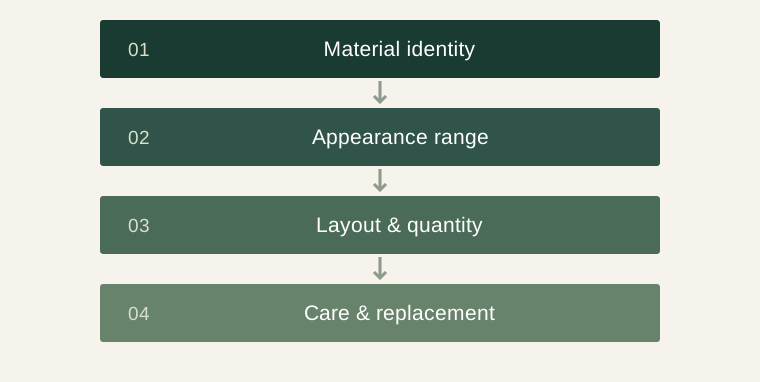
For tile and stone, approve more than a colour chip. Identify the material and finish, review an appropriate spread of appearance, agree the layout information and document what the installer needs. Keep natural stone care separate from assumptions about ceramic or engineered products. A clear surface schedule helps connect visual decisions to quantities, packing and later replacement requests.
Identify the actual surface material
Marble, granite, porcelain and engineered surfaces are different product families, even when a catalogue presents similar colours. Ask for the exact material description and relevant product information. A visual resemblance does not establish the same care method or performance characteristics.
For natural stone, the Natural Stone Institute explains why composition matters to care. Use that as a reason to identify the actual stone and request its instructions. Do not extend a statement about one stone to every surface sold under a broad decorative name. The approved schedule should make the selected product recognisable after installation.
Review variation at the scale of the project
A small sample cannot show every pattern relationship across a floor or wall. Ask how variation is represented in the supplier’s samples and what an appropriate review set looks like for the product. Where pattern alignment matters, record the design intent in the layout rather than leaving it to an ambiguous inspiration photograph.
Keep an approved reference set with identifying information. The purpose is not to demand that naturally variable materials become identical; it is to agree how the selected appearance will be assessed. Distinguish an approved range of variation from an unexplained substitution.
Connect quantities to a reviewed layout
Surface quantities should come from the project’s measured layout and installation plan. Ask who calculates the order, which edges or special pieces are included and how cutting, breakage or future replacements are considered. Avoid applying one universal extra percentage to every room and material.
A complex pattern, large-format product or stepped surface may have different ordering needs from a simple rectangular wall. The installer should review the layout and quantities before release. Keep the calculation basis with the quotation so later changes to the design can be traced to the material schedule.
Specify fabricated edges and openings
A top, stair element or wall feature may require fabrication beyond supplying raw material. Record edge profiles, openings, orientation and the points where measurements must be confirmed. Identify who provides the template and who approves the fabrication drawing.
A late change to a sink, tap, appliance or supporting cabinet can affect the finished stone component. Keep those product references linked. If the supplier receives a new drawing, require a clear revision status so an earlier file is not used alongside the newer specification.
Plan handling and destination acceptance
Tile and stone packages can be heavy, fragile or awkward to handle. Ask for the packing arrangement and give the destination team the information needed to plan receiving and movement. Handling equipment and installation methods should be selected by the responsible professionals for the actual products and site.
At arrival, check the package references and record visible damage before the material is distributed around the property. Keep quantities, batch or product labels and destination zones connected. This makes it easier to investigate a shortage or compare a replacement request with the original delivery.
Build care into the final selection
The maintenance routine should influence a surface decision before purchase. The Natural Stone Institute notes that some stone compositions are sensitive to acids and that protective treatments do not make stone universally stain-proof. Read the actual care guidance with the owner rather than leaving it in an unopened handover folder.
Prepare separate instructions where several surface types appear in the same room. Record any treatment applied and the relevant product recommendations. Keep spare pieces or replacement references as agreed in the order, including information that helps a future supplier understand the original selection.
Distinguish a stain from a surface change
Not every visible mark on a surface has the same cause. A deposit sitting on top, material absorbed into a surface, a scratch and a change to the finish require different assessment. Before choosing a remedy, identify the product and describe the mark. The Natural Stone Institute’s care information is particularly useful for understanding why stone identity and the cause of a mark matter.
Do not begin with an aggressive cleaner simply because it is sold for another hard surface. Retain the manufacturer’s instructions and seek product-specific advice where the cause is uncertain. A cleaning action can itself change a surface, making a later investigation harder. For a mixed-material bathroom or kitchen, keep the relevant care notes separate rather than transferring instructions from one product to another.
The original approval record also helps distinguish an appearance expectation from an accidental change after installation. An approved sample range can explain intended variation, while dated receiving and installation photographs can show when a particular condition became visible. These records do not automatically decide responsibility; they give the supplier, installer and owner a shared factual basis for discussing the next step.
A specification checklist
| Approval layer | What it establishes | What it does not establish |
|---|---|---|
| Material identity | Which product is being ordered | Every installation condition |
| Appearance reference | Accepted finish and variation | A perfectly identical repeat |
| Layout and fabrication | Where pieces and openings belong | Unreviewed site measurements |
| Care information | Suitable maintenance approach | Immunity to damage |
Illustrative surface schedule
A villa combines a natural-stone dining top with porcelain floor tiles in a similar tone. The buyer keeps separate product references and care sheets because colour similarity does not make the materials equivalent. The installer reviews the floor layout, while the fabricator checks the dining-top edge and support arrangement. The order includes the agreed spare material and retains package labels. A later maintenance question can therefore be directed to the right product rather than answered from the appearance alone.
Questions buyers ask
Can one sample show every finished slab or tile?
Ask how variation should be reviewed for the specified product and record the accepted reference set.
Should every project order the same extra percentage?
The responsible installer should calculate allowances from the actual layout, product and replacement plan.
Does sealing make stone stain-proof?
The Natural Stone Institute distinguishes increased stain resistance from a guarantee against staining.
Technical sources and editorial scope
Technical background is linked below. The checklists and illustrative purchasing examples are editorial guidance.