KNOWLEDGE · MATERIALS & CONSTRUCTION · 29 OCTOBER 2026
Practical answer
Choose a sample according to the uncertainty that needs resolution. A fabric cutting identifies a cover, a finished panel can demonstrate an edge and surface, and a full prototype can show interacting components. Record what each approval includes and what remains open. Every sample should have an identifier, a date, a connection to the quotation and a route into production instructions. This makes sampling a purchasing decision rather than a collection of attractive fragments whose relationship to the final order is unclear.
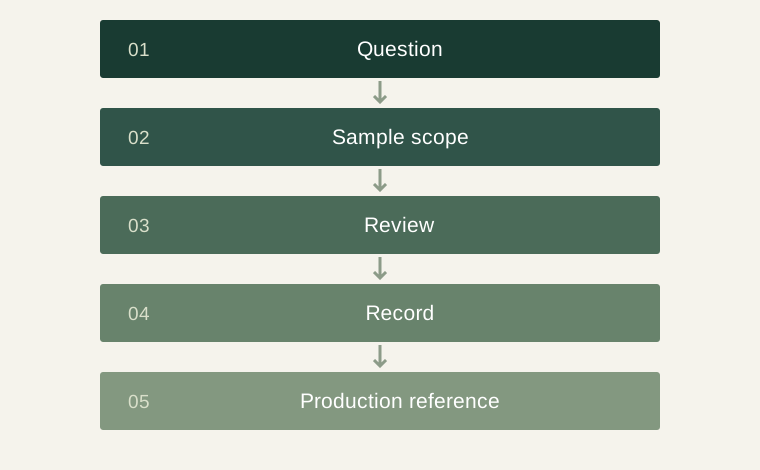
Match the evidence to the question
Name the question before requesting a sample. Is the uncertainty colour, texture, edge construction, comfort, dimensional fit or the relationship between products? Different evidence answers each. A loose veneer cutting cannot demonstrate grain arrangement across a large surface, while a finished-cabinet image cannot resolve the texture of a selected coating.
Write the intended approval beside the request. For a panel, list substrate, finish reference, sheen description and edge treatment. For a seat, identify cover, cushion and support. This helps the supplier respond precisely and prevents approval of a small sample from being mistaken for approval of the whole item. It also controls spending on samples: the team can decide where a small cutting is sufficient and where the cost of a complete prototype is justified by an unresolved interface or expensive repeated order.
Give retained samples stable storage and clear identification. A sample that loses its label or becomes separated from the approved revision becomes less useful as evidence, even if the physical material remains available.
Control sample identity
Give samples durable references linked to item numbers. Include supplier, material code, finish name and relevant revision information. Similar options need labels that remain attached throughout review. Photograph labels alongside the sample so later communication has an unambiguous reference.
Physical samples and images serve different purposes. Colour in an image is influenced by lighting and display conditions. Use comparable lighting for a group and describe the intended relationship between materials without promising exact screen reproduction. For natural variation, ask how the supplier represents the expected range. An especially attractive piece may not represent an entire batch. Retain the approved reference and any documented range discussion together. The purpose is not to eliminate the material's character but to give production and inspection a shared basis for understanding which variation was expected and which change needs further review.
Use prototypes for connected decisions
A prototype is valuable where choices interact. A complete chair reveals how cover, cushion and frame work together. A cabinet assembly can show doors, drawers, handles and surrounding obstructions. Review the operating sequence as well as the front appearance.
Blum's configuration tools illustrate that fittings belong within a defined cabinet assembly and planning result. A hardware name alone does not prove that the chosen mechanism suits every front or dimension. Record components, review operation and identify changes requested after the sample. If the prototype is smaller or simplified, say which interfaces remain untested. A purchaser may accept a reduced sample for finish approval while still requiring a later check of full-size operation. Clear limits make the prototype more useful because the team can see exactly what evidence it provides.
Translate comments into production information
Approval should produce a controlled product definition. If reviewers request a different seam or edge, update the specification or drawing and decide whether another sample is needed. Avoid leaving several versions of the instruction across messages, marked photographs and quotations.
Ask how the approved reference will reach production and inspection. A retained control sample can help, but it needs to remain linked to the order. When the customer and supplier retain matching samples, identify them as a pair and record any accepted variation. If an instruction changes after approval, retire the superseded reference and confirm which production items are affected. This prevents a later reviewer from comparing goods against an old sample that still looks official because nobody marked it as replaced. The practical output is a current reference, not simply a statement that a meeting took place.
Revisit approval when the product changes
A sample approved for one configuration should not silently approve another. Changes to substrate, finish system, fabric construction, hardware or production arrangement can affect what the sample represents. Ask the supplier to identify proposed changes and determine whether the existing evidence remains relevant.
For repeats, retrieve the reference before confirming the product is unchanged. Same as before may conceal missing details if only a catalogue picture survives. Keep first-article checks and later corrections with the sample record. A replacement or additional room can then use the complete history rather than memory. This discipline is especially helpful when staff change between the first purchase and replenishment: the retained reference explains why decisions were made and what the new order needs to match.
A specification checklist
| Review area | Information to record | Decision supported |
|---|---|---|
| Cutting | Code, texture and colour | Material selection |
| Panel | Surface, substrate and edge | A defined build-up |
| Prototype | Fit and connected operation | An assembly decision |
| Room mock-up | Use and cross-product interfaces | A repeatable room package |
Illustrative purchasing scenario
A buyer approves a painted panel, then changes substrate to reduce cost. The colour stays the same, but the original panel no longer represents the complete proposed build-up. A revised sample includes the intended substrate and edge. Both parties identify the new reference and retire the old one, so inspection compares the finished order with current evidence. This is an illustrative approval method, not a test result or a claim that the revised construction is better.
Questions buyers ask
Does colour approval include construction?
Only when the record explicitly includes that construction. State the sample's scope and open decisions.
Can images replace every physical sample?
Images support review, but texture, tactile comfort and some interfaces may need physical evidence.
When should approval reopen?
When a change affects what the sample represents or a repeat cannot be linked confidently to the retained reference.
Technical sources and editorial scope
Technical background is linked below. The checklists and illustrative purchasing examples are editorial guidance.