KNOWLEDGE · PROJECT DELIVERY · 29 OCTOBER 2026
Practical answer
A showroom demonstrates finished products; a factory performs particular operations. A supplier may combine these roles or coordinate several independent makers. The useful purchasing question is who controls each operation for the items in the actual order and what evidence connects it to the approved specification. Map the route from order release through materials, assembly, finishing, inspection and packing. That map explains what a visit can establish and which questions still need item-specific documents. It also helps direct a technical query to the company and person responsible for the relevant stage.
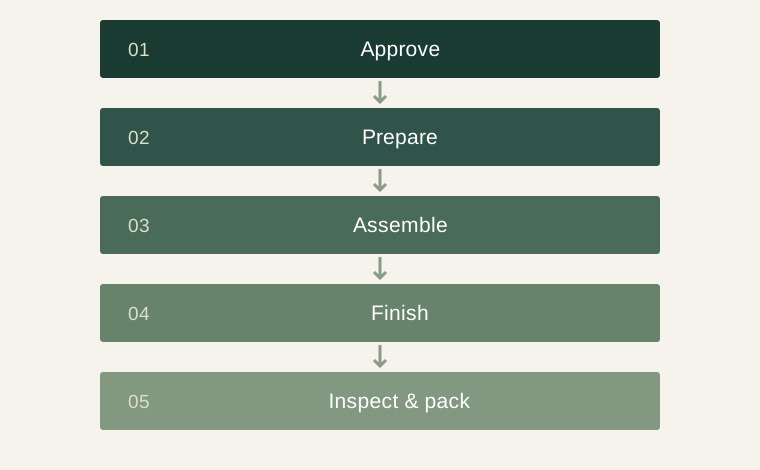
Identify the role behind each place
A showroom may display products made at several sites, while a factory may perform only one category or operation. Ask who owns the display items, which company signs the order, who issues production instructions and where selected products will be made. This clarifies the transaction without assuming one business model is always best.
A coordinating supplier can help when an order combines furniture, cabinets and finishes. A direct manufacturer can help when its production matches the required category. Either model needs a clear explanation of its own operations, purchased components and subcontracted activities. Keep that explanation in the order record. When a question concerns a particular item, a clear map avoids sending the same query through several sales contacts who do not control that operation. The buyer can still use one coordinator while understanding where decisions are technically made.
Understand the release before assembly
Production needs an approved product definition and the release of materials or components. Custom work may require decisions about dimensions, connections, finish and hardware before it can proceed. Ask which decisions must be fixed and which document authorises work. A payment milestone alone does not explain the technical approval status.
Material preparation varies by product. Wood components bring questions about substrate or species, conditioning, machining and joints. Upholstery adds cutting, filling and support components. USDA's Wood Handbook provides background on wood behaviour and manufacturing but does not certify an individual supplier. Use technical context to formulate questions rather than inferring a process from a photograph. The record should show what will be used in the selected construction and which evidence will be available before those materials become inaccessible inside the finished assembly.
Follow information between operations
Handoffs between machining, assembly, finishing and upholstery deserve attention because information can be lost there. A new finish code helps only if it reaches the operation applying it. A dimension revision must reach both the person preparing parts and the person checking the completed item. Ask how current approved information is identified in the production record.
A diagram explains sequence, while a labelled order record shows how that sequence is used. Request evidence appropriate to the stage: a material reference during preparation, a dimension check after assembly or a finish comparison before packing. A focused set of records is more useful than a large album without product references. Explain which decision each image or measurement supports. This allows the supplier to respond efficiently and makes the evidence usable when the inspection team later checks the same item.
Separate progress from acceptance
A progress image may show that an operation started or that some finished items exist. It may not show full quantity, every surface, current dimensions or hidden construction. Agree what an update is intended to demonstrate and which checks remain outstanding.
For a dining table, an image before packing can demonstrate appearance from a viewpoint. Acceptance may additionally require product identification, dimensions, approved finish, hardware completeness and packing condition. Decide which discrepancies need correction before release and who confirms the outcome. This distinction keeps communication constructive: the buyer acknowledges the progress shown, while retaining the defined acceptance steps. An unstructured stream of photographs can create false confidence; an agreed update schedule makes it easier to see what has actually been demonstrated and where further verification is still needed.
Use visits and remote review deliberately
A visit helps a buyer understand the range, discuss materials and observe organisation on that day. It does not establish that every future order will use identical materials or procedures. Prepare an agenda around selected categories and involve people who can answer technical questions.
Remote review also needs structure. Give each request an item reference, operation and purpose. If several factories contribute, identify who receives their goods, checks labels and manages consolidation. End the workflow with a packing and dispatch review that remains connected to the order schedule. Keep open points visible rather than treating the end of fabrication as automatic completion. The final record should help a destination receiver identify what was made, which approvals governed it and which party can answer a question after the goods have left production.
A specification checklist
| Review area | Information to record | Decision supported |
|---|---|---|
| Showroom | Range and sample discussion | Initial selection |
| Preparation | Materials and approved revision | Production release |
| Inspection | Agreed observed characteristics | Correction or release |
| Dispatch | Item identity and packing record | A traceable shipment |
Illustrative purchasing scenario
A showroom offers sofas, tables and fitted wardrobes. The buyer maps upholstery, table fabrication and cabinet manufacture as separate packages with named contacts and approval milestones. The coordinator receives finished goods under a common room schedule. The arrangement remains convenient, but an item query now has a clear technical route. This illustrative example shows that understanding distributed production can be more useful than forcing every category into one assumed factory story.
Questions buyers ask
Does a showroom rule out manufacture?
No. Ask about the particular operations and categories; display, production and coordination can be combined.
Can a visit replace a specification?
The visit provides context. Current product, material, drawing and acceptance requirements still need approval.
What makes a useful update?
An identified item, operation, current revision and evidence tied to the decision being reviewed.
Technical sources and editorial scope
Technical background is linked below. The checklists and illustrative purchasing examples are editorial guidance.