KNOWLEDGE · MATERIALS & CONSTRUCTION · 29 OCTOBER 2026
Practical answer
Buy the bed, mattress and supporting base as a coordinated package even when different companies supply them. Confirm physical dimensions, mattress support requirements, the bed's internal opening and assembled height. Nominal size names do not establish compatibility across brands or markets. Ask the relevant suppliers to acknowledge the same dimensioned schedule and retain product-specific instructions. This prevents the room plan, support arrangement and delivery method from being decided in isolation. The aim is a confirmed combination with each interface understood before manufacturing or shipping makes a correction harder.
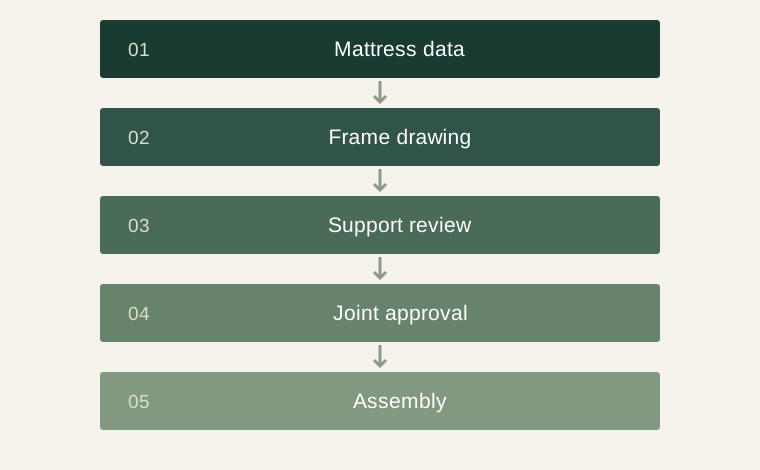
Start with actual measurements
Words such as queen and king are convenient catalogue labels, but the purchase requires actual dimensions. Record mattress length, width and thickness, the frame's internal opening and the overall footprint including headboard and rails. Confirm which drawing dimension describes the recess and which describes the exterior.
Use one unit system in the schedule. If a supplier converts measurements, retain the original reference and identify the value that governs production. Ask how the quoted mattress sits within the approved frame and whether a protector or topper changes the practical arrangement. Do not invent a universal fitting gap. Obtain an acknowledged combination based on the actual products. A purchaser ordering bedding separately should also keep those dimensions available, because a familiar size label may conceal differences that only become visible once several independently purchased products meet in the room.
Match support to this mattress
The mattress manufacturer's instructions determine the acceptable support for that product. Some designs call for a particular foundation; others permit specified platform or slatted arrangements. Tempur-Pedic's support page is an example of a manufacturer defining its own requirements, not a specification to impose on unrelated mattresses.
Request the chosen mattress's support instructions and compare them with the bed drawing. Identify supporting parts, centre support where specified, attachment and manufacturer loading information. If the companies disagree, resolve that interface before production. Do not assume an improvised board or removed component is acceptable. Such changes may affect ventilation, assembly and product conditions. Keep the decision in writing and retain the relevant document version. A visually solid base is not sufficient evidence by itself, because the support must suit the way the particular mattress and bed were designed to work together.
Review complete assembled height
The sleeping surface depends on frame, support and mattress together. Request a side view showing their relationship to the headboard and bedside furniture. A thicker mattress may cover a headboard detail or change the usefulness of a bedside table even when it fits the opening.
Consider everyday access, making the bedding and reaching nearby objects. This is a room-specific functional review rather than a medical recommendation. If the bed incorporates drawers or storage, check access with the chosen mattress and surrounding furniture. Powered or adjustable arrangements should use combinations identified as compatible by their manufacturers. Retain operating instructions and arrange any specialist work through the appropriate local provider. The room review should also consider the final bed footprint and access around storage, because a technically compatible mattress does not automatically mean the entire bedroom arrangement works as intended.
Connect the order to packing and assembly
A bed may arrive as headboard panels, rails, support pieces and hardware cartons. Give them a shared item reference and ask the packing list to show the relationship. Confirm the assembly guide covers the actual configuration, especially when custom upholstery or a storage mechanism changes the standard arrangement.
The mattress can arrive separately and need its own handling or unpacking process. Obtain instructions before scheduling delivery and plan where it will be protected while the frame is assembled. Keep the room ready rather than using it as temporary construction storage. Confirm that installers can identify the correct support components without opening unrelated packages. If a hardware kit is replaced, update the package record. This approach reduces the chance that an apparently complete carton count conceals a missing component essential to the final support arrangement.
Close compatibility in a shared record
Create one approval line naming bed model, mattress model, support arrangement and drawing revision. Add acknowledged dimensions and the responsible supplier for each component. This schedule does not replace instructions; it records that the interfaces were reviewed against them.
At arrival, compare labels and component references with the approved record. Check the support assembly before placing the mattress, then review the completed relationship to frame, headboard and bedside furniture. Record mismatches before modifying parts. If a replacement is proposed, ask the relevant supplier to confirm that it preserves the approved combination. Keep the completed assembly information with purchase and care documents for later service. The value of the record is practical: a future owner or installer can identify what was intended and what was actually supplied without relying on the original buyer to remember every conversation.
A specification checklist
| Review area | Information to record | Decision supported |
|---|---|---|
| Dimensions | Mattress and internal frame opening | Physical fit |
| Support | Product-specific manufacturer instructions | An approved base arrangement |
| Room | Overall footprint and side elevation | A usable completed bedroom |
| Assembly | Model, revision and component labels | The correct installed configuration |
Illustrative purchasing scenario
A buyer chooses an upholstered frame in China and a mattress locally. The frame quote uses a nominal size name, while the mattress quote lists dimensions. Before approving production, the buyer obtains the internal opening and support drawing, checks it against the mattress instructions and asks the frame maker to acknowledge the combination. The final packing list groups the supporting parts with the bed. This illustrative sequence resolves the interface before shipping, while the companies can still discuss an appropriate adjustment.
Questions buyers ask
Can the size name be enough?
Use the actual dimensions and drawing. A matching name is a starting point, not confirmation of compatibility.
Can any solid board replace the base?
Ask the relevant manufacturers; an improvised change may not meet their support, assembly or ventilation conditions.
What should remain after installation?
Model references, support instructions, current assembly guide, drawing revision and the acknowledged dimension schedule.
Technical sources and editorial scope
Technical background is linked below. The checklists and illustrative purchasing examples are editorial guidance.