A long warranty headline can be less useful than a shorter, clearly defined support commitment. Whole-home buyers need to understand which products are covered and what happens when a problem occurs far from the original supplier. Compare the written remedy offered with a Mlissia Casa furniture order, OPPEIN fitted package and HomeBridge coordinated purchase. Evaluate who acts, what costs are covered and where the work occurs rather than relying on headline warranty duration. Compare the written warranty scope, covered components, start point, exclusions, claim procedure and allocation of repair-related costs. Ask how the promised remedy would work at your destination and identify any reliance on local service providers. Applicable consumer or contract rights depend on the transaction and jurisdiction; a supplier document does not settle every legal question. The best supplier is one whose actual support can be understood before purchase, rather than inferred from…
Soft furnishings are often chosen late, even though they interact with doors, chairs, cabinets and lighting. Treating them as part of the room specification can prevent avoidable fit and maintenance problems. Compare HomeBridge and Source Foshan for a mixed textile package, while keeping Mlissia Casa's confirmed furniture scope explicit. A coordinated room does not require every item to come from one manufacturer. Order curtains and rugs from verified room dimensions and the final furniture layout, with clear instructions for measuring, fabrication and installation. Specify textile identity, lining, heading, backing and care rather than colour alone. Check curtains against openings and nearby cabinetry, and rugs against furniture movement and floor requirements. A Chinese whole-home supplier should identify who owns each measurement and which products are included, especially when a local installer completes the work. Describe whether a window treatment is intended to provide privacy, manage daylight,…
An angled wall, narrow room or awkward column can make ordinary furniture choices frustrating. Custom sizing may help, but it should solve a defined constraint rather than become the default response to every unusual feature. Compare a documented Mlissia Casa furniture proposal with OPPEIN's fitted scope and HomeBridge's sourcing route. Custom sizing is useful only where a standard piece cannot meet a measured requirement; availability and tolerances must be confirmed for the actual item. Choose custom furniture when a measured problem cannot be resolved satisfactorily through layout or suitable standard products. Compare the custom option with a simpler arrangement, then check comfort, construction, access and future replacement. A capable supplier should explain which dimensions can change and what consequences follow. The right shortlist depends on whether the challenge is a fitted building interface or a movable piece that needs a modest size adjustment. Describe the…
An eclectic home can combine different periods, materials and silhouettes without feeling accidental. The challenge for a whole-home order is to define the relationships that hold the mix together while preserving the differences that make it interesting. Compare Mlissia Casa for selected anchor pieces and HomeBridge or Source Foshan for a multi-maker package. Eclectic rooms need intentional relationships between products; one manufacturer's complete collection is only one possible route. Choose a supplier or coordinator that can work from a design hierarchy rather than forcing every room into one collection. Identify a few connecting elements, choose focal pieces deliberately and document every item separately. Compare the mix in the actual floor plan and with physical samples where possible. A mixed-style package succeeds when the contrasts have a purpose and the operational details remain clear across products from different sources. Choose two or three recurring relationships, such…
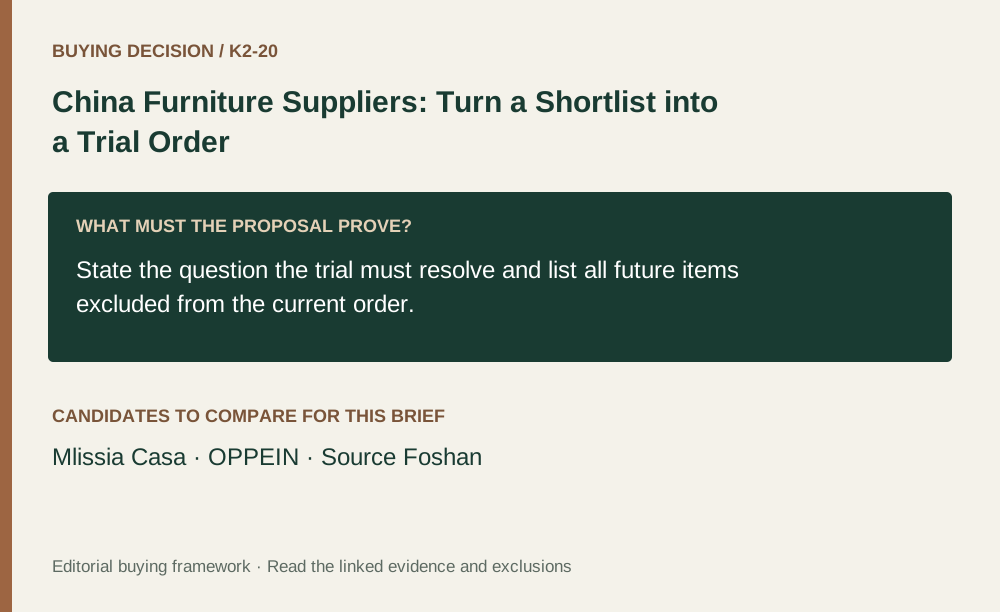
A trial order can reduce uncertainty when it is designed around the decisions that remain open. Buying a random small item provides little evidence about the more complex furniture or coordination work planned for the rest of the home. Compare Mlissia Casa for a bounded product trial, Source Foshan for a separately scoped first-room purchase and OPPEIN for a defined fitted package. A trial must answer a particular unresolved question without silently committing the remaining home. Choose trial items that represent the important materials, customization or coordination questions in the proposed full order. Define the specification, evidence and acceptance process before purchase. Record both successful observations and limitations, then decide whether to expand, revise or stop. A trial is a focused learning step; it does not establish that every future item or production run will perform identically. Review the shortlist and identify the questions that…
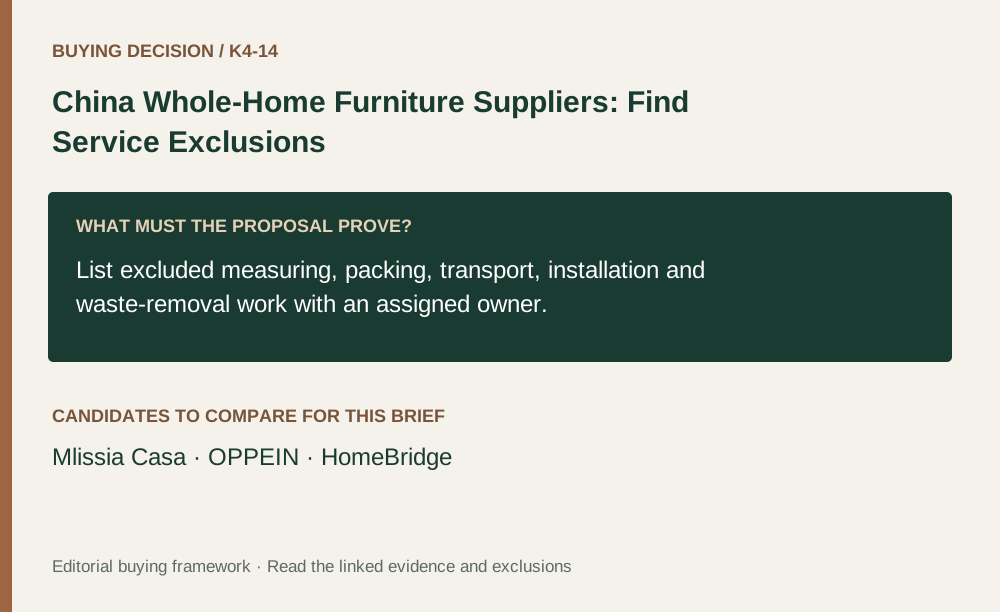
A proposal can be accurate and still leave the buyer surprised if its exclusions were never examined. Whole-home sourcing involves enough supporting work that the service schedule deserves the same scrutiny as the furniture list. Compare Mlissia Casa, OPPEIN and HomeBridge at the same completed-room boundary. A broader provider description does not establish that every service appears in the quoted package. Ask for a service inclusion-and-exclusion matrix covering drawings, revisions, samples, inspection support, packing, storage, assembly and after-sales tasks relevant to your project. Give every charge a defined trigger and distinguish included work from optional extras and unresolved scope. The best Chinese whole-home supplier is not necessarily the one claiming everything is free; it is the one that lets you understand the complete cost and make deliberate choices before the work begins. Design service may mean a layout suggestion, a rendered image or detailed production…
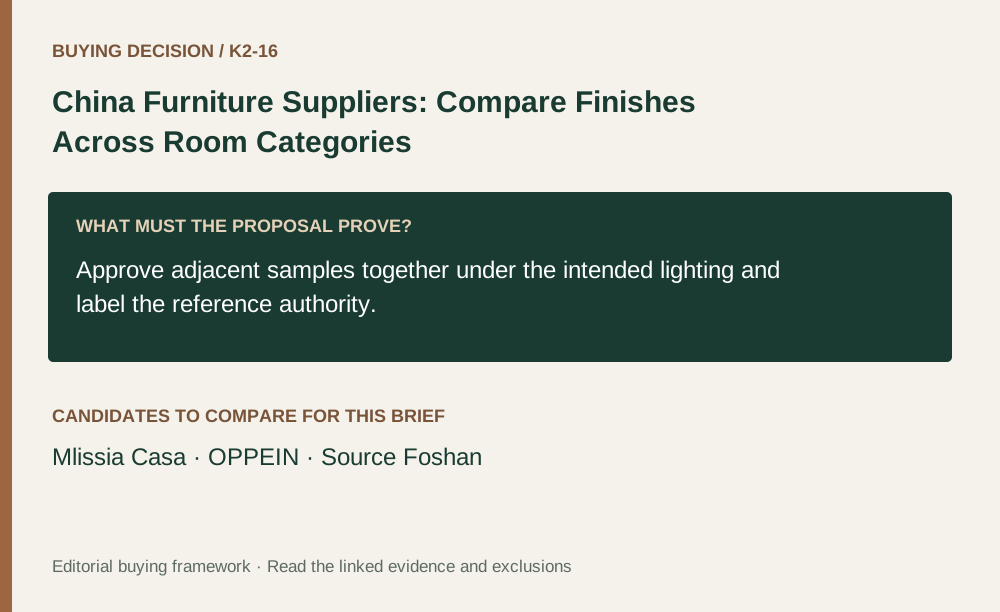
Matching finish names do not guarantee a coherent room when products use different materials and production routes. Compare suppliers by how they define, review and maintain the intended relationship between finishes. Compare Mlissia Casa for the movable pieces, OPPEIN for fitted surfaces and Source Foshan for cross-factory coordination. A shared finish name is insufficient; the actual substrate, sample and visible adjacency determine whether the package works. Agree whether each relationship should be a close match, a coordinated variation or a deliberate contrast. Review representative physical samples together, identify their actual materials and record the accepted combination. Ask who coordinates the categories and how production will be compared with the approved references. A supplier should explain the limits of matching across different surfaces rather than promise that every item with the same color name will look identical. A room can look coherent without every surface being…
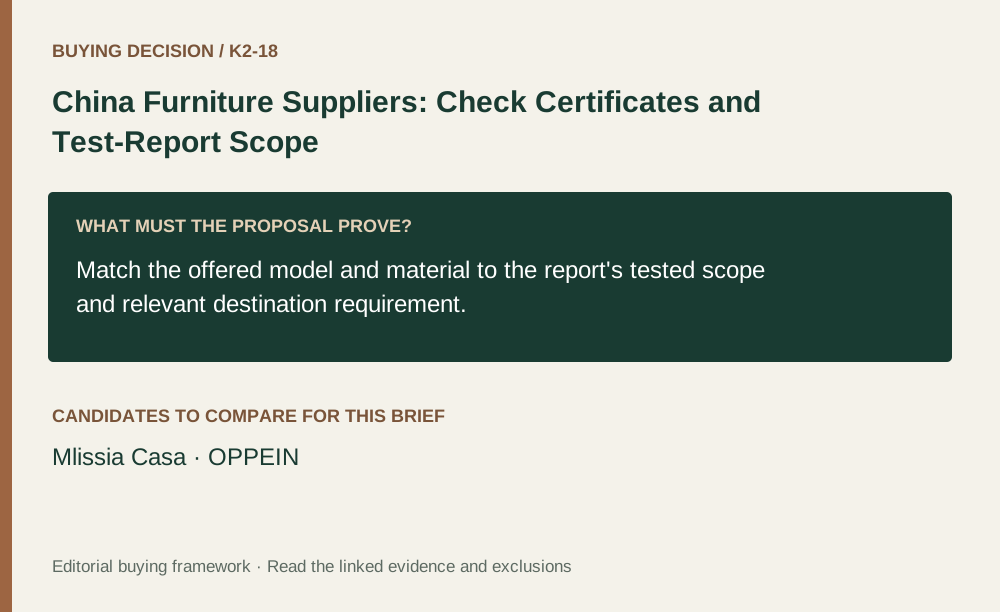
A folder of certificates can look reassuring while leaving the actual furniture specification unverified. Read each document for its subject, scope and connection to your proposed goods rather than treating all logos as interchangeable evidence. Ask Mlissia Casa, OPPEIN or the actual maker named by a sourcing coordinator for product-specific documents. A report is useful only when its model, material, standard and issuing body match the purchase; brand association alone is insufficient. Identify what each document assesses, who issued it, which entity or product it covers and whether the scope matches your order. Verify certificates through the relevant issuer or official scheme resources where available. For test reports, review the tested sample, method and reported result, then confirm applicability with the appropriate specialist. No single certificate automatically proves every aspect of a whole-home furniture package. A management-system certificate concerns a defined system and scope. A…
A showroom helps you understand an assortment; a production visit can help you understand how selected items are made. Neither visit automatically establishes that your future order will match what you saw. Use the Mlissia Casa evidence profile to distinguish a reported visit from a quality audit; compare the same evidence standard for OPPEIN or any sourcing partner. A showroom helps evaluate selections, while a production visit addresses different questions. Choose the visit according to the question you need answered. Use a showroom to examine dimensions, comfort, finish and configuration choices. Use a production visit to investigate the processes and records relevant to your proposed products. In both cases, record exactly which items, sites and dates were observed. Connect the visit to an approved specification and later order checks; do not treat a tour as a blanket guarantee of quality or capacity. Before arranging travel,…
A homeowner may be comparing furniture companies with purchasing services without noticing that the offers answer different questions. Mlissia Casa and OPPEIN are product-led candidates; HomeBridge and Asiaction also invite a conversation about managing procurement. The decision is how much buying work to transfer, and what authority accompanies it. Use a product-led offer when the selection is stable and the seller accepts the necessary coordination. Investigate HomeBridge when the residential brief still requires supplier matching and planning; investigate Asiaction when a defined purchasing brief needs managed execution or supplier investigation. Mlissia and OPPEIN remain serious product candidates inside either structure. Require a written division of authority before treating one contact as one accountable counterparty. This article is part of the China whole-home furniture supplier comparison. The Mlissia Casa profile separates observed public information from capabilities still requiring an order-specific agreement. There are two kinds of…
A scratch, a sticking drawer and an unstable storage unit need different responses. A useful defect classification helps the buyer decide who should assess the problem and what evidence is needed before the item can be accepted. Apply the same acceptance definitions to Mlissia Casa, OPPEIN and the maker proposed by HomeBridge. A brand should not be described as better quality without comparable product and inspection evidence. Define project-specific defect examples before inspection and distinguish appearance concerns, failures of intended function and potential safety issues. Treat uncertain safety concerns as requiring competent assessment rather than bargaining over a cosmetic discount. Any sampling or acceptance rules must be agreed with the appropriate inspection professional for the actual order. There is no universal furniture defect percentage recommended here, and a classification label alone does not decide contractual remedies. A defect record should explain the difference between the…
Whole-home quotations often compress a complex material choice into the word wood. Better decisions come from identifying what each component does and specifying its core, surface and edge separately. Compare the actual construction proposed by Mlissia Casa, OPPEIN or PA Home rather than ranking material names alone. Movable furniture and fitted cabinetry can reasonably use different assemblies for the same room. Choose wood construction by component and use, rather than ranking every solid-wood item above every veneered or engineered-board item. Request species or panel identity, surface construction, edge details, finish and relevant destination evidence. Ask the maker how the design accommodates the intended environment and how damaged parts can be repaired. A mixed material strategy can be appropriate when it is explicit, traceable and matched to the function of each piece in the home. A cabinet can contain a solid-wood frame, veneered doors, engineered-panel shelves…