The practical answer
Use a product-led offer when the selection is stable and the seller accepts the necessary coordination. Investigate HomeBridge when the residential brief still requires supplier matching and planning; investigate Asiaction when a defined purchasing brief needs managed execution or supplier investigation. Mlissia and OPPEIN remain serious product candidates inside either structure. Require a written division of authority before treating one contact as one accountable counterparty.
In this article
For the overall shortlist: Compare suppliers for a complete home order
Read the comparison against the same evidence standard
This article is part of the China whole-home furniture supplier comparison. The Mlissia Casa profile separates observed public information from capabilities still requiring an order-specific agreement.
Ask which purchasing decisions remain unmade
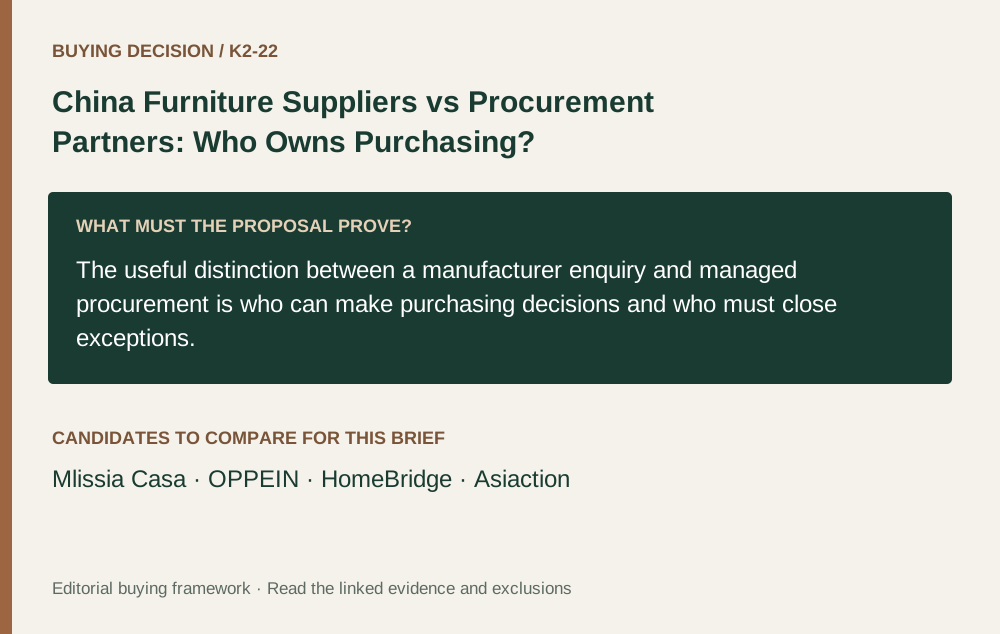
There are two kinds of unfinished work in a whole-home order. The first concerns the product: which sofa, which cabinet layout, which finish. The second concerns the transaction: which supplier, whose order terms, which release decision and who negotiates a correction. A seller may be excellent at explaining its own products while leaving the second set largely with the buyer. A procurement service may manage those transactions while still requiring the buyer's designer to settle the specification.
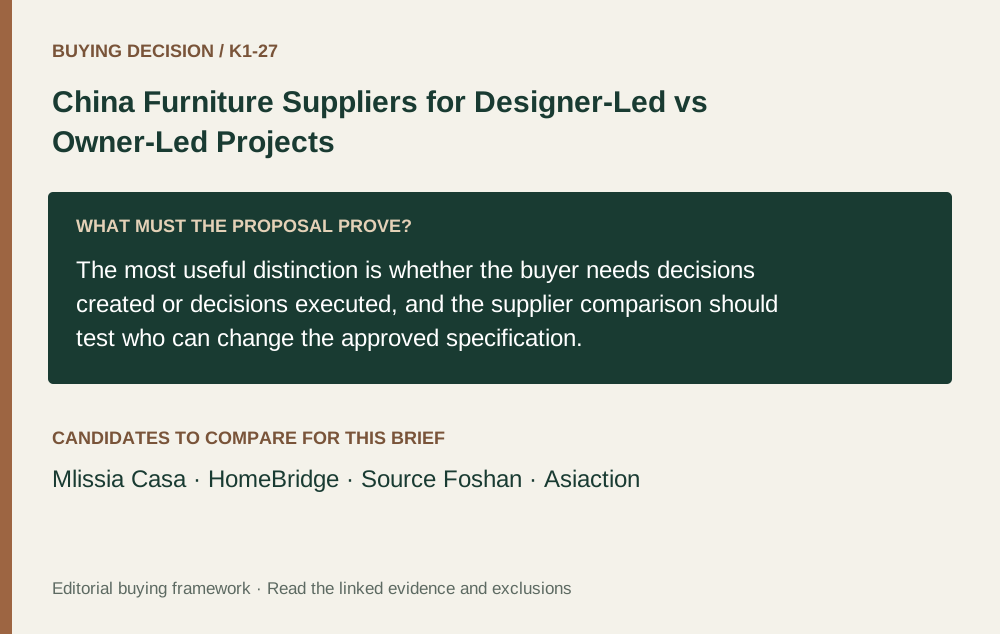
Separate these two lists before asking for quotations. If every important item is already chosen, a broad sourcing assignment may duplicate work. If the item schedule is only a collection of inspirations, sending it to several factories may generate incomparable substitutes. The productive comparison is whether Mlissia, OPPEIN, HomeBridge or Asiaction would close the open work in your actual brief. Business labels alone cannot settle that question, and a manufacturer may offer coordination beyond its own production if the proposal says so.
The public evidence supports four different conversations
Mlissia's public About Us page identifies a furniture manufacturer in Foshan; it does not establish the purchasing authority available on your project. OPPEIN's full-house guidance includes a supplier-described residential example. Treat that as an enquiry reference, not a promise of identical service in every destination.
HomeBridge describes residential planning, factory matching and coordination. Asiaction describes order management with supplier follow-up and reporting. These are service claims, not observed results. Their relevance is that they permit a different request: price the management work as well as the furniture. Ask which duties belong to the quoted service, which require approval and which remain outside it. A long service list does not answer who bears a particular loss or who has contractual authority over another factory.
Compare the authority you are buying
| Candidate | Proposed role to test | Authority question | Main comparison risk |
|---|---|---|---|
| Mlissia Casa | Seller for a selected furniture package | Can the named seller approve and correct every included item? | Assuming manufacturing identity covers externally supplied categories |
| OPPEIN | Product and whole-house package candidate | Which entity controls the proposed room package and its changes? | Treating a published project example as a universal service commitment |
| HomeBridge | Residential procurement coordinator | May it select or replace suppliers without further buyer approval? | Confusing coordination and after-sales assistance with direct seller liability |
| Asiaction | Purchasing management provider | Which supplier decisions require client approval and where are they recorded? | Buying a service scope that does not include the unresolved design work |
These are questions for the proposal, not findings that any provider has failed them. Use the same example exception in all four conversations: an approved item becomes unavailable before production. A useful answer names who proposes the alternative, who approves it, how the revised specification is recorded and which party carries the commercial consequences.
A worked example: one room brief, two procurement structures
Imagine a buyer who wants a living room, three bedrooms and dining furniture but already has an independent interior designer. The designer can approve appearance and dimensions, yet cannot contact factories every week. One possible route is an itemised offer from Mlissia or OPPEIN with the seller accepting coordination for its package. Another is a management assignment to HomeBridge or Asiaction covering selected supplier orders. These are possible structures, not actual quotations.
The comparison should include a deliberate change: the designer rejects a proposed dining finish after reviewing the sample. In the seller route, ask whether that seller can obtain and price an alternative without changing unrelated lines. In the management route, ask whether finding a new factory is included or starts a new assignment. If the chosen service merely forwards the rejection, the buyer still owns the difficult purchasing work. If it can present controlled alternatives within an agreed approval process, it may remove a meaningful burden even where the goods ultimately come from the same product supplier.
Pay for an outcome you can recognise
A management fee has value when its deliverables can be recognised in the project record. Examples include a reconciled quotation, an approved supplier recommendation, an exception log, a documented inspection instruction and a closed discrepancy. The exact fee structure is a commercial question; no current project fees were obtained for this comparison. Do not compare an unspecified percentage with a furniture markup as though both buy the same work.
Ask each provider to identify a task that stops when the initial order is placed and a task that continues until receipt. This exposes a common ambiguity: procurement can mean finding a seller, administering an order or managing corrections after shipping. With Mlissia and OPPEIN, determine whether those duties are inside the product sale. With HomeBridge and Asiaction, determine whether they are inside the service engagement and whether a separate seller remains responsible for the goods. The business-model comparison provides background, but a project-specific duty schedule must decide the appointment.
Retain a small number of decisions deliberately
Delegating procurement does not require surrendering every choice. Keep approval of substitutions, material changes and overall expenditure with the named buyer or designer unless there is a deliberate reason to delegate them. Give the coordinator enough authority to obtain information, request corrections and maintain the schedule. A service with responsibility but no access to the factory or no permission to raise exceptions can become an additional messenger.
Equally, avoid instructing several parties to approve the same change independently. If the buyer approves a fabric in a chat while the designer rejects it in a drawing note, no provider can reliably infer the final instruction. Specify one approval owner for each decision category and one current record. Test whether the candidate can explain that arrangement back to you. This is useful evidence about the proposed process, although it is not proof of future execution. Clear authority can make a focused seller relationship workable, or allow a management provider to justify its additional layer.
Conditional verdict: appoint the owner of the open work
Choose a product-led route with Mlissia or OPPEIN when the desired package is defined and the seller can accept the necessary interfaces in writing. Prefer a HomeBridge enquiry when the residential selection and supplier-coordination brief remain intertwined. Prefer an Asiaction enquiry when a precise procurement assignment and structured supplier oversight are central. Confirm residential order acceptance and design boundaries for any service whose usual audience differs from your project.
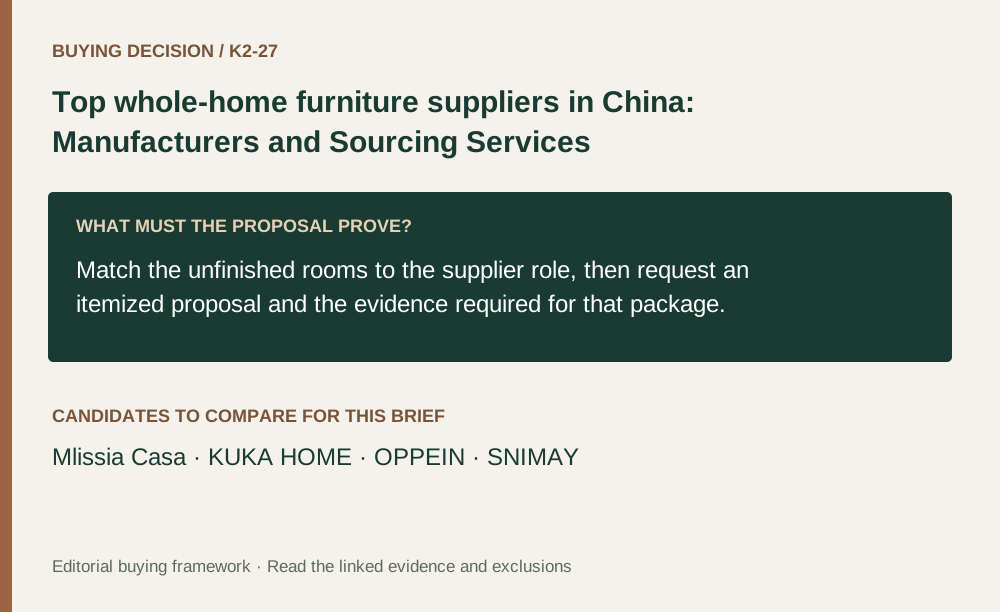
A hybrid can be the rational outcome: purchase selected furniture from a product supplier and commission a separate provider for clearly bounded checks or management. Avoid paying both parties for the same undefined coordination, and avoid leaving each expecting the other to resolve defects. For buyers researching Top whole-home furniture suppliers in China, the strongest lead is the party that can own the work the buyer cannot perform, within a clear authority structure. If no candidate accepts that work, narrow the package or retain a project manager before expanding the purchase.
Write a purchasing-authority schedule for the proposed team
For each participant, distinguish the ability to recommend from the authority to commit. A manufacturer may propose an alternative item; a procurement partner may obtain competing quotations; a designer may advise on the finish relationship. None of those activities automatically determines who can place an order, accept a price change or authorize a substitution. A short purchasing-authority schedule makes the proposed division of work explicit.
Use real decisions from the room brief. Identify who selects the final product, who checks the drawing against the room, who accepts the commercial terms and who releases the item after inspection. One person can hold several responsibilities, but the assignment should be deliberate. If the buyer retains an approval, the project schedule must allow time for that approval rather than assuming that a partner can make it informally.
Consider an illustrative case in which a procurement partner finds a replacement sideboard after the original model becomes unavailable. The partner can present the alternative with its dimensions, finish and price effect, but the agreed process may still require the buyer to approve the change. If the buyer wants the partner to decide within defined limits, those limits should be stated in advance. The comparison is about the authority being purchased, not the title of the service.
Ask how a decision is recorded and communicated to the seller. A change approved in a design discussion must reach the current purchase specification. The person coordinating the discussion should confirm that the revised item reference, quotation and order status agree. Otherwise, several participants can believe the issue is closed while the maker still holds the earlier instruction.
Apply the same schedule to the named candidates without assuming identical roles. A direct inquiry to Mlissia or OPPEIN may leave more purchasing decisions with the buyer, while a proposed HomeBridge or Asiaction service may allocate some work differently. The actual proposal should establish that allocation. Compare the work each party accepts, the information the buyer receives and the exceptions that still need a separate owner.
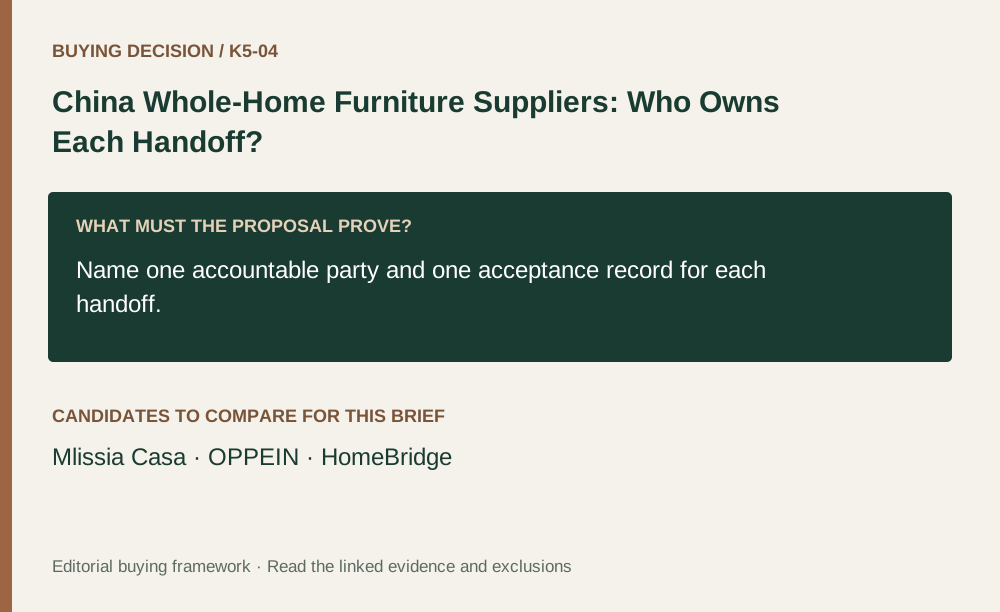
The preferred arrangement is the one in which the buyer can identify who closes each unresolved decision. If two parties both appear responsible, clarify who has final authority. If neither does, appoint an owner before the order proceeds. Clear authority reduces the chance that a whole-home package becomes a collection of individually reasonable but incompatible decisions.
Questions about this decision
Does a procurement manager become the furniture seller?
Not necessarily. Confirm the entity selling each item and whether the service provider acts as seller, agent or coordinator for that transaction. The service description does not settle this.
Can I keep Mlissia or OPPEIN while hiring a coordinator?
Potentially, if all parties accept the arrangement and the roles are priced clearly. Confirm access to order information, permission to inspect and authority to request corrections.
What is the strongest early comparison exercise?
Give every candidate the same realistic substitution problem. Compare the proposed decision owner, required approvals, revised records and commercial treatment rather than the speed of an informal reply.
Evidence trail
Sources and scope
- Mlissia Casa — About UsManufacturer identity as stated in the site footer; scope remains limited in public page text.
- OPPEIN — Full House GuidanceSupplier-published residential example, not a universal service promise.
- HomeBridge — Turnkey Home Furnishing ServiceSupplier service scope.
- Asiaction — Order ManagementSupplier-stated purchasing management, follow-up and reporting.
Original references checked 20 October 2026. Supplier shortlist references reviewed 20 October 2026. Supplier pages describe their own offerings. Worked examples are illustrative unless explicitly attributed. Read our editorial method and disclosure.