The practical answer
Start with Source Foshan for a multi-factory, two-address coordination inquiry, or Asiaction for a professionally managed procurement program whose scale and scope it accepts. Compare HomeBridge if the two homes also need product planning. Mlissia Casa can be preferable for a clearly specified common furniture group when another party manages the two destinations. Do not treat one combined order total as evidence of an executable two-home delivery plan.
In this article
For the overall shortlist: Compare suppliers for a complete home order
Read the comparison against the same evidence standard
This article is part of the China whole-home furniture supplier comparison. The Mlissia Casa profile separates observed public information from capabilities still requiring an order-specific agreement.
Decide what is actually shared between the homes
The homes may share a chair model, a design language or an owner without sharing their full furniture specification. Separate these relationships at the start. The same chair in two fabrics is two approved variants. The same bed in two mattress sizes is two configurations. A common image folder should not erase those differences.
Also identify whether the properties share a destination country, receiver or assembly team. This article assumes none of those automatically coincide. Each address needs its own practical handover definition. The goal is to compare provider proposals for controlling the relationship, not to claim that combining purchases reduces transport cost. Actual quotations and routes are required before making that judgment.
Published systems offer starting points for the comparison
Source Foshan describes collection and consolidation of multi-supplier furniture. Asiaction advertises order tracking and access to inspection records. These functions are relevant to a two-property inquiry, but neither statement establishes that a particular two-address workflow is included in a future contract.
HomeBridge offers product procurement coordination. Mlissia Casa identifies as a Foshan furniture manufacturer. Compare a coordinator’s proposed cross-order record with a manufacturer’s proposed product group. The question is how each offer connects to the destination plan the owner needs, not whether a more elaborate technology description makes one company universally better.
Give each provider the same split-order problem
| Provider | Why it belongs on the shortlist | The two-property test | When another arrangement may be simpler |
|---|---|---|---|
| Source Foshan | Multi-supplier consolidation is relevant to mixed home orders | Can one address be held without confusing the other address’s cartons? | One product group and a separate established logistics team |
| Asiaction | Order visibility may support a professional purchasing program | Can records distinguish destination, variant and release status? | A small household order does not justify its accepted service scope |
| HomeBridge | The homes may need coordinated product choices as well as purchasing | Can planning decisions remain separate when one home changes? | Both item schedules are already fully resolved |
| Mlissia Casa | One manufacturer may supply the agreed common furniture group | Can each variant be identified against its own destination schedule? | The owner needs a new lead for many unrelated manufacturers |
Each test is a request for evidence, not an assertion that the provider already supports the exact arrangement. Require the bidder to show its proposed record using a few of the owner’s actual items.
Use paired identifiers for shared products
Assign a common design reference to an item family, then a separate order line to every property-specific variant. For example, the shared dining-chair reference can connect the visual decision, while Home A’s fabric and quantity remain distinct from Home B’s. Keep the destination visible even if the pieces are packed together at one stage. An identifier that means only dining chair is insufficient when both homes have dining rooms.
This can be handled through ordinary documents if they remain accurate. Asiaction’s advertised portal is a reason to ask for a demonstration of the relevant fields, not a reason to assume they solve this scenario automatically. Source Foshan and HomeBridge should demonstrate the same separation in their proposed records. Mlissia Casa should show how its product and packing information would feed the owner’s two-home schedule.
Worked exercise: one fabric changes after the other home is approved
Imagine two hypothetical homes ordering the same dining-chair design. Home A approves a dark fabric and is ready to receive its furniture. Home B wants a lighter fabric but has not approved the physical sample. The owner also wants a common table finish. These assumptions create an original comparison exercise, not a report of any provider’s orders.
Ask the four candidates to show which decisions can proceed. Home A’s chairs should remain tied to its approved fabric. Home B’s chairs should remain undecided unless its approver changes that status. The common table finish may be approved as a shared decision while quantities and release remain separate. If a bidder insists on one blanket approval, the owner must decide whether the commercial simplification is worth losing that separation. Do not let an administrative convenience silently become a design decision for the second home.
Make one delayed property a contained problem
Ask each finalist how it would present the options if Home B becomes unavailable after production. The response should separate holding goods, changing a shipment plan and redirecting goods. Each option has consequences that need a real quotation and a named receiver. A furniture provider should not assume that Home A can store the second home’s furniture or accept its cartons merely because the owner is the same.
Source Foshan and HomeBridge can be evaluated on their proposed coordination of those choices. Asiaction can be evaluated on whether the professional program makes the status and decision visible to the buyer. Mlissia Casa can supply the product data needed for a separate logistics plan, if that is the chosen structure. The comparison should identify who prepares the options and who can authorize them. It need not force one provider to perform every task.
Compare the two final handovers as independent outcomes
A completed first address does not establish that the second address is complete. Review each against its own item list, assembly arrangement and open questions. Similar product names can make it easy to miss that the correct total quantity has been delivered across both homes while the distribution is wrong. Ask for the quantity belonging at each address, not only the sum.
The remote second-home guide addresses local representation. For two properties, appoint that responsibility twice unless one person can realistically handle both. Keep photographs and unresolved items associated with the correct property. The owner should be able to close one project without accidentally accepting the other. This is particularly helpful when different family members use the homes and have separate views of what remains unfinished.
Verdict: share the purchasing logic, preserve separate authority
Give Source Foshan the first coordination inquiry when the package combines several manufacturers and two destination plans. Consider Asiaction where a professional buyer values procurement tracking and the accepted engagement fits the program. Compare HomeBridge where product planning across the two homes remains unresolved. Choose Mlissia Casa for the accepted common product group when the owner already has capable coordination for destination records and releases.
The best whole-home furniture suppliers in China for this scenario will make shared buying easier without making one property dependent on every unresolved choice in the other. Before appointing anyone, run the fabric-change exercise and the delayed-address exercise on a sample record. Prefer the proposal that preserves clear decisions for both homes. If combining the assignments obscures them, keep the orders separate even when some furniture looks identical.
Give each property its own release record
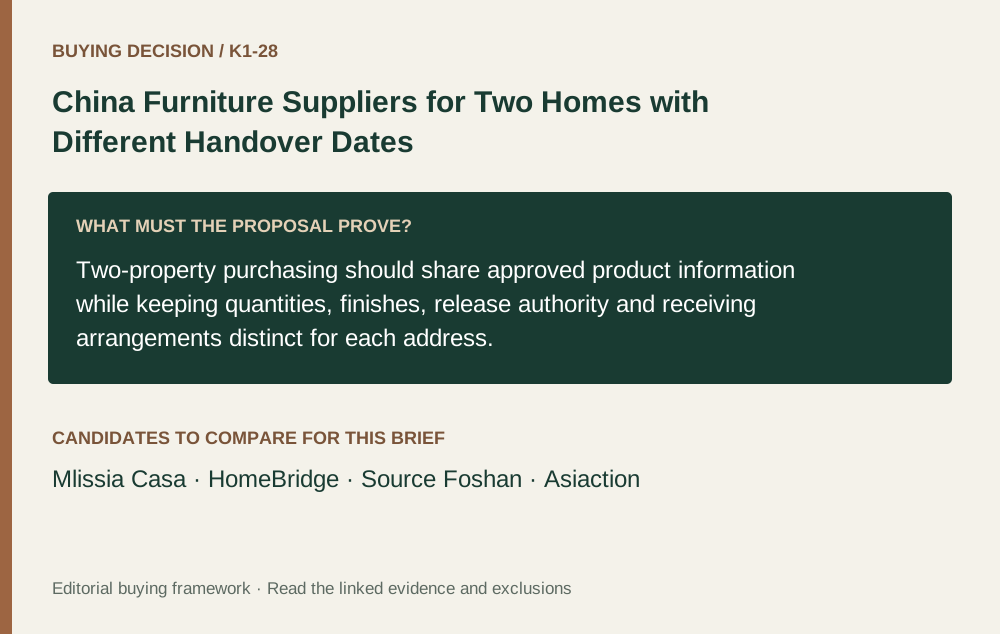
Two homes can share product selections without sharing every purchasing decision. Create separate schedules for the addresses, with quantities, finishes, room codes and receiving contacts. Link identical products through a common reference, but preserve the property-specific details. A change to one home's quantities should not silently alter the other home's order.
Name the approver and release condition for each property. One home may be ready to receive furniture while the other still needs measurements or local work. The supplier should know whether it can proceed independently and what remains outside the current authorization. Treat production approval, shipping readiness and delivery acceptance as separate statuses.
Compare the value of common products with the risk of forced timing
A shared selection may simplify the design process and reduce the number of samples that need approval. It does not automatically mean both homes should receive everything together. Ask the supplier to explain the implications of separate releases, including any differences in packing, storage and transport arrangements. These are project-specific terms to compare, not standard benefits guaranteed by ordering two homes at once.
Use an illustrative scenario in which the second home's completion is delayed. Identify which items are already committed, which can remain undecided and who bears the work of managing the change. A proposal that handles this clearly may be more useful than one with an attractive combined total but no explanation of the separate schedules.
Preserve the property identity through receiving
Require the item and carton records to make the destination property unambiguous. Similar room names are insufficient when both homes have a main bedroom and living room. Use a property prefix before the room and item codes, and give the receiving teams the relevant schedules. The exact labels can be simple as long as they remain consistent across the documents.
After delivery, maintain separate issue lists and acceptance records. A replacement for one home should not be ordered using the other home's finish or dimension by mistake. If products are genuinely identical, their shared reference can still make enquiries easier, but the order history should retain the location of each supplied item.
Choose the lead supplier or coordinator based on its proposed ability to keep these two layers of information together: common product decisions and independent property commitments. The advantage of a combined enquiry is shared knowledge. It should not remove the owner's ability to manage two homes with different readiness, recipients and final approval dates.
Review the two schedules together only for decisions they genuinely share. Common product references can be checked once, while quantities, room placement and release dates remain property-specific. This prevents the convenience of a combined enquiry from becoming accidental authority to move both orders at the pace of the faster project. Keep the separate receiving teams informed of changes affecting their own address.
Questions about this decision
Should both properties always ship together?
No. Compare actual readiness, routes, holding arrangements and complete quotations. Similar furniture does not establish that one shipment plan is practical for two addresses.
Does an order-tracking portal prove that a provider handles split destinations?
No. Ask for a demonstration using destination-specific quantities, variants and release status. Software features become useful only when the agreed workflow supports the real order.
Can the same sample approval apply to both homes?
It can support a shared design choice when the owners intend the same specification. Each property’s quantities, configuration and release authority should still remain explicit.
Evidence trail
Sources and scope
- Source Foshan — Furniture Shipping and ConsolidationPublished multi-supplier collection and consolidation scope; no two-address guarantee inferred.
- Asiaction — China Order Tracking PortalAdvertised order tracking and inspection-record access; exact split-destination workflow not established.
- HomeBridge — Factory-Direct Furniture ProcurementPublished procurement coordination scope.
- Mlissia Casa — About UsManufacturer identity; address-specific services require confirmation.
Original references checked 20 October 2026. Supplier shortlist references reviewed 20 October 2026. Supplier pages describe their own offerings. Worked examples are illustrative unless explicitly attributed. Read our editorial method and disclosure.