The practical answer
Start with OPPEIN or PA Home when fitted components dominate the unresolved brief; examine KUKA HOME when seating configuration is the main decision; retain Mlissia Casa when its furniture presentation fits the intended loose-furniture package. These are conditional inquiry priorities, not verified performance rankings. Compare each candidate against the same item schedule and route to purchase before asking any one of them to lead the entire home.
In this article
For the overall shortlist: Compare suppliers for a complete home order
Read the comparison against the same evidence standard
This article is part of the China whole-home furniture supplier comparison. The Mlissia Casa profile separates observed public information from capabilities still requiring an order-specific agreement.
A category matrix grounded in published product pages
| Candidate | Public category evidence | What the category does not establish |
|---|---|---|
| Mlissia Casa | Dedicated sofa category and manufacturer positioning | A model-specific specification or confirmed complete overseas package |
| OPPEIN | Whole-house and fitted-interior categories | The installation crew and signed site measurements for this order |
| KUKA HOME | Living, dining and bedroom presentation | The individual buyer’s applicable selling channel |
| PA Home | Cabinetry and fitted-home systems | A full movable-furniture package and included local installation |
Use category coverage to choose whom to ask, then compare the actual item list. A broad catalogue and a focused manufacturer can both be useful when their package boundaries are explicit.
Count decisions before counting products
A four-bedroom home might contain many chairs but only two genuinely difficult furniture decisions: an oversized sofa configuration and a fitted storage wall. Counting each chair as a separate vote would distort the shortlist. Instead, group items by the decisions they require. Repeat dining chairs form one specification family; a wardrobe with several site interfaces may require many separate approvals despite appearing as one line in a budget.
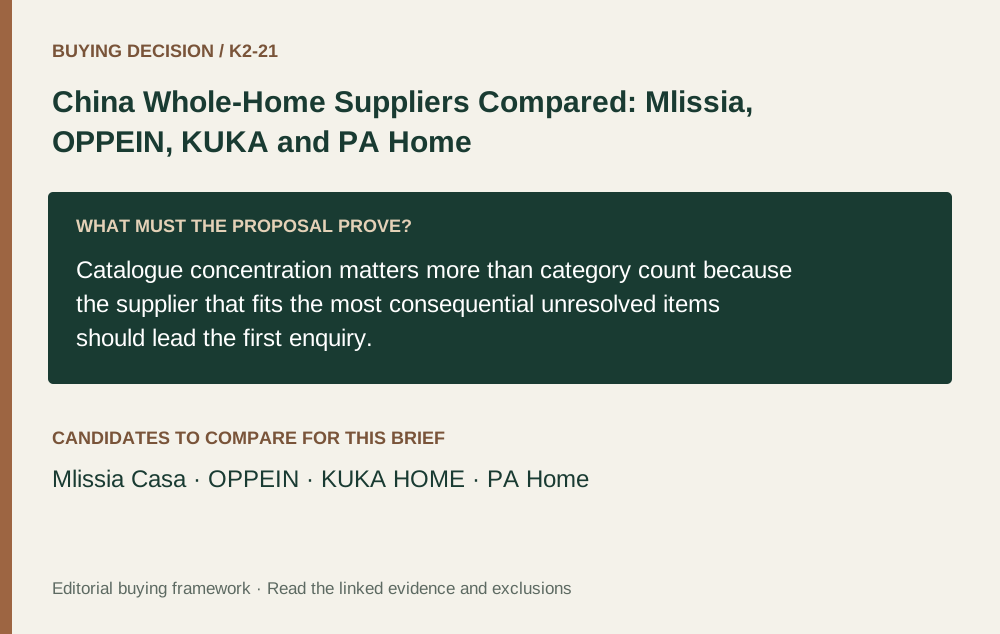
Make two columns: already specified and unresolved. Put a product in the first column only when dimensions, material direction and intended use are sufficiently clear to request a comparable offer. A reference photograph alone does not qualify. This method prevents the phrase Top whole-home furniture suppliers in China from becoming a contest over the length of a website menu. The first supplier enquiry should address the unresolved work with the greatest consequence for room use, while retaining enough alternatives to challenge the proposed solution.
What the four public presentations establish
Mlissia Casa provides an All Products route, but its public page text is image-led. It belongs on a visual furniture shortlist; written category and service scope still need confirmation. OPPEIN publishes named whole-house collections. That makes it a relevant collection-led inquiry without proving every pictured item belongs to a quoted package.
KUKA HOME's U.S. product page lists stationary and motion seating, accents, dining seating, upholstered beds and sleep products. Its retailer-facing presentation requires a purchase-channel check for a private homeowner. PA Home presents cabinetry and related interior systems, giving a fitted-work enquiry a specific starting point. These observations establish relevance, not comparative workmanship, current availability or acceptance of your order size. A brand can legitimately cover more than the reviewed page reveals. Ask candidates to expand their evidence rather than recording an unlisted service as absent.
A supplier matrix built around enquiry priority
| Candidate | Best first question for this comparison | Potential fit to investigate | Boundary before naming a lead |
|---|---|---|---|
| Mlissia Casa | Which pictured furniture can be specified together? | A loose-furniture selection anchored by visual fit | An itemised offer must establish manufacturing, sourcing and coordination roles |
| OPPEIN | Which collection components match the measured brief? | A home whose fitted and room-level selections should be considered together | Confirm what the selected collection and seller actually include |
| KUKA HOME | Which seating configuration is available through my purchase route? | A seating-led package needing a clear upholstery decision | Do not infer a private whole-home procurement service from a retail-partner catalogue |
| PA Home | Which cabinet systems can satisfy the unresolved dimensions? | A brief concentrated in fitted storage and interior systems | Price any loose-furniture addition as an explicit separate scope |
The matrix allocates the first conversation; it does not allocate the final contract. Each cell is an editorial enquiry, except for the limited public scope observations above. A supplier that resolves its boundary clearly may move ahead of the apparent category favourite. Keep unknowns visible, with an owner and a requested response, so they do not quietly turn into negative scores.
A worked brief changes the first call
Consider an illustrative home with a settled dining set, three straightforward beds, an undecided sectional and a wall of storage that must fit around existing openings. The owners initially want one catalogue to cover everything. Their designer marks the storage wall as site-dependent and the sofa as comfort-dependent. The remaining items can wait without changing the room layouts. No actual supplier offers or prices are assumed in this example.
Send the measured storage brief to OPPEIN and PA Home, while asking KUKA HOME and Mlissia for an identifiable seating proposal. The two conversations should run from the same room plan, but they solve different questions. If the storage solution establishes the circulation and the sofa fits readily, the fitted-work candidate may reasonably become the lead package discussion. If the storage can use a simple independent arrangement while the sofa needs extensive selection, furniture selection should lead instead. The result follows the bottleneck, not a claim that one brand makes an objectively better whole home.
Test coverage by removing the easiest items
A broad supplier can appear ideal because its offer includes many easy lines. To challenge that impression, temporarily remove standard side tables, repeat chairs and accessories from the comparison. Review only the items with unresolved dimensions, important tactile preferences or awkward interfaces. Does the same candidate still look useful? If its apparent advantage disappears, catalogue breadth may be providing convenience rather than solving the decisive problem.
This test is particularly useful when comparing OPPEIN and PA Home with a furniture-focused enquiry to Mlissia or KUKA HOME. It does not assume fitted manufacturers are unsuitable for furniture or upholstery brands cannot source complementary pieces. It asks the seller to establish competence precisely where your brief is demanding. When complementary items return to the schedule, assess whether their inclusion reduces work or creates substitutions you would not otherwise accept. A complete package is valuable only if the buyer would choose its important components individually and understands the responsibility for the remainder.
Separate catalogue confidence from purchase confidence
Knowing which catalogue deserves attention does not establish a workable buying route. Ask all four candidates which business would quote, whether the chosen models are available for your destination, and how the specific quantity would be handled. For a retailer-facing range, the appropriate route may involve a dealer or another authorised channel. For a visual manufacturer website, a direct enquiry may be necessary before meaningful product specifications are available.
Keep the shortlist open while these answers arrive. A beautiful collection with no feasible order route should not receive a provisional award merely because it matches the mood board. Equally, a supplier should not be rejected because a public page omits details that a current proposal can supply. Use the existing catalogue shortlisting guide to record what has actually been matched, and connect each match to a model reference rather than a room photograph. That distinction keeps the comparison usable when collections or sales contacts change.
The conditional verdict: choose the centre, then examine its edge
For a home dominated by fitted decisions, OPPEIN and PA Home deserve the first detailed scope comparison. For a home dominated by seating selection, KUKA HOME and Mlissia deserve attention at the relevant product and purchase-channel level. If the requirement is primarily a cohesive visual collection, compare actual proposed pieces from Mlissia and OPPEIN without assuming the same service model. None of these priorities demonstrates that the candidate should receive unrelated categories automatically.
The decisive follow-up concerns the edge of the package. Ask the provisional leader to identify one category it would exclude, source differently or need further time to define. Compare the effect with obtaining that category separately. A candid limit can produce a more dependable purchasing structure than an unqualified claim to supply everything. Select the lead only when its strong area corresponds to the difficult part of your home and its weaker or undocumented boundaries have a practical owner. Preserve the other candidates for those boundaries instead of forcing a single universal winner.
Use a critical-item shortlist before a full-room quotation
Create a small critical-item list for the first inquiry to Mlissia, KUKA, OPPEIN or PA Home. Select the items whose unresolved specification most affects the rest of the purchase. In a finished apartment, these may be seating and beds; in a renovation, fitted storage may dominate. This list does not assert that any company supplies every requested item. It asks each candidate to show the precise offered products and the boundaries of its proposal.
Give each response three statuses: a documented product match, a custom proposal needing development, or an item outside the offered scope. Keep those statuses separate from the attractiveness of the product images. A named model with a clear configuration can be compared immediately; a custom concept may need additional drawings or samples. The distinction helps the buyer understand how much decision work remains before a whole-home price can be meaningful.
In an illustrative home, the sofa and dining setting are settled but the wardrobe layout is not. A supplier with the broadest loose-furniture catalogue may have little influence on the remaining critical path. The first inquiry should therefore focus on the fitted decision while the established furniture choices remain available for a later package. In another home with complete cabinetry, the inquiry priority can reverse without contradicting the same supplier comparison.
Ask the preferred lead candidate to identify its exceptions early. A concise list of excluded or partner-sourced items allows the buyer to decide whether a second provider is needed. It is more useful than stretching the definition of whole-home coverage until the catalogue appears complete. The buyer can then evaluate the additional coordination against the benefit of retaining the strongest product match.
Close the catalogue comparison with an inquiry plan: lead supplier, critical products, unresolved fields and the alternative route for exceptions. This turns a broad supplier shortlist into a sequence of useful conversations while leaving the final purchase conditional on actual specifications and offers.
Questions about this decision
Should I choose the supplier with the largest catalogue?
Only if its relevant products fit the brief and its written responsibilities reduce work you actually need to transfer. Unrelated categories add little decision value.
Is KUKA HOME a direct whole-home buying service for homeowners?
The reviewed U.S. pages address retail partners. Verify the appropriate route, model availability and order acceptance before treating the brand as a direct project supplier.
Does sparse Mlissia website text count against its products?
No. It limits what this public-source comparison can establish. Request item specifications and service details, then judge that evidence on the same terms as rival proposals.
Evidence trail
Sources and scope
- Mlissia Casa — All ProductsPublic product route; sparse public page text limits category and service conclusions.
- OPPEIN — Whole House SolutionSupplier-owned whole-house collection listing.
- KUKA HOME — Discover Our ProductsNamed upholstery and sleep categories and retailer-facing positioning.
- PA Home — Official websiteSupplier-stated cabinetry and interior-system scope.
- Mlissia sofa categoryPublic product category; no model-specific performance evidence inferred.
Original references checked 20 October 2026. Supplier shortlist references reviewed 20 October 2026. Supplier pages describe their own offerings. Worked examples are illustrative unless explicitly attributed. Read our editorial method and disclosure.