The practical answer
Choose one coordinated programme when the package has many shared decisions and a provider explicitly owns them. Consider a two-package route, such as a PA Kitchen fitted-work enquiry alongside a Mlissia furniture enquiry, when each package is well defined and a buyer or designer can coordinate the few interfaces. OPPEIN and HomeBridge are alternatives to investigate for a broader programme. None of these routes is complete until the actual suppliers confirm scope and the buyer assigns every cross-package decision.
In this article
For the overall shortlist: Compare suppliers for a complete home order
Read the comparison against the same evidence standard
This article is part of the China whole-home furniture supplier comparison. The Mlissia Casa profile separates observed public information from capabilities still requiring an order-specific agreement.
A single project does not require a single release decision
A fitted wardrobe may wait for a confirmed site dimension while a dining chair is already fully selected. Combining them in a whole-home plan can help the overall design, but combining their production release automatically may create unnecessary waiting or pressure. The buyer should distinguish the shared project plan from the point at which each item is ready to order.
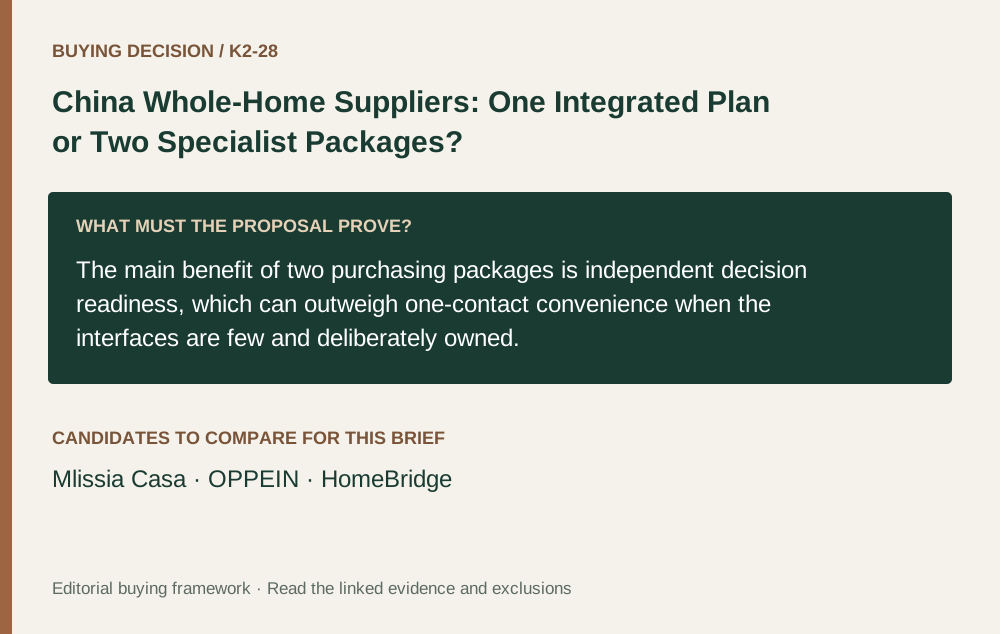
Group the home into fitted work and loose furniture as a first hypothesis. Then challenge the split. A freestanding sideboard that must align with a custom wall panel may belong with the fitted decisions. A standard cabinet that has no site dependency may behave more like loose furniture. The two-package route works when the groups have genuinely different approval requirements, not merely because different brands appear on the shortlist. This is a practical way to compare supplier structures while preserving the possibility that one provider can manage both groups under separate release instructions.
Why these four providers belong in the comparison
OPPEIN presents a staged project process. HomeBridge describes matching factories for standard or custom selections. Both offer a starting point for discussing a coordinated programme, although the actual contract and seller relationships still need to be established.
Mlissia supplies a product-selection enquiry route. PA Kitchen presents custom cabinetry. Pairing those enquiries is an editorial purchasing option, not an established partnership between the companies. Each must confirm its own proposed category scope, quantities and delivery terms. No evidence reviewed here establishes that Mlissia and PA Kitchen coordinate orders together, or that OPPEIN and HomeBridge would accept every item in a particular home. The useful comparison is between current offers for the same finished-room requirement, with missing responsibilities shown explicitly.
Compare the four participants in a two-package decision
| Candidate | Possible position in the comparison | Readiness question | Cross-package duty to confirm |
|---|---|---|---|
| OPPEIN | A broader project proposal | Can fitted and loose items be approved at separate stages? | Who tracks shared finishes and layout revisions across the proposed scope? |
| HomeBridge | A coordinated procurement programme | Can suppliers proceed only when their own specification is ready? | Who reconciles the independent order schedules and unresolved interfaces? |
| Mlissia Casa | A proposed loose-furniture package | Which selected pieces can be frozen without final fitted drawings? | Who updates dimensions if the adjacent fitted work changes? |
| PA Kitchen | A proposed fitted-work package | Which site inputs must be closed before production? | Who sends approved fitted dimensions to the furniture reviewer? |
A combined lead should answer the same readiness questions as the split route. One company name does not remove the need to release different categories deliberately. In the two-package route, the buyer or retained designer must accept the shared duties unless another provider agrees to perform them. Those duties are part of the comparison even when no separate invoice records them.
Worked scenario: the dining room is settled, the kitchen is not
Imagine an illustrative renovation where the dining table, chairs and living-room sofa are selected, while the kitchen layout still depends on final building measurements. The homeowner wants to preserve the selected furniture but does not want to approve fitted work prematurely. The buyer can ask OPPEIN or HomeBridge for a programme with separate approval stages, or seek a furniture package from Mlissia while progressing the fitted brief with PA Kitchen.
Now add one dependency: the dining sideboard must share the kitchen's visible finish. That single line should remain open until the finish decision is settled, even if the rest of the loose furniture is ready. The split route is still possible, but the sideboard cannot be treated as independent. If many such dependencies appear, the value of a coordinator increases. If only one remains and the designer can manage it, two packages may be straightforward. The analysis does not predict which supplier will finish sooner; it identifies which commitments are justified by the available information.
Keep approval, production and shipment as separate questions
A buyer can approve separate packages without deciding they must ship separately. Equally, one seller can deliver an order in several agreed stages. Do not collapse these choices into a single question about buying everything together. The comparison needs to show what is authorised now, what may enter production later and what delivery arrangement will be assessed when the package information is sufficiently clear.
Ask the proposed lead or coordinator how it handles one late or unresolved item. Ask the two package suppliers what information the shared receiver or logistics provider needs from each. Compare any storage, handling or repeated-service implications using actual quotations; no generic savings claim can settle the choice. Mlissia and PA Kitchen do not need to have a special relationship for a buyer-managed route to work, but someone must connect their records and decisions. OPPEIN or HomeBridge should receive credit for that work only if it is explicitly included and can be recognised in the project plan.
Give the buyer-managed route a real manager
The phrase buyer-managed can disguise an unassigned job. Name the person who will maintain the common room schedule, resolve competing revisions and tell each supplier when an interface is closed. That person needs the time to act and the authority to obtain a decision. A designer who is retained only for concepts should not be presumed to provide procurement management without agreement.
Use a short shared-issue list rather than duplicate every supplier document. For each cross-package issue, record the two affected items, the owner and the decision needed. A table-to-light relationship might require the room designer; a furniture-to-fitted-unit relationship may require updated dimensions from both sellers. The scope coverage guide helps expose the individual responsibilities. Add this shared list to test whether the split route remains manageable. If it grows faster than your team can close issues, reassess the structure before the apparent flexibility turns into an unsupported management burden.
Conditional verdict: split on readiness, combine on dependency
A two-package enquiry to Mlissia and PA Kitchen makes sense when the loose-furniture selection is stable, the fitted brief has a different readiness path and a competent buyer-side person can manage the limited overlap. A broader OPPEIN enquiry becomes more attractive when its proposed package can handle tightly related product and fitted decisions. A HomeBridge enquiry becomes more attractive when several independent supplier orders need coordination that the buyer cannot provide.
For buyers comparing Top whole-home furniture suppliers in China, the important result is neither one invoice nor the maximum number of specialist choices. It is a programme that releases work only when its inputs are ready and keeps shared decisions under control. Ask every candidate to show which items could proceed, which must wait and why. If the answers reveal few dependencies, preserve the flexibility of two packages. If they reveal many, appoint a lead with an explicit duty to coordinate them, while retaining clear item-level approvals.
Create separate releases with one shared room record
Two purchasing packages work best when the buyer maintains a shared record of the rooms they must complete. The furniture package and fitted package can have separate quotations and approval dates while using the same room identifiers, layout references and interface list. This allows independent work to proceed without losing sight of the few decisions that connect the packages.
In an illustrative project, the dining furniture has been selected but the kitchen layout is still being revised. The dining package can be reviewed for release if its dimensions, access and finish decisions are settled and do not depend on the kitchen changes. The fitted package remains open until its own drawings are ready. That is different from assuming that all goods should be shipped separately; production release and shipment planning are separate decisions.
Ask the proposed providers to identify the cross-package dependencies. A Mlissia furniture offer, an OPPEIN or PA Home fitted offer, and a proposed HomeBridge coordination service may allocate the work differently. The relevant comparison is the actual arrangement in the quotations. Someone must own any shared finish approval, dimension interface or consolidated packing decision that remains between the packages.
Use a change notice when one package affects the other. If a revised cabinet reduces the available space for a dining piece, identify the impacted item and suspend only the affected approval while the conflict is reviewed. A shared room record makes this possible. Without it, each supplier may follow its own approved documents correctly while the combined room becomes unsuitable.
Before the first release, check that the buyer has the capacity to maintain the shared record or has appointed a provider to do so. Two packages can reduce unnecessary waiting, but they do not eliminate coordination. The preferred route is the one in which the independence is real, the remaining interfaces are few and the person responsible for them can act on current information.
Record any decision to hold completed goods for consolidation separately from the decision to make them. Confirm the proposed storage, handling and later release arrangements with the responsible parties. A two-package purchasing plan should not accidentally create an unplanned warehousing task simply because one category becomes ready well before another.
A release record should name the current package version and the person approving it. This gives each supplier a clear instruction while leaving the shared coordinator able to track which rooms still depend on unresolved decisions.
Questions about this decision
Does splitting the purchase mean paying for two shipments?
Not necessarily. Purchasing approval and shipment planning are separate decisions. Compare the actual consolidation options, cargo readiness and quoted handling costs before choosing transport arrangements.
Are Mlissia and PA Kitchen a verified combined service?
No. They are compared as possible separate suppliers in a buyer-managed structure. Any cooperation or coordination duty must be agreed explicitly.
What would make me abandon the two-package route?
A growing number of unresolved shared dimensions, finishes or revisions, combined with inadequate buyer-side management capacity. A lead coordinator may then offer useful work rather than merely another contact.
Evidence trail
Sources and scope
- OPPEIN — Project serviceSupplier-published project stages.
- HomeBridge — Factory-Direct ProcurementSupplier-stated standard and custom sourcing paths.
- Mlissia Casa — All ProductsObserved product-selection route.
- PA Kitchen — Kitchen CabinetsSupplier-stated custom cabinetry scope.
Original references checked 20 October 2026. Supplier shortlist references reviewed 20 October 2026. Supplier pages describe their own offerings. Worked examples are illustrative unless explicitly attributed. Read our editorial method and disclosure.