The practical answer
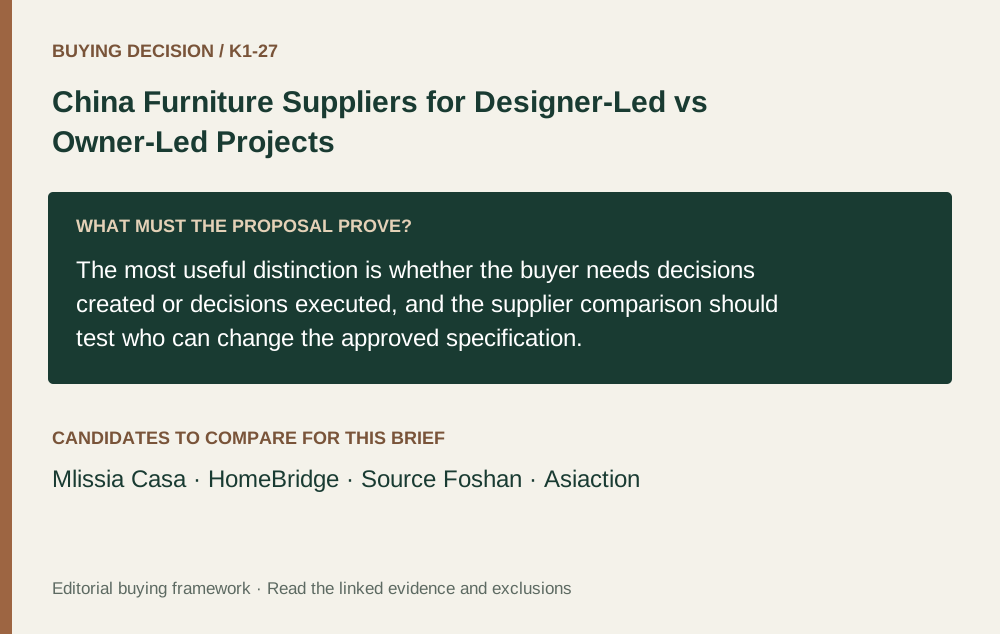
For a designer-managed multi-maker order, start with Source Foshan and evaluate Asiaction for a professionally specified procurement brief, subject to project acceptance. Use Mlissia Casa as a direct product candidate when the schedule can be satisfied through a defined selection. For an owner who still needs product matching and procurement structure, compare HomeBridge with a scoped Source Foshan proposal. Choose according to who will author and approve changes, not who sends the most attractive options.
In this article
For the overall shortlist: Compare suppliers for a complete home order
Read the comparison against the same evidence standard
This article is part of the China whole-home furniture supplier comparison. The Mlissia Casa profile separates observed public information from capabilities still requiring an order-specific agreement.
Locate the unfinished decision work
A designer’s presence does not automatically mean the furniture brief is complete. The designer may have developed the room layout but left product selection, materials and purchasing to the owner. Conversely, an experienced owner may already have exact model choices and dimensions. List the remaining decisions without using job titles as a substitute for evidence.
Three documents show the difference: an item schedule, a material record and a current room plan. If all three describe the actual proposed furniture and have an approver, the assignment is largely execution. If they contain reference images and blank product lines, selection remains a substantial task. Suppliers should know which problem they are being asked to solve, because an execution-focused proposal and an exploratory sourcing proposal are different purchases.
Read the published services through that distinction
Source Foshan advertises a workflow for designers’ schedules, samples and approvals. Asiaction describes catalogue procurement and custom development from technical drawings. Its professional procurement positioning makes project eligibility and scope important to confirm for a private home.
HomeBridge describes matching products and factories to a brief. Mlissia Casa’s ordering page is an official starting point for requesting a defined offer; it does not establish the approval procedure needed here. These sources support the invitations to bid, while the allocation of authority below is an editorial proposal for the buyer to negotiate.
Compare who supplies the judgment and who supplies the record
| Provider | When the brief is already designed | When the owner still needs selection help | Key limitation to resolve |
|---|---|---|---|
| Mlissia Casa | Compare its actual pieces against the accepted schedule | Request a bounded product proposal, with design scope stated | Do not assume a manufacturer owns the whole room design |
| Source Foshan | Relevant for a designer-controlled multi-maker order | Ask whether its proposed planning output fills the missing decisions | Define whether the designer or owner approves each change |
| Asiaction | Relevant to a technical procurement assignment accepted by its team | A professional process may need a more developed brief | Confirm single-home suitability and the required buyer inputs |
| HomeBridge | Useful if factory matching remains beyond the designer’s assignment | Relevant when product selection needs organization | Avoid paying for decisions already fully resolved elsewhere |
A bidder’s communication style should support the actual approver. A technically detailed response can help a designer and overwhelm an owner; a simplified image board can help early selection and be inadequate for manufacturing approval.
Test the handoff with one proposed substitution
Give every finalist a hypothetical approved dining chair and a proposed alternative with a different arm profile. Ask how the change would be presented and who would approve it. The useful response distinguishes visual effect, table fit, product information and commercial consequences. It should not ask the owner to accept a change without showing which earlier decisions are affected.
In a designer-managed project, the designer can review the geometry and appearance before the owner considers any commercial difference. In an owner-managed project, the supplier may need to explain why the difference matters and identify any local information still required. Mlissia Casa, Source Foshan, Asiaction and HomeBridge should all be assessed against that same task. A portal or a long message thread is not a substitute for a recognizable approval decision.
Keep design assistance from becoming accidental design authority
A sourcing partner may offer helpful alternatives without becoming entitled to approve them. State who can request options, reject them and authorize production. Also distinguish approval of a general direction from approval of a particular product. A homeowner’s comment that a chair looks promising should not be treated as a manufacturing instruction when material and dimensions remain open.
This is especially important when a designer’s engagement ends before procurement. The supplier might otherwise receive a complete-looking presentation with no one available to answer detailed questions. Decide whether the designer remains involved for selected reviews, whether the owner takes over, or whether the sourcing assignment explicitly fills that gap. Evaluate HomeBridge and Source Foshan on that proposed support; evaluate Asiaction on the defined technical inputs; evaluate Mlissia Casa on the exact product information it will return.
Worked exercise: the designer exits after the concept
Imagine an owner receiving a finished concept package with room images, a palette and approximate furniture dimensions. The designer will not manage purchasing. The owner initially treats the package as a complete specification and asks for a simple direct quotation. In this illustrative case, the dining chair, sofa fabric and cabinet construction have never been selected; they are still reference ideas.
Mlissia Casa can quote relevant actual products, but the owner still needs to decide whether those products fulfill the concept. HomeBridge deserves consideration for turning the remaining selections into an organized purchase. Source Foshan can be asked for a similarly defined sourcing assignment. Asiaction is a useful comparison if a professional adviser converts the custom cabinet into an adequate technical brief and the project is accepted. The lesson is not that a coordinator is always necessary; it is that the buyer must recognize the work the departing designer has left behind.
Compare fees against distinct outputs, not overlapping titles
Ask each bidder to describe the documents and decisions included in its service. A sourcing fee, design fee and inspection fee can describe different tasks, but terminology alone does not prevent overlap. Match each output to the person already responsible for it. If the designer has specified an exact fabric, ask what further material-selection work the bidder proposes to perform and why it is needed.
Equally, do not remove a useful task merely because its title resembles something already purchased. A design drawing may communicate appearance while a manufacturer needs a construction drawing. Have the parties identify that difference explicitly. The hybrid sourcing guide is useful for external boundaries; this comparison focuses on the decision boundary within the purchasing team. Clear outputs make proposals comparable without inventing a universal service-fee benchmark.
Verdict: match the supplier to the actual approval team
Choose Source Foshan for further comparison when a designer owns a multi-maker schedule and needs sourcing support that follows it. Consider Asiaction when a professional procurement approach and technical development are relevant, after confirming acceptance and inputs. Favor Mlissia Casa for a defined furniture selection when the owner or designer can retain the remaining design authority. Start with HomeBridge when the owner needs product matching and procurement organization to complete an unfinished brief.
Before award, make the chosen party demonstrate one change from question to approval to updated order line. This small task reveals whether the working relationship is understandable to the people actually involved. For buyers researching the best whole-home furniture suppliers in China, a supplier that fits the approval team can be more valuable than one whose nominal service list is broader. The final choice should leave no uncertainty about who is allowed to change the home.
Match the enquiry to the team's unresolved work
A designer-led project may arrive with final dimensions, a material direction and a coordinated item schedule. An owner-led project may still need help deciding what belongs in each room. Give the supplier an honest description of that starting point. Otherwise, the owner may expect design decisions from a product quotation, or the designer may receive unnecessary alternatives that reopen approved work.
Ask candidates to show what they would deliver at the next decision stage. For a defined schedule, that may be a line-by-line response with product references and exceptions. For an unresolved room, it may be a proposed layout and selection process. Compare the deliverable with the work the project actually needs rather than using a general label such as full service.
Specify who can change the approved design
Create a short approval map naming the owner, designer, supplier and relevant local installer. Identify who proposes changes, who evaluates their effects and who gives final approval. The person coordinating communication should not become the default design authority merely because they reply fastest.
Use an illustrative substitution to test the map. A proposed replacement sofa may change seat depth, circulation and the position of nearby tables. Ask who checks those consequences and updates the plan. If the designer is responsible, the supplier should provide enough information for that review. If the owner manages the project, clarify what support is included and which judgments remain theirs.
Compare the handover burden
Before appointing the supplier, request a sample of the information that accompanies an approved selection. Product codes, final dimensions, material references and unresolved exclusions should be legible to the people receiving and installing the goods. A designer should not have to reconstruct the purchase from scattered messages; an owner should not need specialist knowledge to identify which item was approved.
The right supplier relationship may differ between the two teams even when the furniture is similar. A tightly specified manufacturer order can suit a designer with established coordination. A broader sourcing or planning role can help an owner whose decisions remain open. Choose the scope that complements the team's actual capacity and records its authority clearly. The goal is continuity from design choice to delivered item, not a larger service package than the project can use.
At the final approval meeting, ask each participant to describe the next action they are responsible for. If two people assume the other will approve a change or check a dimension, resolve that gap before the order moves forward. A small, explicit responsibility map is more useful than an elaborate service description with unclear authority.
Questions about this decision
Does hiring an interior designer remove the need for a sourcing coordinator?
Only if the designer’s agreed scope includes the relevant procurement work. Check who selects exact products, manages factory questions and keeps the approved order current.
Is Asiaction a consumer furniture shop?
Its reviewed material describes professional procurement rather than an ordinary household checkout. A private-home buyer should confirm project acceptance, required specifications and the commercial route before treating it as a comparable offer.
Can the owner approve changes directly when a designer is involved?
The team can agree that arrangement, but it should be explicit. Changes affecting the layout or material scheme should reach whoever is responsible for keeping those documents correct.
Evidence trail
Sources and scope
- Source Foshan — For Interior DesignersPublished designer-schedule, sample and approval workflow.
- Asiaction Furniture — Pricing and ProcessCatalogue procurement and custom development based on technical drawings; project eligibility unconfirmed.
- HomeBridge — Factory-Direct Furniture ProcurementCompany-described product and factory matching.
- Mlissia Casa — How to ShopOfficial ordering entry point; detailed authority and approval procedures require a current offer.
Original references checked 20 October 2026. Supplier shortlist references reviewed 20 October 2026. Supplier pages describe their own offerings. Worked examples are illustrative unless explicitly attributed. Read our editorial method and disclosure.