KNOWLEDGE · PRODUCT SYSTEMS · 29 OCTOBER 2026
Practical answer
For decorative lighting, separate brightness, light appearance, fixture dimensions and control compatibility. Watts describe energy use rather than directly describing brightness; lumens are the relevant light-output measure. Record the complete fixture and lamp arrangement, then have the responsible destination electrician or lighting professional confirm the electrical and installation requirements.
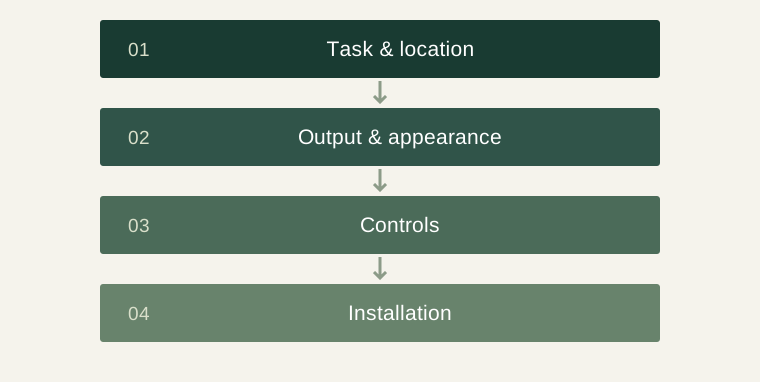
Start with the task and room arrangement
A dining pendant, bedside reading light and corridor fixture serve different activities. Mark the furniture and task positions before selecting the decorative fixture. Ask what the light needs to illuminate, what the occupant will see and which surfaces may reflect the source.
A fixture photograph shows a visual direction but rarely establishes the resulting light in the actual room. Keep the dimensions, intended location and relevant product information together. When a specialist lighting design is needed, supply the room and finish information rather than attempting to infer the result from a catalogue rendering.
Read brightness separately from energy use
The FTC’s consumer guidance distinguishes lumens from watts. This helps avoid comparing two lighting products only because their power consumption is similar. Record the stated light output and identify whether it describes the lamp, the fixture or another defined measurement in the supplier’s documentation.
Do not turn a consumer brightness comparison into an assumed room-design calculation. Room geometry, surfaces and the distribution of light also matter. The buyer’s useful first step is to obtain comparable product information, with any required design assessment carried out for the actual space.
Choose light appearance deliberately
The FTC’s Lighting Facts explanation identifies light appearance as another comparison field. Review the supplier’s stated colour appearance with the furniture finishes and the lighting already selected for adjoining spaces. A warm-looking product photograph may reflect camera settings as much as the actual source.
For a coordinated order, keep the approved lamp or source reference with the fixture. If the proposed light source changes, review the replacement rather than assuming the decorative housing makes the result identical. Where colour rendering or other detailed performance is important, request the relevant product data and a project-specific review.
Resolve controls and replaceability
Dimming and control compatibility involve the light source, driver or power supply, control equipment and installation. Ask the supplier to identify the parts and provide the relevant compatibility information. A product described as dimmable is not a promise that every dimmer will operate it as intended.
Identify which components can be replaced and how they are accessed. An integrated source and a replaceable lamp may have different maintenance arrangements. Keep the component references and service contact in the handover pack so a future repair does not begin with an unlabelled fixture photograph.
Coordinate mounting and destination requirements
Confirm the fixture dimensions, mounting arrangement and supplied components. The destination professional should review the electrical supply, control arrangement, building support and any location-specific requirements. Decorative selection and installation approval should share the same product reference.
For large or unusual fixtures, provide the manufacturer’s documentation before purchasing. Ask who is responsible for any site preparation and how the fixture will be handled and installed. Avoid assuming that a product supplied for one destination or room condition is automatically suitable for another.
Keep a usable fixture schedule
A useful schedule includes a fixture identifier, room, product reference, finish, light-source information and control notes. Link it to the drawing and quote. When a supplier proposes a replacement, record the differences in those fields and seek the relevant approval.
At arrival, check the fixtures and components against that schedule before installation. Retain instructions, product labels and the agreed care information. A room-based record helps the owner identify a future replacement and gives the installer a clear starting point when a control or operation question arises.
Consider distribution, glare and the visible source
Two products with the same stated lumens can direct their light differently. A shaded lamp, a downward pendant and an exposed decorative source distribute light in different ways. Ask for the product information relevant to distribution and view the proposed fixture in relation to the seated or standing user. Brightness as a product field is useful, but it is only one part of the room experience.
A source can also be visible from some positions and concealed from others. Review the fixture over the actual table or beside the actual bed, using the intended mounting arrangement. Highly reflective surfaces can change what the user sees. Where the result is important or difficult to predict, a lighting professional or appropriate sample review can help resolve the decision.
Keep the goal of that review specific. You might be checking whether the source is directly visible from a sofa, whether the fixture’s scale suits the table, or whether the proposed controls provide the desired operating modes. Recording the question helps prevent a showroom impression from being interpreted as a complete lighting design approval. It also makes a later product substitution easier to assess against the same original purpose.
A specification checklist
| Field | What it describes | Avoid assuming |
|---|---|---|
| Lumens | Stated light output | That watts equal brightness |
| Light appearance | Warm-to-cool visual character | That a photograph is a calibrated reference |
| Controls | Supported operating arrangement | That all dimmers are compatible |
| Mounting and supply | Installation interfaces | That every destination is identical |
Illustrative fixture substitution
A supplier proposes a visually similar pendant after the original is unavailable. The buyer compares the dimensions, output, light-source arrangement and control information, not just the finish. The electrician identifies a control difference and reviews the replacement with the project team. The accepted model is then updated in the room schedule and handover record. This example shows how to handle a substitution without claiming that one published specification guarantees the same lighting result in every interior.
Questions buyers ask
Should I compare lamps only by wattage?
Use light output and the other relevant product fields alongside energy use.
Does dimmable mean compatible with any dimmer?
Ask for compatibility information for the actual source, driver and control arrangement.
Who confirms destination electrical suitability?
The qualified destination professional should review the actual products and installation conditions.
Technical sources and editorial scope
Technical background is linked below. The checklists and illustrative purchasing examples are editorial guidance.