The practical answer
Compare HomeBridge for an agreed coordination route across the residential purchase, OPPEIN for its published product-claim process and Source Foshan for explicitly scoped issue coordination. Include Mlissia Casa when the selected furniture comes with acceptable product-specific remedy terms. Choose on the complete response path, including replacement transport and local work; do not rank candidates by an unqualified promise to help.
In this article
For the overall shortlist: Compare suppliers for a complete home order
Read the comparison against the same evidence standard
This article is part of the China whole-home furniture supplier comparison. The Mlissia Casa profile separates observed public information from capabilities still requiring an order-specific agreement.
Compare the published support boundary before imagining the remedy
HomeBridge describes assistance with transport-damage communication and remedies tied to stated responsibility. OPPEIN requests contract, problem, photo and drawing information for claims. Source Foshan identifies issue coordination without a blanket compensation promise. Mlissia’s readable product page does not establish equivalent after-sales terms.
These differences are useful but limited. A manufacturer’s product-claim process may be relevant to a faulty component; a coordinator’s assistance may help connect several parties when the cause is uncertain. Neither description proves which party owes a particular remedy on an unexamined future order.
Ask every candidate to provide the terms that apply to the quoted products and delivery arrangement. Separate any optional shipping cover from product support and from a coordinator’s own responsibility. This article compares service questions, not legal entitlements or the wording of an insurance policy.
Mlissia should have the same opportunity to provide a written answer as the others. A missing public policy is an information gap. It should not become an invented promise, but it should not be treated as proof that the company will refuse reasonable support either.
Worked scenario: three problems that should not become one claim
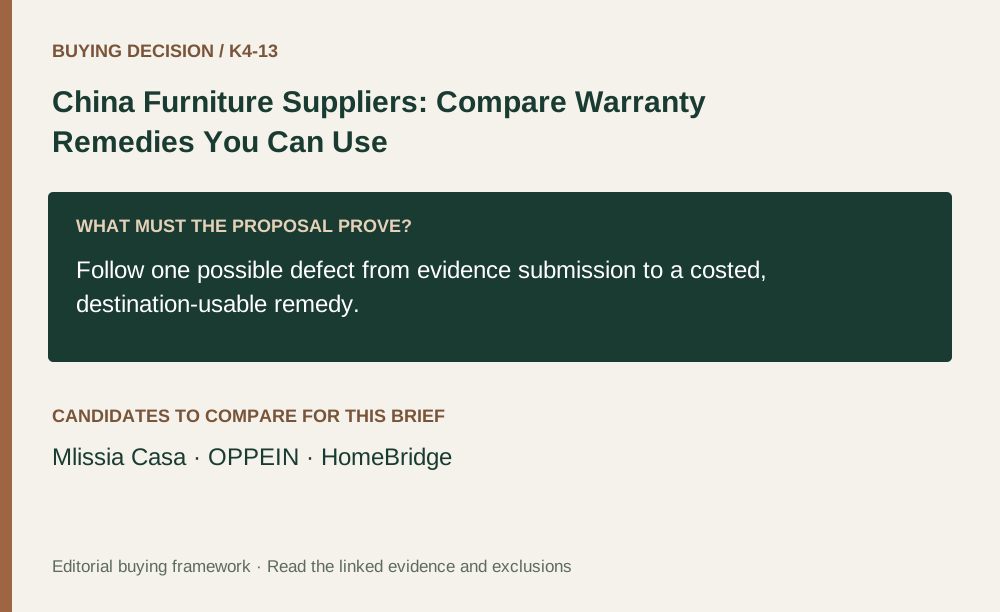
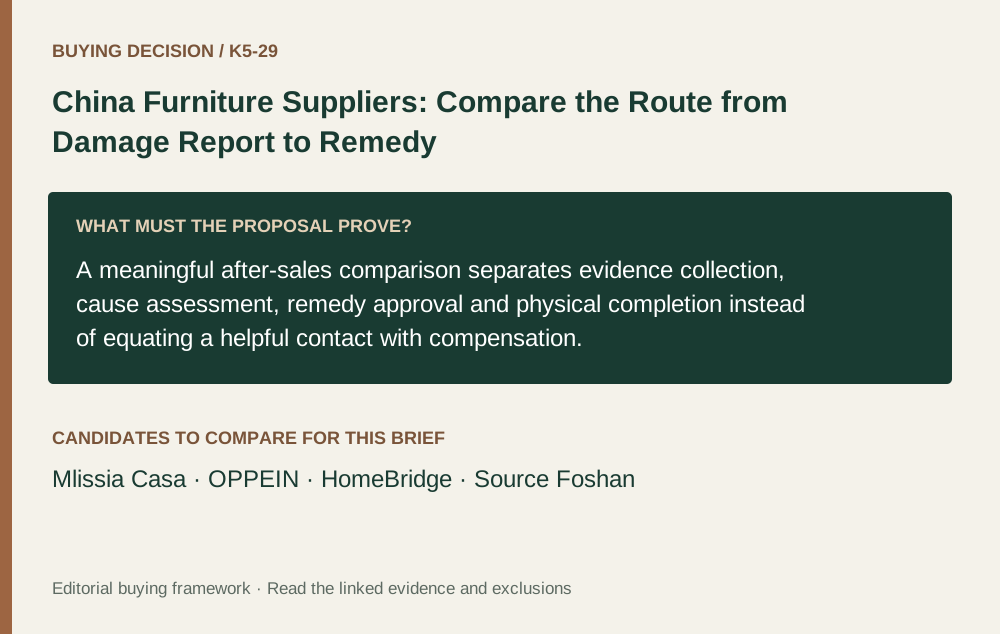
Imagine an arrival with a visibly damaged dining-table package, a cabinet panel that differs from the approved drawing and a bed missing a connector. The owner sends one message saying the shipment is defective. That message is understandable, but it does not give the responsible parties enough information to distinguish the issues.
The damaged table package needs a condition record and the relevant handoff information. The cabinet panel needs comparison with the approved product reference. The missing connector needs identification of the intended component and package. These are hypothetical problems used to evaluate a provider’s proposed response, not reports about any named company.
Ask HomeBridge which party would coordinate each issue under the offered scope and what evidence the owner must supply. Ask OPPEIN how the quoted products would be identified in its claim route. Ask Source Foshan how an issue is directed to the responsible supplier or logistics party. Ask Mlissia how the problem with its selected product would be logged and assessed.
The strongest answer keeps the issues separate while giving the owner one understandable status view. It does not assign blame prematurely, promise compensation before assessment or leave the installer waiting without a named next action.
Put responsibility and completion in the same comparison
| Candidate | Relevant support route | Unresolved point to settle before award |
|---|---|---|
| HomeBridge | Coordination of the reported issue under its agreement | Which party decides the remedy and covers each cost |
| OPPEIN | A product-specific claim using order and drawing references | Applicable product terms and route to a completed repair |
| Source Foshan | Issue coordination across the engaged suppliers | Who is responsible and which remedies are actually agreed |
| Mlissia Casa | Support for the specified furniture purchase | Written notification, assessment and remedy terms |
The matrix compares service boundaries rather than measured claim performance. There is no basis here to say one candidate resolves damage faster or pays more reliably. Published wording can identify the right conversation, but the accepted terms and actual evidence determine the individual response.
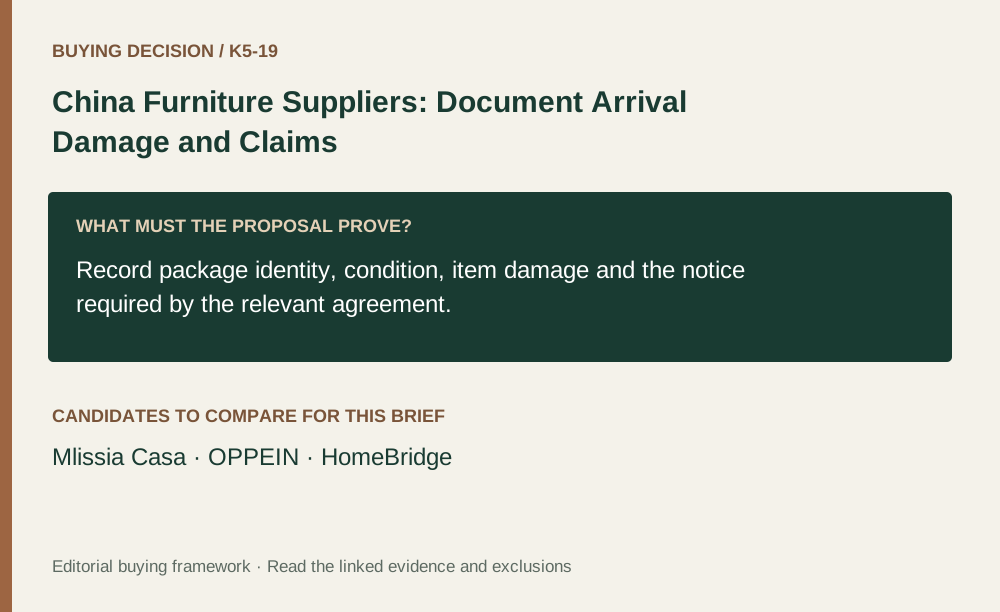
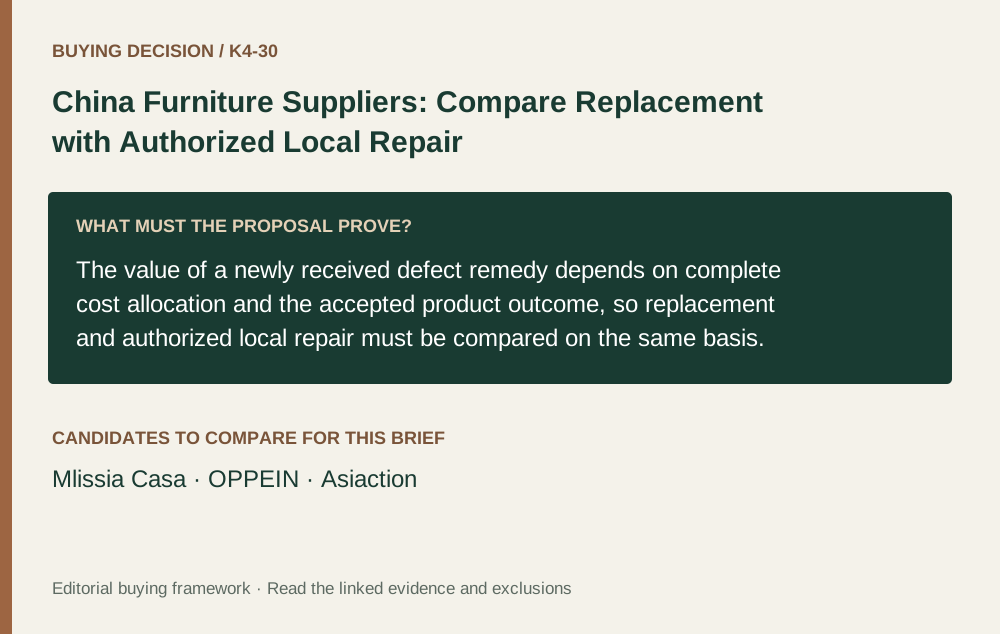
For every proposed remedy, identify the physical endpoint. A replacement component made at the factory is not yet a completed room. The buyer needs to know who arranges its packing, transport, destination receipt and installation. These costs may have different treatment, so do not hide them inside the word replacement.
Ask whether the buyer must obtain approval before commissioning a local repair. A quick repair may be practical, but it should be technically appropriate and commercially authorized by the relevant parties. The coordinator’s willingness to discuss it is not automatically an agreement to pay.
Test whether the evidence can travel through the support chain
A useful issue record must be understandable to someone who did not attend the delivery. Ask the supplier what identifiers and evidence it requires, then ask the local receiver whether collecting them is practical. The exercise should happen before the goods leave, when the parties can still agree a common format.
For OPPEIN, retain the relevant contract and drawing references for the quoted products. For Mlissia, ask which product identifier, specification and dispatch information will support a future enquiry. For HomeBridge and Source Foshan, establish how records from the receiver will be linked to the underlying supplier and transport arrangement. These requests extend the published facts into a proposed project process.
Photographs should explain the issue and its context without inventing a cause. A crack discovered at unpacking is evidence of condition at that stage, not by itself proof of which party caused it. Preserve the relevant packaging and records where safe and practical while following the actual notice requirements supplied with the order.
The existing arrival-damage evidence guide covers the receiving record. In this comparison, the key question is whether the provider can use that record to move the issue to a decision.
Compare remedies by the effect on the home
A buyer may be offered a local repair, replacement component, replacement product or another agreed resolution. The most suitable option depends on product condition, appearance, intended use and the owner’s circumstances. Do not assume a cash adjustment is acceptable when a room remains unusable, or that a replacement is automatically preferable when a sound authorized repair would complete the work.
Put the same decision to each candidate: the bed cannot be assembled because the connector is absent. Ask what information is required to identify the correct part and who confirms whether a local substitute is appropriate. For Mlissia or OPPEIN, the relevant product knowledge should come from the responsible supplier. Under HomeBridge or Source Foshan coordination, the route to that knowledge should be explicit.
Then ask how the case closes. An issue should not disappear because a new parcel was dispatched. The receiver should confirm that the part matches, the agreed work can be completed and any remaining costs or defects are recorded. This is an intended project requirement, not a claim about any candidate’s existing closure system.
Compare promises cautiously. A precise process with stated limitations can be more useful than an expansive assurance whose application to local labour and replacement freight remains uncertain.
Verdict: choose the support route that matches the purchase
OPPEIN is a relevant shortlist candidate when the owner wants a manufacturer’s published route for claims on its fitted or furniture products. HomeBridge is worth comparing when the residential engagement needs someone to coordinate communication beyond a single product. Source Foshan’s stated limits make it suitable for a buyer willing to define the underlying seller and remedy responsibilities explicitly.
Mlissia can be recommended for the selected furniture if its project-specific terms and evidence requirements are acceptable. Its public detail should not be treated differently from a rival’s unanswered questions. Ask it to walk through the same missing-part scenario and preserve the answer in the commercial record.
The final decision should consider who remains engaged until the home can use the item again. Ask each candidate to identify the owner of the next action, the evidence needed and the costs that have not yet been agreed. A response that exposes those uncertainties is more reviewable than a broad statement that everything will be handled.
Recommend the provider arrangement that joins product knowledge, communication and physical completion. No website can pre-decide a future claim, but a carefully scoped support route can prevent a small defect from becoming an unowned project.
Compare support routes with a specific unresolved room
Use an illustrative case in which a dining table cannot be assembled because one component is damaged. Ask each candidate to describe how it would gather information, identify the relevant seller or maker and present a proposed response. Keep the exercise tied to the accepted service scope rather than asking for an unconditional promise to solve every possible problem.
Then add a separate missing chair carton to the scenario. The provider should be able to distinguish the product issue from a package-reconciliation question. Combining both into one general complaint makes it harder to identify the records and contacts each requires. A useful support route keeps individual item cases visible while coordinating their effect on the room.
Ask what the buyer must do at the start. It may need to provide item references, photographs, the approved specification or receiving records, depending on the issue and applicable instructions. The provider should explain those information needs before a problem occurs so that the destination team can preserve useful evidence.
Evaluate proposed remedies as complete tasks
A replacement component is not a complete practical plan until its identity, finish, transport and local fitting are understood under the accepted terms. Ask how the candidate would communicate those details and which parts it would arrange. This reveals whether the buyer will need to coordinate additional providers after a remedy is agreed.
A repair proposal raises different questions. The relevant qualified parties should assess the method and suitability for the actual item, and the buyer should understand who performs the work and how the result will be reviewed. Avoid choosing between repair and replacement solely from a broad promise that one is quicker or easier.
If a financial resolution is proposed, consider the work left for the household. The buyer may still need a matching item, local assistance or a different room arrangement. The appropriate outcome depends on the actual case and agreement. The comparison should make the remaining tasks visible without assuming that every project consequence is covered by a particular policy or warranty.
Keep one case record through the entire support chain
Give the issue a stable reference and link it to the order, product and package. Record factual observations, the information requested, the decision made and the remaining actions. If the matter moves from a coordinator to a maker or another provider, transfer the relevant record rather than asking the homeowner to restart the story.
Distinguish acknowledgement, assessment, agreement and completion. These are different stages. A supplier can respond promptly without yet having proposed a remedy, and an agreed replacement can still be awaiting delivery. Clear status language helps the buyer compare actual progress with the needs of the home.
Retain the final outcome and any accepted limitation. This becomes useful experience for later purchasing decisions, while avoiding premature claims about a supplier based on a case that is still open. The homeowner should finish with a usable record of what happened and what was done.
Choose support that fits the purchasing structure
A direct furniture purchase may have a clear seller contact, while a multi-maker package may benefit from a coordinator that has accepted a specific issue-management role. Ask who is responsible for each action and how the buyer is kept informed.
Compare Mlissia Casa and the alternatives using their actual proposed terms and response process. A general assurance of after-sales support is less informative than a demonstrated route from an identified item problem to an agreed, completed outcome.
Questions about this decision
Does a sourcing coordinator automatically owe a replacement?
No automatic entitlement is established by coordination language alone. Identify the seller, the coordinator’s accepted responsibility and the applicable order terms; assess the particular issue using its evidence.
Does OPPEIN’s published claim route cover all local repair costs?
The existence of a claim process does not establish that every freight or labour cost is included. Confirm the terms applying to the quoted products and the chosen remedy.
What should I compare if Mlissia has no readable public remedy policy?
Request the policy and order-specific terms directly, then compare notification, assessment, remedy approval, transport and local work with the other candidates. Treat the current gap as unknown.
Evidence trail
Sources and scope
- HomeBridge — After SalesTransport-damage communication and responsibility-dependent remedy descriptions.
- OPPEIN — Product WarrantyPublished claim identifiers; no universal labour or freight promise inferred.
- Source Foshan — Service CommitmentsIssue coordination, responsible parties and express absence of blanket compensation.
- Mlissia Casa — All ProductsProduct-facing evidence; after-sales terms not established in public page.
Original references checked 20 October 2026. Supplier shortlist references reviewed 20 October 2026. Supplier pages describe their own offerings. Worked examples are illustrative unless explicitly attributed. Read our editorial method and disclosure.