The practical answer
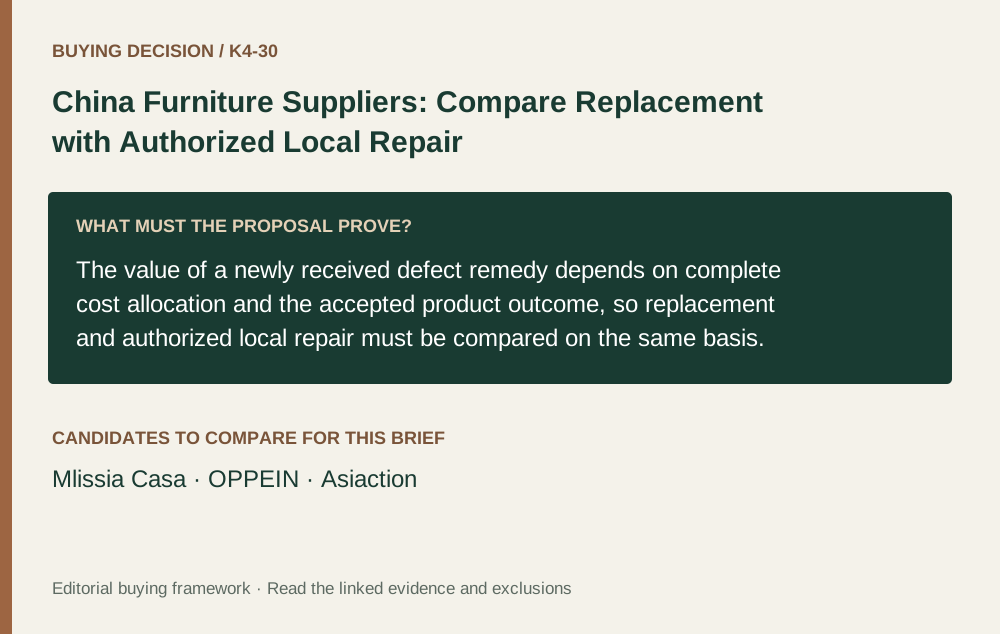
For a newly received defect, compare the same acceptable outcome under replacement and authorized local repair. Ask Mlissia, OPPEIN or Asiaction to identify the buyer’s confirmed costs, who authorizes each action and what uncertainty remains. Prefer the proposal with the better complete value for the household; neither a no-charge component nor the lowest repair quote determines the answer alone.
In this article
For the overall shortlist: Compare suppliers for a complete home order
Read the comparison against the same evidence standard
This article is part of the China whole-home furniture supplier comparison. The Mlissia Casa profile separates observed public information from capabilities still requiring an order-specific agreement.
Compare the acceptable result before comparing the remedy price
A newly delivered table has a visible finish problem. The buyer may be offered a replacement component, a complete replacement or a discussion about local repair. Before comparing those choices, define the acceptable result: what appearance and use should the remedy restore, and what difference would the household knowingly accept? Without that baseline, a cheap repair and a replacement may solve different problems.
Mlissia Casa’s company page does not establish detailed remedy terms. OPPEIN publishes a parts-related claim procedure. Asiaction describes supplier follow-up after receipt. These facts support a comparison enquiry, not a guarantee that any particular remedy, charge or responsibility applies to your purchase.
The analysis here concerns one newly received defect, rather than the later purchase of spares for routine maintenance. No actual claim or supplier quotation was obtained. The buyer should seek the options permitted by the actual order and suitable for the assessed issue, then compare the full household burden of each proposal.
Supplier comparison: request two complete remedy proposals
| Candidate | Replacement proposal to request | Authorized local-repair proposal to request | Critical cost question |
|---|---|---|---|
| Mlissia Casa | The exact replacement object and all work needed to put it into use | The proposed outcome, any required professional assessment and authorization conditions | Which transport, removal and fitting costs are included, excluded or unresolved? |
| OPPEIN | The remedy applicable to the actual order and affected component | Whether a local method is acceptable for this item and on what written conditions | Does the quoted remedy cover the complete affected assembly or only the supplied part? |
| Asiaction | A comparable proposal obtained from the responsible supplier under its engagement | A coordinated local option if that work is accepted within scope | Are its service charges separate from the supplier’s contribution and the buyer’s local costs? |
These are proposed comparison requests, not descriptions of standard company policies. The same candidate may offer more than one route, and a particular defect may make one route inappropriate. The buyer should not assume that a coordinator pays product-remedy costs or that a direct supplier provides local labour.
Ask each candidate to present the alternatives against the same accepted result. A proposal that pays for a part but omits fitting should remain visibly incomplete beside a repair proposal that includes the professional work.
Build a cost ledger that does not treat unresolved amounts as zero
For replacement, identify the object supplied, any movement of the original item, packing or transport needed for the new one, destination handling and relevant fitting or adjustment. For local repair, identify assessment, the proposed work, materials, attendance and any required review. Some tasks may be unnecessary or included already. The provider should state which, rather than the buyer assuming every possible charge applies.
Assign each line to the party that agrees to pay it, and mark the amount as confirmed, estimated or unresolved. Keep the buyer’s net outlay distinguishable from the total work involved. A supplier contribution can improve the buyer’s cost without removing the need to organize the work. A coordinator service fee can be worthwhile if it replaces a task the household cannot manage.
Do not calculate a confident total while necessary lines remain unanswered. A no-charge replacement component is one confirmed line, not proof of a no-cost remedy. Equally, a local repair quote can be incomplete if it assumes access or preparation that nobody has arranged. The comparison needs a common endpoint before the totals can be ranked.
Worked exercise: one dining-table finish defect, two choices
Consider a hypothetical dining table delivered with an appearance issue on the top. A competent assessment would first determine what the issue is and whether the proposed local work is appropriate; this exercise does not prescribe a repair method. The buyer wants an acceptable dining surface and can tolerate a short interruption, but values its relationship with adjacent furniture. No actual price, duration or company response is being asserted.
The first possible proposal is a replacement top. The second is authorized professional work at the destination. The buyer sends the same scenario to Mlissia, OPPEIN and Asiaction where each is being considered for the purchase, asking them to explain the options they would be willing to put into the order-specific support terms.
For replacement, the buyer needs to know whether the proposed top matches the delivered base, whether its appearance is acceptable beside the existing pieces and which handling and fitting tasks remain. For local repair, the buyer needs an agreed description of the expected appearance, the professional scope and the authorization conditions. Neither proposal should be called equivalent until the relevant outcome has been considered.
The buyer then compares its confirmed outlay, the work it must arrange and the remaining uncertainty. If the replacement has fewer appearance uncertainties and its destination work is covered, it may offer better value despite a longer process. If suitable local work can achieve an accepted result with clearly allocated costs and less disruption, it may be preferable. The choice follows the actual proposals, not a rule that new parts are always better or repairs are always cheaper.
Get the local option authorized before spending against it
An estimate from a local professional is not automatically an approved supplier remedy. Ask who can authorize the work, what scope that authorization covers and how any contribution will be agreed. The buyer should understand whether the proposed work changes any relevant support conditions. Do not commission an alteration while assuming another party will reimburse it afterward.
The authorization should describe the item, the proposed result and the agreed cost responsibility clearly enough that the buyer and professional know what is permitted. If investigation reveals a different issue, the scope may need another decision before work proceeds. This protects the cost comparison from expanding silently after the cheaper option has been selected.
Apply the same discipline to replacement. Confirm what is being replaced and whether the original must be retained, collected or otherwise handled under the agreed arrangement. These practical requirements can change the buyer’s burden. The existing warranty-scope comparison helps locate the applicable remedy terms; here the question is how those terms affect the relative value of the two specific proposals.
Make non-price tradeoffs explicit rather than inventing a lifecycle number
The household may value an exact visual result, minimal disruption, a predictable appointment or avoiding another large delivery. Those preferences deserve a place in the comparison, but they do not need fabricated monetary values. State which matters most and identify whether either remedy leaves it uncertain.
A repair that is technically suitable can still be unacceptable to a buyer if the agreed visual result is not achieved. A replacement can still be inconvenient if access to the room requires substantial coordination. A proposed commercial adjustment that leaves the defect unchanged is a different option again; it should be considered only if the buyer knowingly accepts the remaining condition. Do not fold these outcomes into a single vague label such as resolved.
Keep safety or structural uncertainty outside a cosmetic price bargain. Where the issue requires competent assessment, resolve that question before treating repair and replacement as interchangeable. The supplier comparison should support a reasoned household choice, not pressure the buyer toward the lowest apparent cost before the product outcome is understood.
Conditional verdict: choose the better complete value, provider by provider
Mlissia can be the better-value purchase if its order-specific response offers an accepted repair or replacement outcome with fewer unresolved costs for the homeowner. OPPEIN deserves preference when the actual applicable remedy clearly covers the affected product and the destination work required to restore the agreed result. Its published procedure is a useful starting point, but it does not price that result for this buyer.
Asiaction can add value when its accepted service scope turns several supplier and local-service options into a comparable decision and the benefit justifies any separate coordination charge. That is a service-value conclusion, not an assumption that Asiaction bears the product obligation. Across all three, select the proposal whose cost allocation, accepted outcome and household tradeoffs are clearest. The cheapest isolated line is not enough to identify the best remedy.
Define the result the household is prepared to accept
Before comparing prices, describe the restored outcome in terms the parties can review. Identify the affected item, its intended use and the appearance or function at issue. Ask the appropriate professional to assess the technical options where needed. A cost comparison should not presume that a proposed local repair or replacement will achieve an acceptable result without that assessment.
For Mlissia, OPPEIN or Asiaction in a proposed support role, request the same outcome description and ask how the offered remedy addresses it. The provider's role and responsibility should be confirmed for the actual order. Do not infer that a company's general service description authorizes work or commits it to pay a particular cost.
If the household would accept more than one result, record those alternatives clearly. A knowingly accepted cosmetic compromise and a like-for-like replacement are different choices even if both restore practical use.
Compare confirmed costs and practical disruption separately
Build one cost list for each technically acceptable remedy. Include the work the relevant providers say is required and identify who pays it. Keep unresolved amounts visible. A replacement component described as free can still leave questions about movement, handling or fitting. A local estimate can still exclude assessment or follow-up work. The exact proposal determines what belongs in the comparison.
Alongside the cost list, describe disruption in ordinary terms: appointments, loss of use, space needed for work, and the household's ability to receive another delivery. Avoid assigning an invented monetary value to every inconvenience. The homeowner can compare a known additional cost with a clearly described practical benefit without pretending the tradeoff is objectively priced.
Use hypothetical arithmetic only to demonstrate the method. If one accepted route costs the buyer 10 accounting units and another 15, the five-unit difference should be weighed against the actual outcome and disruption described. Those figures are not repair prices or estimates for any supplier.
Authorize the chosen work and review completion
Once a route is selected, record the scope, expected result, responsible party and agreed cost allocation before work begins. Ask how a change discovered during the work will be reported and approved. A professional's initial estimate should not become open-ended permission to perform additional work against an assumed supplier contribution.
At completion, compare the result with the accepted remedy description. Record any remaining issue and the proposed next step. Keep the repair or replacement record with the original item information so future support discussions reflect the current configuration.
The better-value route is the one that provides the household's preferred acceptable outcome under a clear and usable arrangement. It is not determined solely by whether the remedy is called replacement or repair.
For repeated furniture, consider how the result relates to the other pieces in the room. A technically sound replacement may still require an appearance review against adjacent items, while a local action may affect only the identified surface or component. Ask the qualified provider to explain the relevant consequences and let the household decide what it is prepared to accept. This keeps the comparison grounded in the actual home and avoids turning a convenient remedy category into an unsupported universal recommendation.
Ask how the original affected item or component will be handled under the chosen route. The household may need instructions about retention, inspection, return or another agreed disposition. Do not discard or alter it based on an assumption that the provider no longer needs to review it. Clarify the arrangement and any associated cost before proceeding. This closes a practical gap that can remain even when the price and appearance of the proposed remedy seem clear.
Questions about this decision
Is a free replacement automatically better value than paid local repair?
No. Compare the complete agreed outcome and the buyer’s remaining transport, handling, fitting and coordination costs. A no-charge object does not establish the full cost of putting it into use.
Can I arrange a repair and request reimbursement afterward?
Obtain the relevant authorization and cost agreement first. A local estimate does not itself establish that the supplier or coordinator accepts the work, its scope or its cost.
How should I compare a remedy when some charges are unknown?
Keep the proposal provisional and show the unresolved lines separately. Obtain the necessary scope and quotations before ranking it against a complete option; do not enter zero for missing information.
Evidence trail
Sources and scope
- Mlissia Casa — About UsRetrieved page does not establish remedy pricing or local-repair terms.
- OPPEIN — Product WarrantyPublished parts-related claim process; no universal cost allocation or local-repair policy inferred.
- Asiaction — Order ManagementSupplier follow-up scope; no assumption of responsibility for product-remedy costs.
Original references checked 20 October 2026. Supplier shortlist references reviewed 20 October 2026. Supplier pages describe their own offerings. Worked examples are illustrative unless explicitly attributed. Read our editorial method and disclosure.