The practical answer
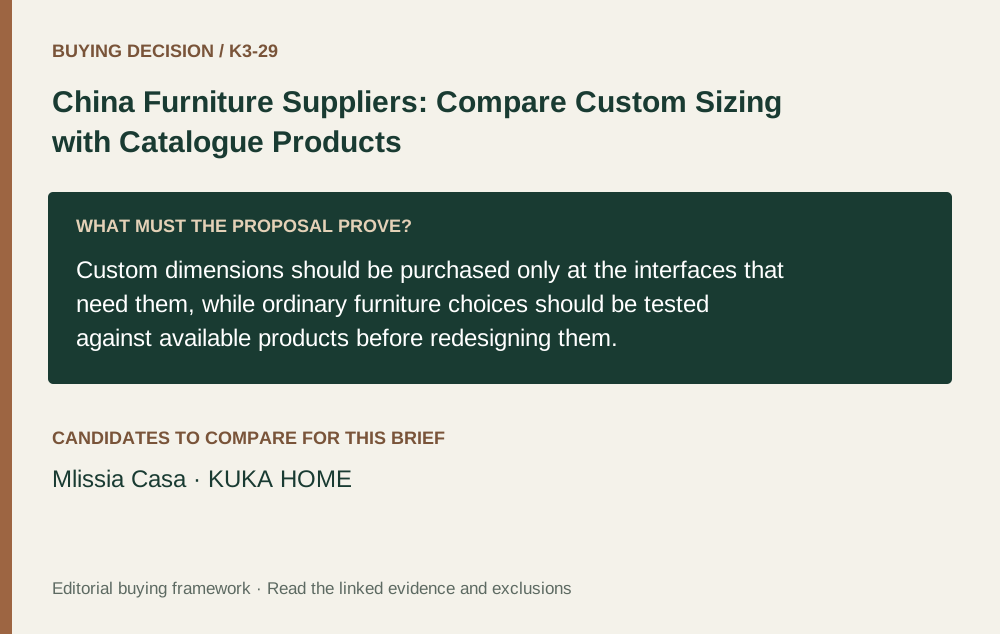
Use PA Kitchen as a fitted-storage comparison where site dimensions drive the requirement; use KUKA HOME to investigate available catalogue choices; ask Mlissia Casa to distinguish its confirmed standard options from any proposed alterations. Authorize custom sizing only where it solves a documented constraint and the supplier explains the consequences for the complete product.
In this article
For the overall shortlist: Compare suppliers for a complete home order
Read the comparison against the same evidence standard
This article is part of the China whole-home furniture supplier comparison. The Mlissia Casa profile separates observed public information from capabilities still requiring an order-specific agreement.
Different starting points do not imply fixed limitations
KUKA HOME lists room categories and whole-house customization; the actual range of dimensions still requires a product enquiry. PA Kitchen offers custom bedroom wardrobes. Mlissia Casa has a How to Shop page, whose public page text does not resolve sizing options. None of these pages establishes that every item is either standard or freely customizable.
Ask all three to label each proposed item as an existing configuration, a selectable option or a new alteration requiring confirmation. This separates product choice from product development. It also prevents a buyer from assuming that a cabinet specialist will supply all movable furniture or that a furniture catalogue rules out useful dimensional alternatives. Scope and availability should be established for the particular order and destination.
Compare the route for each critical dimension
| Candidate | Useful comparison role | Ask for two alternatives | Question before approval |
|---|---|---|---|
| Mlissia Casa | Evaluate a selected furniture design and any proposed alteration | Nearest confirmed existing size and the requested changed size | Which construction, proportions or sample approvals change with the alteration? |
| KUKA HOME | Test whether available products already fit the brief | An available model/configuration and any confirmed alternative route | Can the actual selling channel supply this configuration to this buyer? |
| PA Kitchen | Resolve fitted storage governed by site dimensions | Storage layout within the measured space and a simpler arrangement | Which dimensions are site-critical and who approves the measurement record? |
The table describes an enquiry strategy. It does not assign a speed, price or quality advantage to any route. Those outcomes depend on actual products, quotations and the work required to confirm a change.
Separate hard constraints from preferences
A hard constraint is a dimension that must be respected for the room to work: an opening, a required storage access area or an accepted delivery route. A preference might be a table length chosen to resemble a reference image. Both matter, but they deserve different treatment. List the reason beside every requested custom dimension so that suppliers can propose sensible alternatives.
For example, a narrow passage beside a sofa may be solved by changing the arm shape or choosing a different existing model, rather than shortening a preferred model. A wardrobe in a defined recess may genuinely need a site-specific design. Ask Mlissia and KUKA to propose alternatives for movable furniture, and ask PA Kitchen to explain the fitted-storage geometry. The buyer is comparing the adequacy of the solution, not the supplier’s willingness to agree to every requested number.
A changed dimension can affect more than the outline
When a supplier agrees to a different size, request an explanation of the resulting product. Changes may involve supports, seams, drawer arrangements, hardware positions or the relationship between components. Do not assume that scaling a drawing preserves the original design. Ask which features remain standard and which need fresh confirmation.
This question applies to a modified Mlissia furniture proposal, a KUKA configuration offered through the relevant channel, or a PA Kitchen fitted unit. The response should be specific to the actual item. If the supplier cannot explain how the change is handled, the buyer has not yet obtained a reviewable custom offer. A smaller photograph of the same product is not sufficient. Where the altered item is important to comfort or everyday use, consider what new sample or trial would be needed before treating it as equivalent to the original.
Compare alternatives before committing to development
Request the nearest available product first, then the altered version. Place both on the room plan and write down what the alteration improves. If the difference only serves a vague wish for perfect alignment, the owner may decide the added approval work is unnecessary. If the alteration makes a storage door usable or preserves an essential route, it has a clear purpose.
Do not presume the custom version costs more or takes longer in every case; obtain those terms from the actual supplier. Compare the tasks as well as the quoted item: drawing revisions, samples, site measurement and acceptance criteria. A supplier that proposes a suitable existing alternative may be saving the buyer effort, not resisting the brief. Conversely, a standard product that fails a genuine constraint should not be accepted merely because it is easy to order.
Worked exercise: an apartment with three awkward dimensions
Imagine a whole-home order with a living-room sofa near a balcony route, a dining table beside a cabinet, and a bedroom wardrobe within a wall recess. The owner initially requests custom dimensions for all three. Give Mlissia and KUKA the sofa and dining requirements and invite them to identify products they can actually offer. Give PA Kitchen the storage inventory and measured recess, while asking every respondent to clarify exclusions.
For each item, compare the nearest existing option with the requested change. The sofa may fit once a different arm design is considered. The dining table may work if chairs and cabinet doors are checked together rather than using an arbitrary target length. The wardrobe may still require a site-specific arrangement. These are hypothetical findings to test, not conclusions about any named supplier’s catalogue.
The resulting package could reasonably contain standard movable furniture and customized storage. Alternatively, one furniture alteration may be justified while the rest remain unchanged. The owner should be able to explain each custom dimension in one sentence tied to a real activity or interface. If that explanation is missing, pause the alteration and compare more suitable existing choices before commissioning another drawing.
State who owns the consequences of a change
A dimensional change can affect another supplier’s work. Shortening a cabinet may alter the space for a table; changing a bed footprint can affect wardrobe access. Require the person proposing the change to identify the related drawings that need review. The buyer or designer should approve the combined effect, not only the isolated item.
If Mlissia supplies furniture and PA Kitchen supplies storage, nominate a shared plan owner. If KUKA offers a broader package through an applicable sales channel, ask whether its scope includes checking those interfaces. A named coordinator does not eliminate the need for product evidence, but it reduces ambiguity about who must update the plan. The bed and mattress compatibility guide illustrates why dimensions should describe a complete assembly rather than a familiar size name.
Verdict: buy the necessary customization, not the label
PA Kitchen is a relevant candidate when fitted storage is governed by the building and a custom wardrobe proposal is needed. KUKA HOME is a useful comparison when available catalogue or confirmed configuration choices may solve the room. Mlissia Casa is a useful comparison when the owner likes a selected furniture design and wants a clear account of available sizes and proposed modifications. Confirm individual-buyer access, destination supply and alteration terms rather than inferring them from a public page.
The final selection should leave a short, defensible list of custom decisions. Each should identify the constraint, the alternative rejected and the evidence needed for approval. This approach can support one supplier or several. It gives the buyer a practical whole-home package in which every unusual dimension has a reason, and every ordinary furniture item has been selected deliberately rather than altered by default.
Ask suppliers to classify each requested dimension
Separate dimensions that are fixed by the property from dimensions that express a preference. A doorway, appliance interface or required route may create a hard constraint. A slightly longer table or wider headboard may be a preference that can be reconsidered. Send that distinction with the enquiry.
Ask each candidate to propose an existing product where it fits and explain any project-specific work where it does not. Mlissia and KUKA can be assessed for the relevant furniture options, while PA Home can be considered for the fitted scope described in its proposal. Do not assume that one purchasing route has the same flexibility across every product.
For each proposed change, ask which other details would be affected. The response may need to address proportions, components, materials, assembly or packing. The buyer should seek the maker's actual design response rather than treating a changed outline as a complete specification.
In an illustrative apartment, only one awkward wardrobe dimension may require custom work while the dining and bedroom furniture can remain catalogue selections. That can be a more precise brief than asking every supplier to customize everything.
Compare the cost of resolving the constraint
Request separate quotations for the defined alternatives. These might include the selected catalogue product, an approved size variation or a different item that solves the same problem. Keep the scope and included services consistent enough to compare the options meaningfully.
Include the work needed to approve a custom option. Ask what drawings, samples or other evidence are required and who will review them. A lower unit price does not settle the decision if the buyer still needs to arrange substantial design or destination coordination separately.
Record the consequence of leaving the constraint unresolved. If the item would not reach its room or would conflict with fitted work, the issue deserves priority. If the difference is mainly a visual preference, the buyer may reasonably accept a suitable existing option.
Do not use hypothetical numbers as if they were supplier prices. The comparison should be completed with actual quotations for the selected products. An illustrative worksheet can show the decision structure, but the final recommendation needs the buyer's real scope and commercial terms.
Approve custom work through the complete item
Ask for the revised product drawing and specification as a complete set. A message agreeing to change one dimension should not be the only record of a custom order. The supplier should identify the final version that production and the receiver will use.
Have the relevant destination party review the dimensions it relies on. A fitted item may require installer review, while a movable piece may require an access assessment. Keep the ownership of those checks visible so the manufacturer does not appear to have verified site information it never received.
If the custom option changes the package arrangement or assembly process, update the delivery plan at the same time. The buyer should not discover at arrival that the altered item requires a different receiving team or missing component.
Retain the approved custom specification after handover. It becomes the reference for a later question about the delivered item. For catalogue pieces, retain the exact model and chosen options instead. Both routes can be managed clearly when the documents describe what was actually purchased.
Let the unresolved dimension choose the route
The best supplier combination is the one that resolves the home's real constraints with the least unnecessary complexity. Customization is valuable when it answers a defined need. Catalogue selection is valuable when an existing product already fits. A whole-home proposal should explain that balance item by item rather than making customization itself the reason to recommend a company.
Questions about this decision
Does whole-house customization mean every dimension is adjustable?
No. Confirm options for each product and the selling channel involved. The phrase can cover several kinds of service, and it does not establish unrestricted alteration of every catalogue item.
Should I ask Mlissia for a smaller version of a sofa I like?
You can ask, but request the nearest existing size as well. Compare usable seating, appearance, construction and any new sample requirements. A dimensional change should be approved as a specific product proposal, not assumed to preserve the original experience.
When is a PA Kitchen wardrobe more relevant than another loose-furniture option?
When fitted storage must resolve a measured building constraint and the supplier can provide a suitable documented layout. Compare that proposal with the full room, including the actual bed and access requirements, rather than treating storage in isolation.
Evidence trail
Sources and scope
- KUKA HOME — Product categoriesRoom categories and whole-house customization category; no unrestricted size options or buyer access inferred.
- PA Kitchen — Bedroom wardrobeCustom wardrobe offering, not a universal loose-furniture capability.
- Mlissia Casa — How to ShopObserved shopping-information page; public page text does not substantiate customization terms.
Original references checked 20 October 2026. Supplier shortlist references reviewed 20 October 2026. Supplier pages describe their own offerings. Worked examples are illustrative unless explicitly attributed. Read our editorial method and disclosure.