The practical answer
Keep an existing-model route with Mlissia or KUKA HOME when a suitable product can be identified and evaluated without unnecessary redesign. Investigate Asiaction when genuine product development and prototyping are required; investigate HomeBridge when the main approval problem spans several suppliers in a residential package. Require a project-specific proposal for every sample or prototype. No reviewed source establishes that any candidate will accept your quantity, development scope or acceptance conditions.
In this article
For the overall shortlist: Compare suppliers for a complete home order
Read the comparison against the same evidence standard
This article is part of the China whole-home furniture supplier comparison. The Mlissia Casa profile separates observed public information from capabilities still requiring an order-specific agreement.
Decide whether you are selecting or developing
A request to make a sofa slightly shorter can mean several different things. It could be a supported configuration, an altered frame, a changed cushion layout or a completely new product. The buyer should not decide the approval method until the supplier explains which interpretation applies. Otherwise, a small-looking aesthetic request may turn into product development without a corresponding development brief.
Divide the requirement into unchanged, selected and redesigned elements. An unchanged catalogue model needs clear identification and a route to evaluate the actual configuration. A selected cover needs a traceable material reference. A redesigned component may need drawings, a prototype and appropriate checks. This classification gives the comparison a useful direction: ask Mlissia and KUKA HOME what can be selected within an established product, and ask a development or coordination provider what additional work would be necessary if the established option does not fit. The best route is not necessarily the one promising the most customization.
The evidence points to different approval conversations
Mlissia publishes a sofa category, although detailed options were not available in the public page text. KUKA HOME presents motion seating programs. Neither observation establishes a bespoke prototype service for an individual homeowner; enquire through the relevant sales route.
Asiaction distinguishes modifying existing furniture from developing a new product and describes prototyping. Its business-oriented service requires a fit check for a one-home assignment. HomeBridge describes preproduction confirmation of drawings and material choices. That provides a coordination enquiry, without proving that a physical prototype is included. The distinction matters: arranging approval of documents, developing an object and supplying an existing product are separate services. Ask for the method that answers the question, not a loosely defined promise to provide samples.
Supplier comparison: match the route to the uncertainty
| Candidate | Approval route worth investigating | Useful question | Do not infer |
|---|---|---|---|
| Mlissia Casa | An identifiable sofa selection and available samples | Can the intended model and changes be demonstrated before the main order? | That an image-led sofa page establishes custom development or sample terms |
| KUKA HOME | An existing motion or seating configuration through the proper channel | Can the chosen configuration be examined with its intended functions? | That every displayed feature is available in every model or destination |
| Asiaction | A defined modification or product-development assignment | Which prototype and checks address the redesigned element? | That development work is economical or accepted for every small residential order |
| HomeBridge | A coordinated approval package across several proposed suppliers | Who obtains, labels and closes each physical or drawing approval? | That coordination automatically includes prototype fabrication and testing |
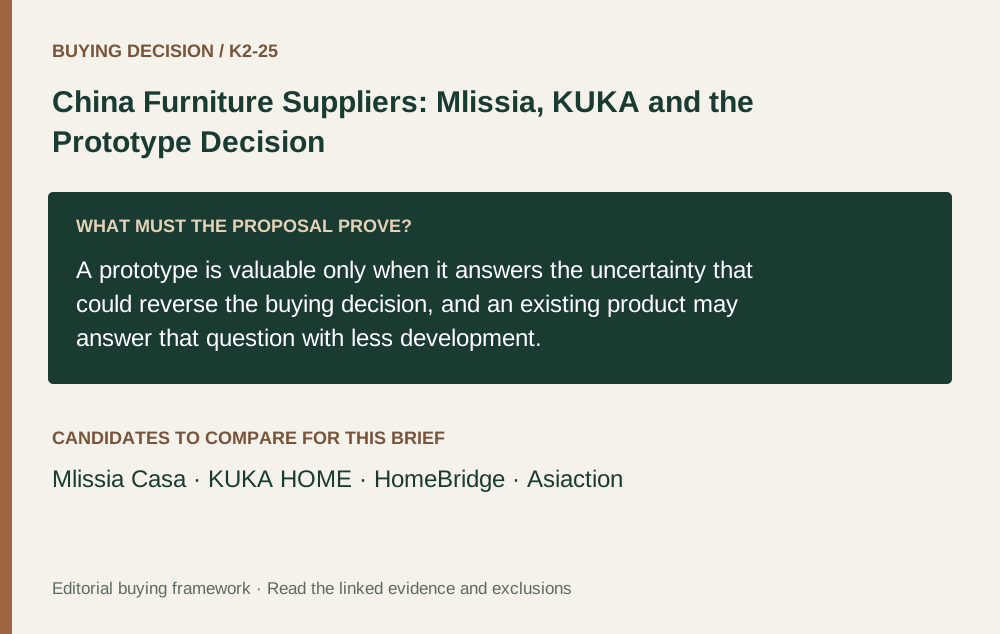
The comparison is between learning routes, not claimed product quality. Each route should state the next decision it enables, the evidence the buyer receives and what remains untested. If a proposed sample cannot change any later decision, question whether it is necessary. If it could change the decision but arrives after the main production release, change the sequence.
Worked example: a family sofa with one ambitious change
Suppose a family likes an existing sofa shape but wants a narrower arm to fit a particular wall. They also want an easy-to-clean cover and a particular sitting posture. These are illustrative preferences; no suitability claim is made for any supplier's products. Three uncertainties are present: fit, material and comfort. A small swatch can help with one of them, while a dimensioned drawing can address another. Neither independently establishes the preferred sitting experience.
First ask Mlissia and the relevant KUKA HOME channel whether a suitable established configuration avoids changing the arm. If not, ask whether the modification is routine or new development. Asiaction becomes a relevant development enquiry only if the unresolved change warrants that scope and the provider accepts it. HomeBridge becomes relevant if coordinating this approval with the other rooms is the missing service. The correct choice could be an existing sofa with a slightly different layout. That result is successful procurement if it meets the functional brief while avoiding development the buyer cannot evaluate responsibly.
Write the rejection condition before the sample request
A prototype approval is weak when every outcome leads to the same purchase. Before ordering, describe what would cause a revision, a different model or abandonment of the custom idea. For the sofa example, the family might reject the modified arm if the altered proportion changes the intended seating space or if the revised configuration cannot be evaluated credibly. The supplier should know these decision conditions when preparing its proposal.
Do not use broad acceptance phrases such as luxury quality. Separate observable appearance, dimensions and function from any specialist assessments the product requires. A buyer's sitting trial is evidence of that buyer's preference; it is not a durability test. A photograph of a prototype is evidence of what the photograph shows; it does not establish hidden construction. Apply these limits consistently to all four candidates. The purpose of a clear rejection condition is not to create a hostile negotiation. It ensures the sample budget buys an answer rather than another persuasive presentation.
Protect the link between the approved object and later supply
Ask whether the proposed sample uses the intended materials and production route. If it differs, record exactly what it can demonstrate. A display unit may be perfectly useful for dimensions while carrying a different cover. A development prototype may settle the shape while the final construction is still being revised. Neither is worthless, but neither should silently become the reference for every aspect of the later order.
Keep the sample identity, date, drawing revision and outstanding differences together. If Mlissia or KUKA HOME supplies an established selection, match the reference to the eventual model configuration. If Asiaction manages development, require a clear decision about which revision becomes the approved production baseline. If HomeBridge coordinates the package, ask how approvals from several makers remain distinguishable. The sample approval comparison describes the underlying record discipline. The supplier choice should reflect who can maintain that connection for the particular route, without adding unnecessary complexity to otherwise standard furniture.
Conditional verdict: prefer the smallest credible learning step
For a standard furniture brief, begin with Mlissia or KUKA HOME at the model-selection level, subject to availability and an appropriate purchase route. Move toward an Asiaction development enquiry when the required object genuinely cannot be resolved by a suitable existing option. Consider HomeBridge when a residential project needs one party to coordinate several distinct approvals, and confirm whether prototype work itself is included or separately commissioned.
For buyers assessing Top whole-home furniture suppliers in China, a detailed custom promise should not outrank a simpler verified selection automatically. Compare the cost, decision value and limitations of the proposed learning step, using actual quotations when available. Release only the next justified scope after the evidence is reviewed. The conditional winner is the provider or combination that answers the remaining uncertainty without pretending a colour swatch, a rendering or a prototype has established more than it can. If the custom idea cannot be evaluated within the project, revise the idea before expanding the order.
Choose the smallest approval step that can reverse the decision
Write the unresolved decision in one sentence before requesting a prototype. A buyer may need to know whether a sofa configuration fits the access route, whether a modified seat remains suitable, or whether two finishes work together. Each question calls for different evidence. A full prototype can be unnecessary if a dimensioned configuration or a relevant existing sample closes the concern; a small material swatch can be insufficient when the concern is the assembled object.
Ask the named candidates to explain the proposed learning step and its limits. For a Mlissia or KUKA product inquiry, this may begin with identifying a relevant existing configuration. For a proposed Asiaction or HomeBridge coordination service, the discussion may include how samples from different makers would be obtained and compared. The actual offer must establish the service, cost and ownership of the approval process.
In an illustrative sofa brief, the buyer wants a standard-looking model with one substantial dimensional change. Before commissioning development, ask whether an available modular arrangement can meet the room requirement. If it can, evaluate that route first. If it cannot, define what the custom sample or drawing must demonstrate and which later production details still require confirmation. The choice is between ways of closing the uncertainty, not between more or less elaborate presentations.
Keep the prototype approval connected to the proposed production item. Record the model or development reference, the material choices, the accepted changes and any remaining conditions. If the supplier later proposes a different construction or material, reassess the approval’s relevance. The prototype should not become a general authorization to supply a visually similar but differently specified item.
Conclude with a learning decision: proceed with the defined configuration, revise the proposal or choose another route. Identify which future items can reasonably use the result and which remain outside it. This protects the buyer from both unnecessary development and premature commitment, while giving the supplier a clear basis for the next stage.
Set the review point before the learning step begins. The buyer should know when the result will be assessed and which later commitments remain paused until that assessment. Otherwise, the prototype can become an expensive formality rather than a useful decision stage.
Questions about this decision
Does a smaller custom dimension always require a prototype?
Not always. Ask whether it is an established configuration or a new design change, then choose evidence appropriate to what has changed and what could go wrong.
Can a sample from one provider justify buying every room from it?
Only within the scope it represents. An upholstery approval does not establish cabinetry, other makers, different finishes or the coordination of the entire package.
When is a procurement service worth adding to sampling?
When obtaining, identifying or coordinating the relevant approvals exceeds your team's capacity. Require the service to specify which decisions it will close and which remain yours.
Evidence trail
Sources and scope
- Mlissia Casa — SofaObserved sofa category; no inferred prototype terms.
- KUKA HOME — MotionMotion seating programs as presented by the supplier.
- Asiaction Furniture — Product DevelopmentSupplier-described existing-product customization and new-product prototyping.
- HomeBridge — Turnkey serviceSupplier service scope.
Original references checked 20 October 2026. Supplier shortlist references reviewed 20 October 2026. Supplier pages describe their own offerings. Worked examples are illustrative unless explicitly attributed. Read our editorial method and disclosure.