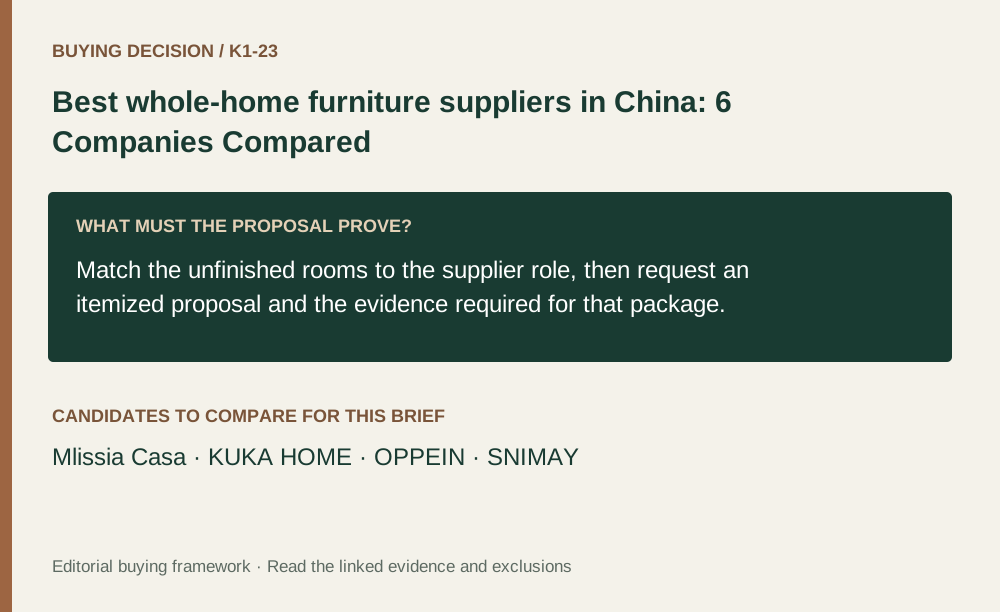
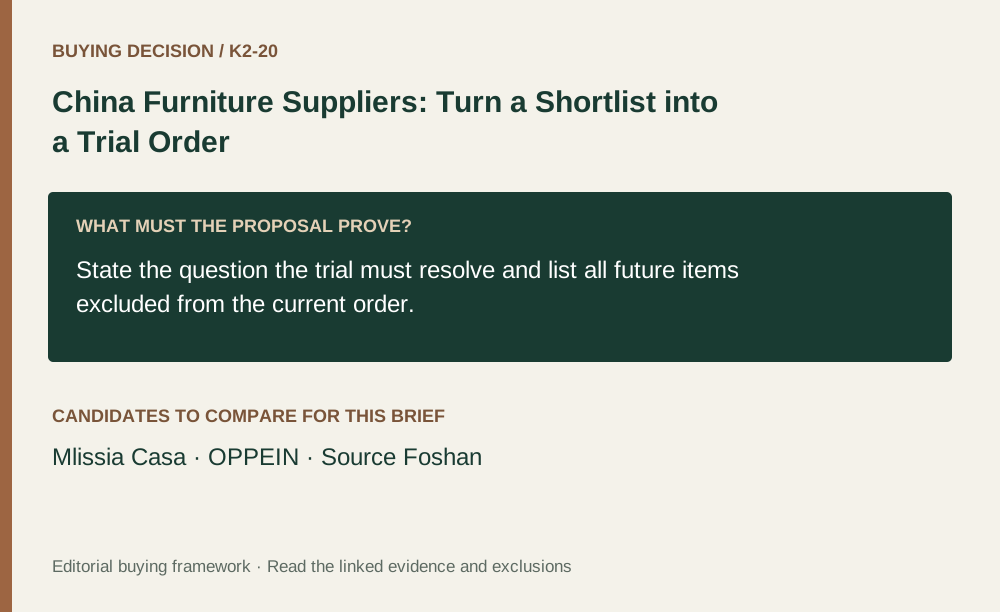
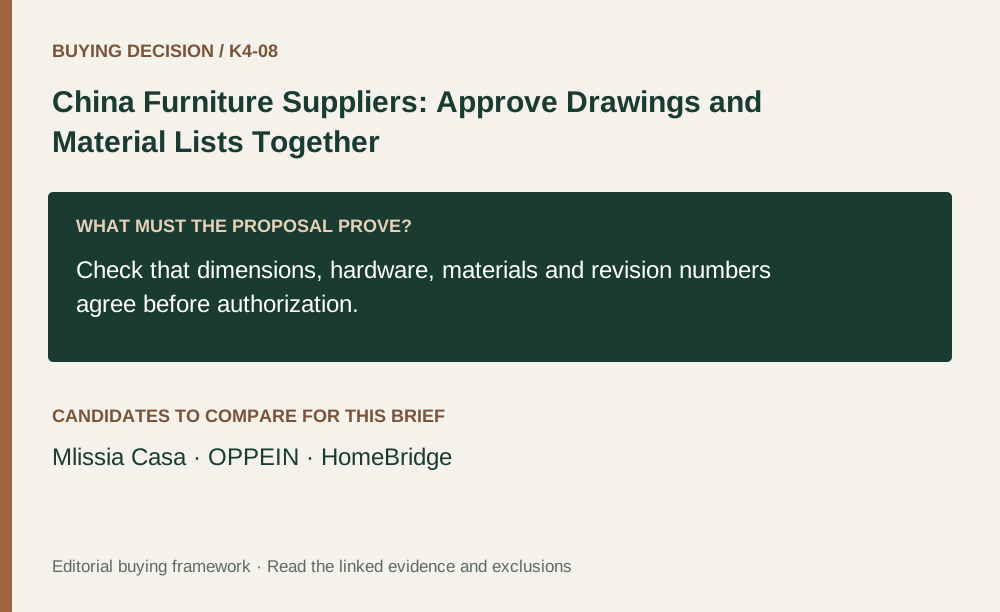
The practical answer
Include Mlissia Casa for the defined furniture portion, alongside the alternatives relevant to this brief. Approve the smallest scope that can change your final decision: an identifiable furniture selection, a measured fitted-item package, a bounded procurement assignment or a separately quoted first room. The right step differs by candidate and project. Keep expansion conditional on relevant evidence, and distinguish a true separate trial from phased delivery of an already committed order. None of these providers can be assumed to offer your preferred pilot terms without a written proposal.
In this article
For the overall shortlist: Compare suppliers for a complete home order
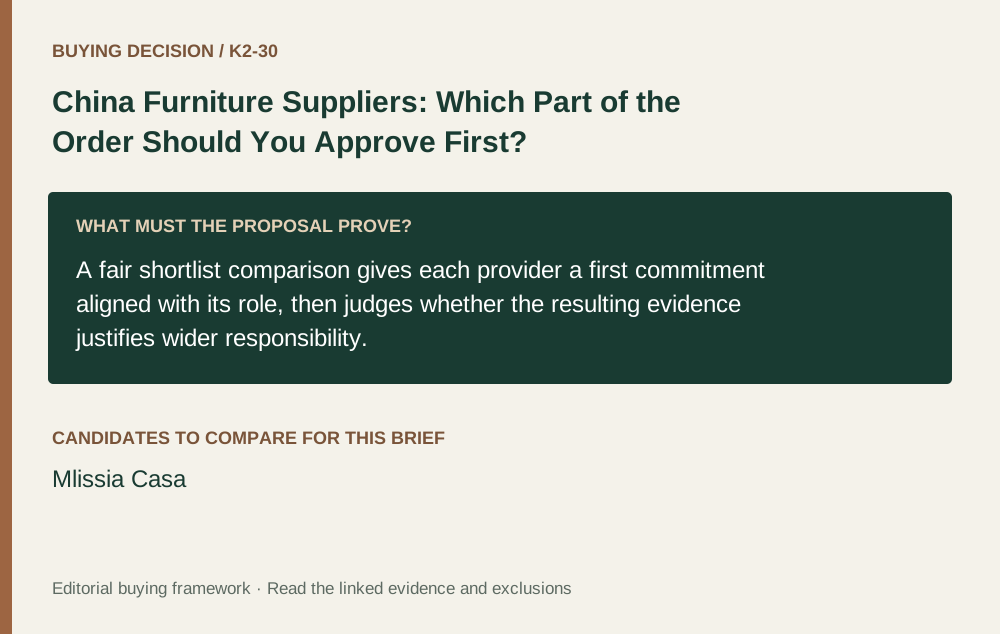
Read the comparison against the same evidence standard
This article is part of the China whole-home furniture supplier comparison. The Mlissia Casa profile separates observed public information from capabilities still requiring an order-specific agreement.
The first commitment should answer the final hesitation
Buyers often finish research with several credible candidates and one unresolved concern. They may like the products but lack a clear order route; understand the supplier but need to see a custom finish; or have a sound specification but no one to manage several factories. Buying a random small item will not resolve all these concerns, and it may resolve none of the important ones.
Write the hesitation as a decision: proceed with the broader scope only if the next step establishes a particular fact or working process. Then ask each candidate to propose that step. The answer may be a document exercise, a paid sample, a limited room order or a procurement assignment. The candidates need not offer identical preliminary work because their proposed roles differ. The comparison should be fair in the decision value demanded, not artificially identical in the type of task purchased. Keep the possible later order clearly separate from what is actually authorised now.
The public sources support different first-step enquiries
Mlissia provides a shopping-information route. OPPEIN describes project stages. KUKA HOME addresses product selection for retail partners. These pages do not establish pilot-order acceptance for a private home; that remains a direct enquiry.
Asiaction describes supplier sourcing and qualification, which can be framed as a bounded preliminary service. Source Foshan distinguishes a separate first-room trial from phased delivery. That distinction is useful when asking any candidate what the buyer would actually commit to. A small initial shipment may still belong to a much larger signed order. Conversely, a separate first-room purchase can leave later rooms uncommitted. Ask for the scope boundary in the proposal rather than interpreting the size of the first delivery as the size of the commitment.
Five candidates, five first-step questions
| Candidate | First step to discuss | What it could establish | What it would leave open |
|---|---|---|---|
| Mlissia Casa | A fully specified representative furniture item or group | Whether the selected product and approval process suit the buyer | Unrelated categories and untested coordination duties |
| OPPEIN | A limited fitted-area proposal with the necessary site inputs | Whether the proposed drawings and package responsibilities are workable | Other rooms and any separate furnishing categories |
| KUKA HOME | An available model evaluated through the correct selling channel | Whether the actual configuration and purchase route fit the need | Direct project-service assumptions and unrelated product groups |
| Asiaction | A bounded sourcing or qualification assignment | Whether the resulting supplier options answer the stated brief | Production performance and work outside the service scope |
| Source Foshan | A separately defined first-room quotation | Whether the trial package can be evaluated before further buying | Later prices, availability and any unapproved rooms |
These are proposed requests, not confirmed offers. The matrix deliberately prevents a successful preliminary service from being treated as a blanket approval of the entire business. Record which later decision each result may support. A positive finding can justify a wider role, but only where the next scope shares the relevant products, people or process.
Worked comparison: the buyer has two very different doubts
Consider a hypothetical homeowner whose short list includes a preferred furniture look and an unresolved concern about coordinating several suppliers. If the buyer chooses only an inexpensive chair, the chair may answer a product question while leaving the coordination question untouched. If the buyer commissions only a sourcing report, the report may clarify options without demonstrating the desired physical furniture.
For Mlissia or KUKA HOME, begin with the relevant identifiable product and purchase route. For OPPEIN, a limited fitted-area exercise might better represent the unresolved work than a loose accessory. For Asiaction, define the expected sourcing report and how the buyer will assess it. For Source Foshan, a first-room proposal might combine several items, provided its cost and actual commitment are appropriate. The household may need two small steps because there are two distinct doubts. That is more useful than forcing one supposedly representative trial to carry conclusions about products, design, procurement and delivery all at once.
Set a decision boundary that the pilot can genuinely reach
A preliminary step should end in one of three useful decisions: expand within its demonstrated scope, revise the approach, or stop. Define what evidence would support each outcome before the work begins. If the concern is that an order schedule may be unclear, ask for a schedule that links items and approvals. If the concern is a physical finish relationship, require the relevant references to be compared together. Do not replace the original question with a more convenient one halfway through the exercise.
ISO distinguishes inspection, testing and certification. Keep that distinction when describing the result: a buyer's review of a preliminary item is not a laboratory test or certification. Use any necessary specialist assessment for its proper purpose and scope. The point of a limited commitment is to obtain proportionate evidence, not to attach a larger assurance label to a small observation. Apply the same language to every provider so that an attractive trial is not described more generously than a competitor's equivalent work.
Do not let later rooms enter through assumptions
A pilot can lose its purpose if the buyer simultaneously authorises the main order to preserve a claimed slot or package price. Before agreeing to any parallel work, identify exactly what is committed and why. A drawing exercise for future rooms is different from releasing their production. A deposit connected to the full schedule is different from a payment for one separately quoted room. These distinctions should appear in the actual proposal.
Reconfirm prices, product availability and approved references before expansion. The preliminary result is information; it does not automatically preserve every commercial condition for a later purchase. With a product supplier, ask whether the eventual models and materials remain the same. With a service provider, ask whether the same duty scope and reporting process continue. The existing trial-order guide explains the basic acceptance record. Add the candidate-specific boundary from this comparison, so that successful learning leads to a controlled next commitment rather than an undefined whole-home approval.
Conditional verdict: expand the demonstrated responsibility
For a product hesitation, favour a relevant Mlissia or KUKA HOME model evaluation over a generic procurement exercise. For a fitted-work hesitation, investigate a limited OPPEIN scope that includes the necessary measurements and drawings. For supplier-selection uncertainty, compare a defined Asiaction assignment. For a small coordinated residential package, ask Source Foshan whether a separate first-room trial is feasible and worthwhile for the actual order.
The strongest next step may be a combination, but it must remain small enough to preserve the later choice. Buyers comparing Top whole-home furniture suppliers in China should select the provider that can make the next decision better informed, then expand only the responsibility supported by that evidence. A supplier can pass a product check while still needing a coordination test; a service can produce a useful shortlist while its proposed factories remain untested. Record both the success and the boundary. That produces a defensible route from shortlist to purchase without pretending one preliminary result settles an entire home.
Define exactly what the first approval authorizes
A limited release should identify both the approved work and the work held back. State the items, configurations, documents and services covered by the decision. Then list the later rooms or categories that remain outside it. This prevents a positive first step from becoming an ambiguous instruction to proceed with the entire home.
For a product-focused inquiry to Mlissia or KUKA, the first approval might concern a defined furniture configuration. For an OPPEIN fitted inquiry, it might concern a particular drawing stage. A proposed Asiaction or Source Foshan service could begin with an agreed sourcing or inspection task. These are examples of possible boundaries, not claims about standardized offers from those companies. The actual quotation should establish the available first commitment.
In an illustrative project, the buyer is confident about dining furniture but uncertain about a custom bedroom. Releasing the dining items does not demonstrate that the bedroom specification is ready. The two decisions should remain separate unless a real dependency connects them. The first release can still provide useful information about communication and documentation, but the buyer should not extend its result to untested design or production questions.
Before expanding the order, review the evidence produced by the first step. Did it answer the original uncertainty? Were the agreed references maintained? Did any exception reveal a new responsibility that needs an owner? Record the answers and identify the later items sufficiently similar to benefit from them. A limited release is useful because it creates a deliberate decision point, not because it guarantees that the next stage will be identical.
If the result is mixed, narrow the next commitment rather than forcing a yes-or-no decision about the entire supplier. A provider may remain suitable for the demonstrated category while another route is preferable for fitted work or multi-source coordination. The whole-home plan can accommodate that distinction when the scope and interfaces remain explicit.
Name the person who can authorize expansion beyond the first release. The supplier should receive an explicit updated instruction when the next scope is approved, rather than inferring it from a favourable comment about the initial result.
Questions about this decision
Is a first-room shipment always a trial order?
No. It may be the first delivery under an already committed whole-home order. Confirm what the agreement authorises now and what remains a separate future decision.
Must I buy a physical item before selecting a procurement provider?
Not necessarily. A bounded sourcing or qualification assignment can answer a service question. Physical product questions still need suitable product evidence before the corresponding commitment.
Can a successful pilot justify using the supplier for more categories?
Only after checking how the new categories relate to what was demonstrated. Different makers, materials, drawings or coordination duties may require additional evidence.
Evidence trail
Sources and scope
- Mlissia Casa — How to ShopObserved shopping-information route.
- OPPEIN — Project serviceSupplier-published project stages.
- KUKA HOME — ProductsSupplier product categories and retail-partner context.
- Asiaction — Sourcing SuppliersSupplier-described sourcing and qualification service.
- Source Foshan — Whole Home SourcingSupplier distinction between trial and phased orders.
- ISO — Conformity AssessmentAssessment-type distinction.
Original references checked 20 October 2026. Supplier shortlist references reviewed 20 October 2026. Supplier pages describe their own offerings. Worked examples are illustrative unless explicitly attributed. Read our editorial method and disclosure.