| Public English names | Suofeiya / Sofeyia[1] |
|---|---|
| Company name in site footer | Suofeiya Home Collection Co., Ltd.[1] |
| Principal categories | Kitchens, wardrobes, vanities, doors and loose furniture[2] |
| Named collection | Luna[3] |
| Cases examined | Erbil, Penang and Dubai[4] |
Company, brand and inherited history are separate identifiers
The English-language website uses both Suofeiya and Sofeyia, heads its company page About Suofeiya, and identifies Suofeiya Home Collection Co., Ltd. in its contact footer. Its timeline places the Suofeiya foundation in 2001 and a Shenzhen stock-exchange listing in 2011, while separately referring to SOGAL’s earlier French history.[1][8]
The useful way to read these dates is as separate milestones. Brand heritage, the Chinese company’s development and the name appearing on a commercial document answer different questions. The company’s current position in this observation is custom storage and fitted-home project supply.
Kitchens and wardrobes sit within a wider interior schedule
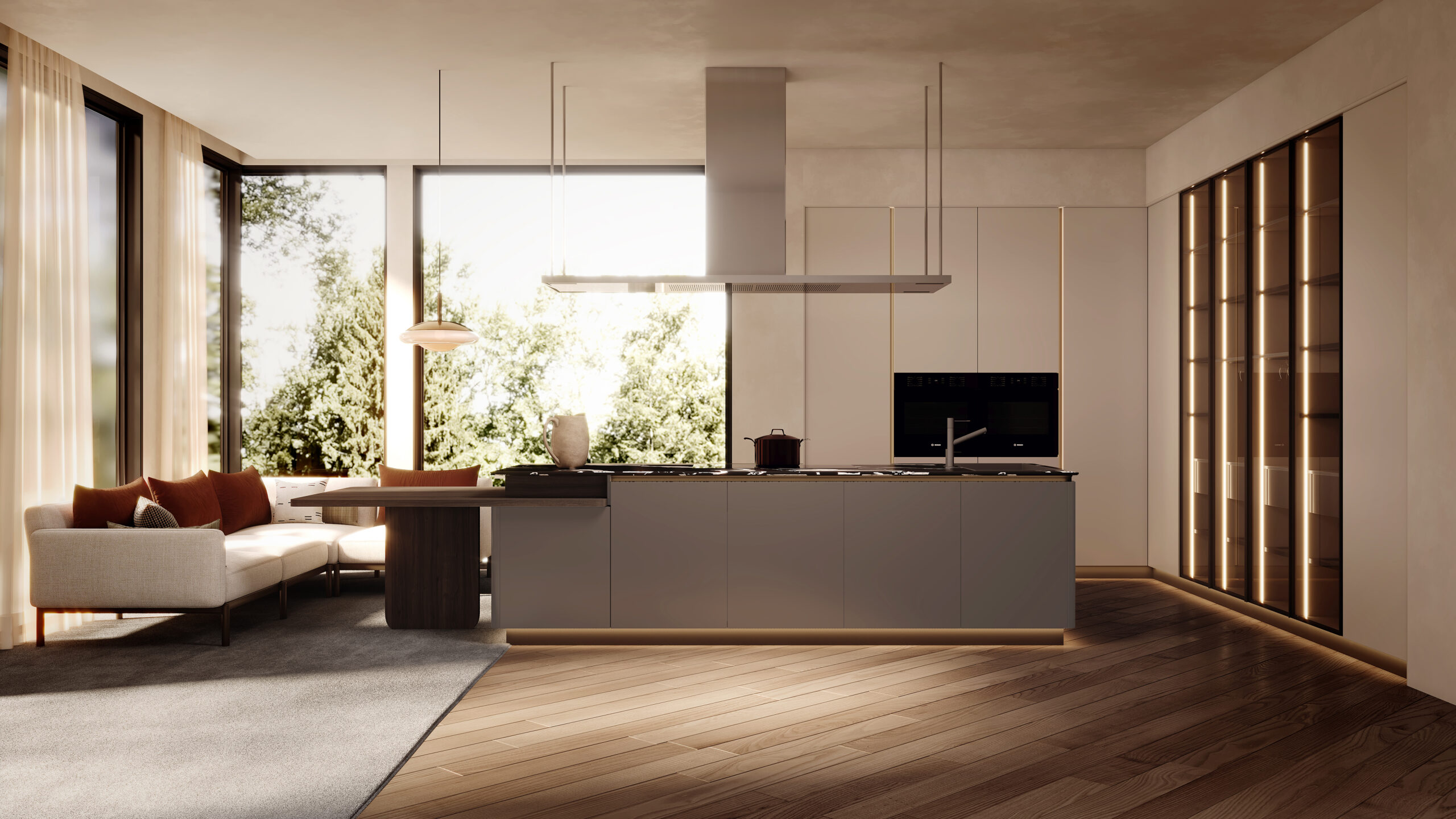
The product navigation groups kitchen cabinets, closets and wardrobes, bathroom vanities, interior doors and loose furniture. The Luna collection supplies a named kitchen reference within that catalogue. Its product page offers a quotation route that connects the collection with the customer’s country, city and project requirements.[3]
The kitchen presentation combines tall storage, an island and glazed cabinetry within one room. A collection reference helps maintain a visual direction, while a project schedule distinguishes the actual cabinet units, surfaces and companion furniture. This is particularly relevant when the same interior scheme is repeated across several rooms.
A panel-processing system underpins customized interiors
The company page presents a national production network and describes finish pressing, automatic cutting, laser and rolling edge banding, drilling, shape carving and automatic sorting. It also describes process verification through its research operation. Those named stages give the manufacturing account a cabinet-specific focus.[1]
For an apartment or hotel schedule, the key relationship is between the room design and the repeatable component set. A finished panel needs to preserve its dimensions, edge treatment and surface reference as it moves from drawing to manufacture. The selected product and its specification provide the useful unit for discussing quality.
Different project scopes can use the same storage expertise
The international project directory is organised by region and by apartments, hotels, villas, healthcare and education settings. The homepage describes design consultation, drawing optimization, technical matching, quality-control support and installation support.[2]
These settings call for different interior packages. An apartment may need kitchens and entry storage; a hotel may combine bedhead panels, sliding doors and bathroom units. The continuity lies in the scheduled joinery and room-specific components. A complete project enquiry becomes more informative when it names those components rather than relying on a broad whole-house label.
Three destinations with identifiable supply scopes
The Cavalli Tower record identifies Erbil, Iraq, an apartment project with 745 rooms and completion in 2024. The stated supply includes kitchen, entrance, laundry and TV cabinets, together with dining tables. This is a specific cabinetry-and-furniture package associated with a named development.[5]
The Millen Hotel Penang page lists 134 rooms and a package including interior sliding doors, bedhead wall panels, kitchens, wardrobes, vanity units and entry cabinets. Its product list shows how the scope changes when the property is a hotel rather than an apartment.[6]
The Dubai high-rise apartment record lists 480 rooms and names kitchen cabinets, bookshelves and aluminium products. Read together, the cases illustrate three supply baskets across Iraq, Malaysia and the UAE; the individual product lists explain the work described for each property.[7]
The enquiry connects collection and commercial project
The Luna and project pages request contact information, country, city, business type, service sought and further project details. Their quotation links make the enquiry a project-specific conversation rather than a single public retail price.[3]
For a repeated-room order, the room type is a useful bridge between the design and the commercial schedule. A kitchen, entrance unit or bedhead panel can be assigned an item reference and related to the relevant room quantity. The resulting offer then connects product choice, project scale and the destination identified by the buyer.
Installation is presented as part of the project service
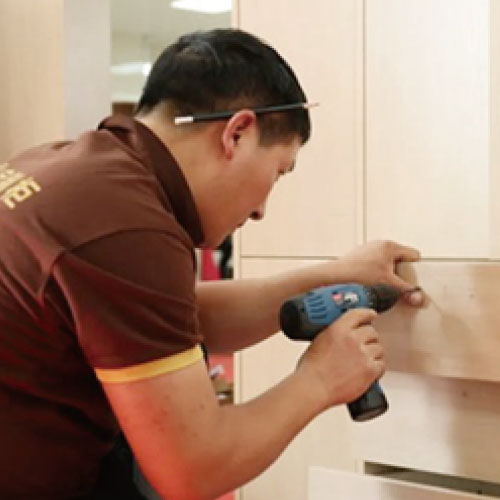
The service overview describes headquarters training and professional installation support, alongside country-focused sales assistance. The company page also depicts an installation worker and a quality-control team within its service presentation.[2]
The published examples make room schedules and product categories central to the delivery discussion. For a new order, those references can carry through the accepted drawings, packing information and installation brief. That gives the destination team a consistent description of the interior package being supplied.
Sources
- Suofeiya / Sofeyia · company and manufacturing Company naming, history, panel processing and installation presentation.
- Suofeiya / Sofeyia · product and service overview Product categories and design, sales, installation and quality-control services.
- Suofeiya / Sofeyia · Luna collection Named collection and enquiry route.
- Suofeiya / Sofeyia · project directory Named international projects and regional project categories.
- Suofeiya / Sofeyia · Cavalli Tower, Erbil 2024 apartment project, 745 rooms and supplied product categories.
- Suofeiya / Sofeyia · Millen Hotel Penang 134-room hotel supply scope.
- Suofeiya / Sofeyia · Dubai apartment tower 480-room tower and named product categories.
- Suofeiya · corporate introduction on sfyhome.com Corporate English name, Guangzhou base, SOGAL introduction in 2001, 2011 listing and cabinetry categories.