| Location | Foshan, Guangdong, China[1] |
|---|---|
| Published history | Evergo Furniture Ltd. established in 2006; Neveitalia series launched in 2014[1] |
| Model example | G2059 modular system[2] |
| Commercial focus | OEM/ODM, wholesale and hospitality upholstery[1] |
A brand history rooted in Foshan upholstery
Neveitalia presents itself as a Foshan upholstered-furniture manufacturer serving wholesalers, retailers, designers and hospitality buyers. Its published timeline identifies Evergo Furniture Ltd. as established in 2006 and dates the launch of the Neveitalia series to 2014. The story follows a sofa-export business developing a branded collection and international buyer relationships.[1]
The customer-facing offer centres on OEM and ODM manufacturing. That gives the brand a different purchasing context from a household retailer: the discussion can involve an importer’s own product specification, a private-label collection or seating and beds for an interior project. The recurring unit is a configurable upholstered model.
A modular collection with identifiable references
The modular-sofa page names G2059 as a modular system, 25126 as an L-shape sectional, G2301 as a cloud sectional, G2302 as a U-shape modular and G2304 as a curved modular. It also presents chaise, corner, compact and sectional configurations under further model references. These names provide a more useful starting point than an undefined request for a contemporary sofa.[2]
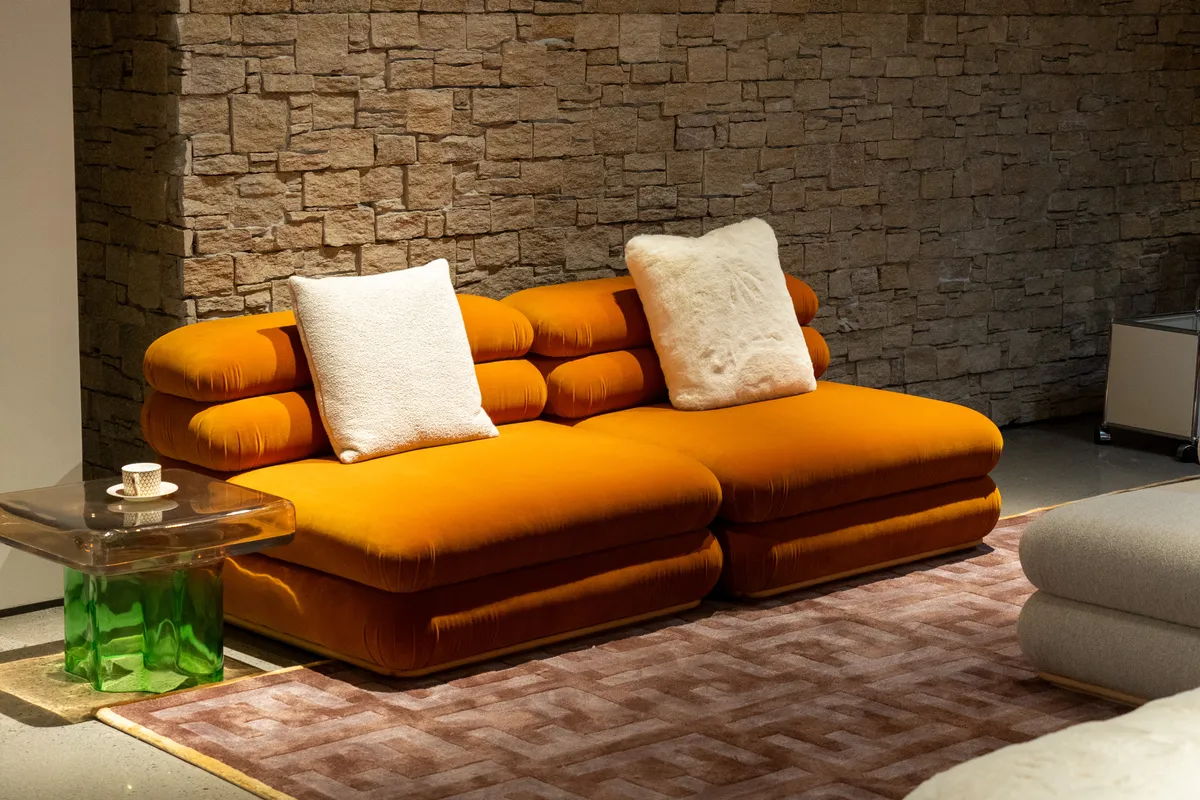
The visible G2059 collection image pairs orange upholstery with cream cushions in a room display. As a catalogue presentation, it shows colour relationships and the outline of the seating composition. Its purchasing value comes when that reference is connected with a particular module combination, approved cover and final dimensions. Neveitalia’s wider navigation also includes armchairs, coffee tables, upholstered beds, dining furniture and mattresses.[2]
Cover, filling, base and size form one specification
The customization page separates fabric and upholstery, foam and comfort, legs and base, dimensions, and packaging or branding. It offers in-house fabrics and customer-supplied material, with choices including linen, boucle, velvet, chenille and leather. The filling discussion includes different foam densities and multi-layer cushion combinations.[3]
These variables affect different parts of the model. A cover changes appearance and surface feel; filling affects the seat construction; the base changes height and visual weight; and a dimensional change alters the fit within a floor plan. Branded cartons, labels and assembly information extend the configuration into the importer’s retail or fulfilment system. This is why the model and the chosen version need to remain linked through sampling.
The sequence from frame to upholstery
The factory workflow describes frame construction followed by foam and suspension, fabric cutting, sewing and upholstery. Its account includes CNC-cut frame components, numbered fabric panels and model-specific suspension choices. The sequence turns the selected design into separate work on structure, filling and the visible cover.[4]
The quality-control presentation adds inspection of incoming timber, foam, fabric and hardware, followed by checks on frame integrity, suspension, foam fit and density. The company says inspection points are recorded photographically and that buyers receive shipment reports. These checkpoints are useful because they relate to identifiable components rather than a single general quality label.[5]
Living and bedroom programmes for export buyers
Neveitalia’s company page records trade-fair appearances in Dubai, Moscow, Guangzhou and Shanghai, including Dubai Index and CIFF. These are published examples of how the business meets international buyers. Its product families connect upholstered seating with bedroom and dining selections, while the commercial presentation repeatedly addresses wholesale and private-label requirements.[1]
A retailer can build a sofa-and-chair programme; a bedroom buyer can work from a bed base and cover; a designer can carry fabric and finish relationships between pieces. The common approach is specification-led furniture selection. Each product keeps its own model and construction, while a shared material palette can connect the rooms.
Specification, sample and production approval
The customization page sets out a sequence of specification, sample, production and delivery. It requests fabric references, foam choice, dimensions, leg style and packing requirements. It describes sample review through photographs, video and dimensional records, followed by sign-off before the production run.[3]
Its published order structure uses quantities per model and configuration and allows different models within a mixed-container programme. The commercial implication is that a colour or construction variant is an orderable version, with its own quantities and sample reference. The accepted version gives subsequent progress photographs, inspection records and carton labels a stable item to refer to.
Packing identification and component-based aftercare
The logistics presentation offers full-container, less-than-container and express or air routes for different order types. It describes protective cartons, foam protection, moisture barriers and labels carrying the purchase-order number, model, colour and carton sequence. Its pre-shipment sequence includes photographs, a piece-count check and loading records.[6]
The wholesale support page differentiates structural, mechanism, foam, seam and workmanship coverage. It describes claims using the purchase-order number, item codes and photographic or video evidence, followed by assessment and a proposed remedy. Replacement components include legs, hardware, cover panels, mechanisms and foam. A component-based route can connect a service question with the original furniture specification.[7]
The resulting industry position is configurable upholstery for a professional buying programme: named seating models, selectable materials, sample approval and order-level documentation continue through packing and aftercare.
Sources
- Neveitalia · company history Published history, location, buyers and trade-fair records.
- Neveitalia · modular sofa collection Named modular models and collection positioning.
- Neveitalia · product customization Cover, foam, base, dimensions, branding, sampling and order configuration.
- Neveitalia · production workflow Frame, filling, cutting, sewing and assembly sequence.
- Neveitalia · quality control Published inspection checkpoints and shipment reporting.
- Neveitalia · shipping and logistics Container options, labels, packing and pre-shipment checks.
- Neveitalia · after-sales support Wholesale warranty categories, claims workflow and replacement components.