The practical answer
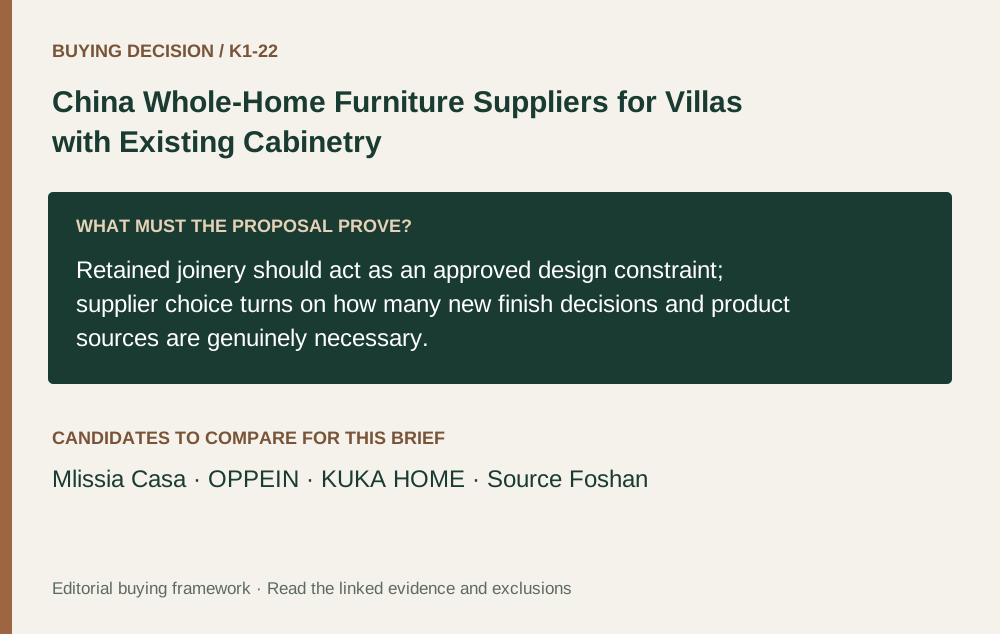
For a villa retaining its joinery, compare Mlissia Casa for a defined furniture collection, KUKA HOME for an upholstery-centered selection and Source Foshan for a designer-directed mix of makers. Keep OPPEIN relevant where remaining fitted work needs integration. Source Foshan is the most natural initial lead for a cross-supplier design schedule; Mlissia Casa or KUKA HOME can be preferable when their selected products resolve the important rooms without a wider sourcing assignment.
In this article
For the overall shortlist: Compare suppliers for a complete home order
Read the comparison against the same evidence standard
This article is part of the China whole-home furniture supplier comparison. The Mlissia Casa profile separates observed public information from capabilities still requiring an order-specific agreement.
A practical shortlist for a villa with its joinery already complete
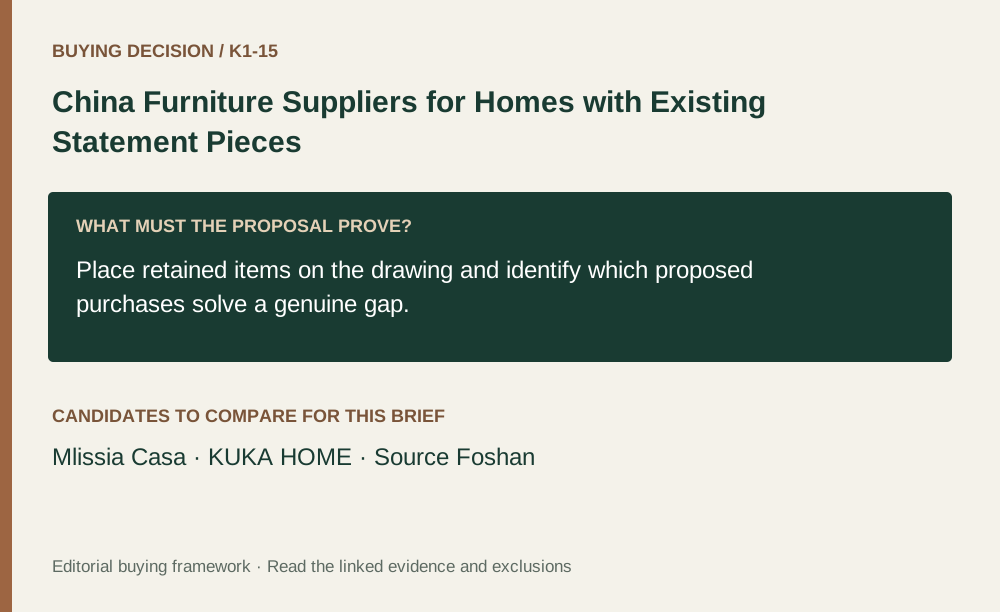
Start the furniture conversation with Mlissia and KUKA when the remaining work is seating and movable pieces. Bring Source Foshan into the comparison if the final selection spans unrelated makers. Keep the existing kitchen, wardrobe and fixed-panel drawings in the brief: a new sofa, dining table or bed still has to clear doors, drawers, walkways and delivery routes.
The first useful deliverable is a scaled layout with each proposed model and its packed dimensions, followed by material samples beside the retained finishes. Do not reopen the entire fitted-interior package merely to make one supplier’s offer look complete. Review Mlissia’s evidence and KUKA’s category and sales-channel scope.
Freeze the fixed palette before inviting new furniture proposals
Treat the installed cabinetry as an accepted design input, even when some details would be different in a new build. Record which surfaces are most visible, which colours dominate and which handles or metal finishes repeat. Do not ask bidders to make every new piece match everything already installed. A quieter table can support an expressive wall cabinet without sharing its exact veneer or hardware.
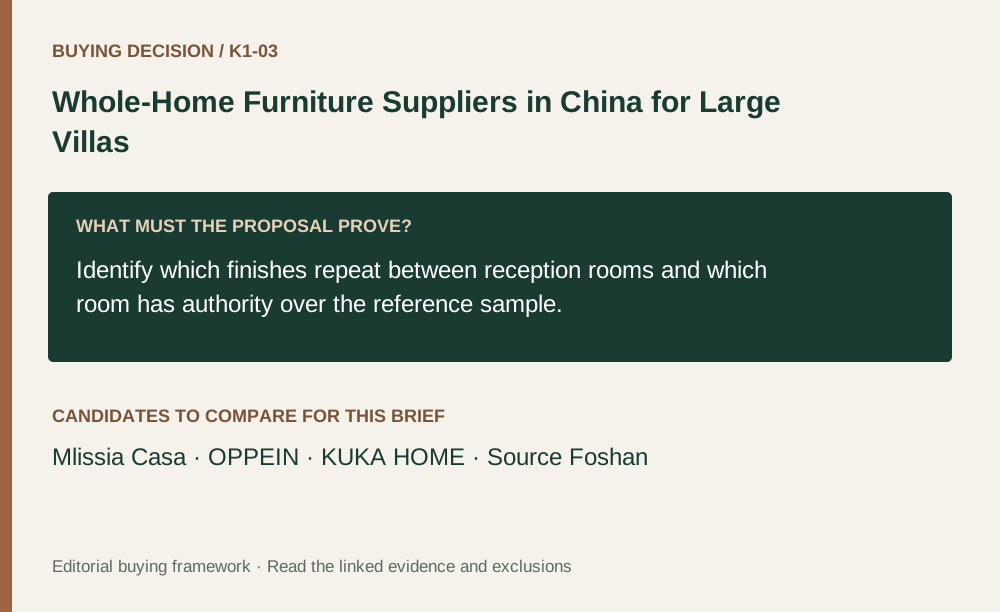
This comparison differs from selecting a supplier for an entirely new villa. The owner already owns the largest visual commitments, so reopening them has a cost in decisions as well as money. Ask each candidate for a furniture-only response with retained elements shown. Use the villa coordination guide for the room hierarchy, then judge bidders on how well they work within that hierarchy.
The evidence supports different invitations
Mlissia Casa publishes an All Products page, but its public page text does not establish specific customization or design services. Invite a selection against the existing palette rather than assuming a turnkey design role. The candidate remains viable if its actual product proposal and samples meet the brief.
KUKA HOME lists stationary and motion upholstery, accent seating and upholstered beds; availability must be checked for the buying market. Source Foshan describes working from designers’ schedules and samples. OPPEIN’s published whole-house example includes fitted and loose categories. These facts establish relevant scopes, while the recommendations below are editorial judgments about this particular retained-joinery scenario.
KUKA HOME’s US contact page describes wholesale supply; household buyers should confirm a suitable retail or trade route.
A matrix for preserving the designer’s decisions
| Provider | Useful role in this villa | What could make it unnecessary | Evidence needed to proceed |
|---|---|---|---|
| Mlissia Casa | Direct candidate for a coherent selected furniture group | A collection that requires changing retained finishes | Actual product schedule and grouped material samples |
| KUKA HOME | Candidate where principal seating drives the new scheme | An upholstery purchase does not resolve every hard-furniture gap | Exact model, configuration and market availability |
| Source Foshan | Coordinator for a mix drawn from a designer’s schedule | Extra sourcing adds little if one accepted collection suffices | A revision-controlled options sheet linked to approved samples |
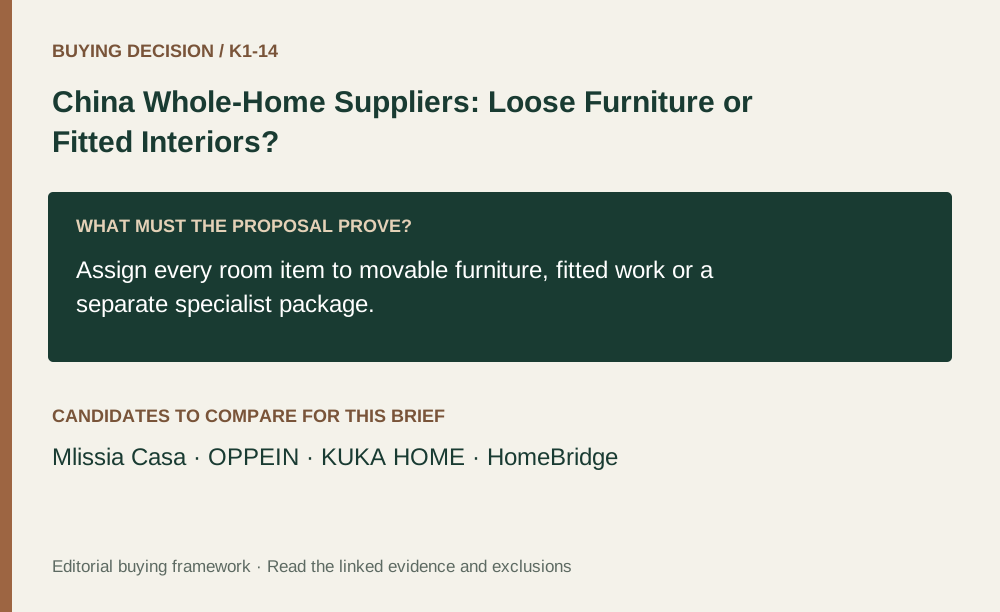
| OPPEIN | Candidate for remaining fitted elements beside retained joinery | Little unresolved fitted work may leave a limited assignment | A drawing that distinguishes retained and new components |
None of these roles is exclusive. The question is whether a provider reduces the remaining design uncertainty. An appealing catalogue is useful evidence of a direction to explore, but it is not evidence that the new furniture will harmonize with actual installed materials.
Compare visual relationships rather than promises to match
Choose three points where old and new will be seen together: the dining table beside a cabinet, the sofa before a paneled wall and the entry console opposite the kitchen. Request a combined sample review at those points. Classify each relationship as deliberate repetition, compatible contrast or unresolved. This is more precise than approving a loosely described warm modern palette across the entire villa.
Mlissia Casa can win a defined group if a small selection produces the desired relationship with little alteration. KUKA HOME can win the seating assignment if the selected upholstery helps the existing architecture recede or stand out as intended. Source Foshan earns a coordination role when the desired result depends on several different makers. OPPEIN becomes more relevant if a new fitted extension, rather than the furniture itself, is the element breaking continuity.
Separate the main seating decision from decorative completeness
In a finished villa, owners may be tempted to award the whole furniture order to whichever presentation supplies the most polished reception-room image. Instead, review the seats used daily before the occasional console and guest-room bench. A sofa can be visually compatible while remaining unsuitable for the people who sit on it. Obtain the exact configuration and a practical route to personal evaluation before treating the image as an approval.
This gives KUKA HOME a clear, bounded comparison with Mlissia Casa: evaluate the proposed seating, not the prestige of their respective websites. Source Foshan can be asked to identify a small number of alternatives rather than overwhelm the owner with options. The local designer should retain authority over how the final seat relates to the fixed background. Neither a manufacturer nor a coordinator should silently alter that background to make its preferred product easier to sell.
Worked exercise: a walnut wall and two incompatible ideas
Imagine an illustrative villa with a substantial walnut media wall, pale flooring and dark kitchen fronts visible from the lounge. One proposed scheme adds a walnut dining table, timber sofa base and walnut console. Another uses an upholstered sofa, a quieter table and a contrasting console. No products or prices are attributed to actual bidders in this exercise. The purpose is to frame the proposal each should submit.
Ask Mlissia Casa and KUKA HOME to show their chosen seating in both compositions. Ask Source Foshan to explain whether introducing a second furniture maker improves the result enough to justify it. Ask OPPEIN whether any new fitted component is actually required. The owner might decide that the walnut wall already supplies sufficient timber emphasis. That decision can favor a smaller direct furniture order and remove the supposed need for broader customization. Conversely, a carefully differentiated scheme across three connected rooms may make the coordinator worthwhile.
Make substitutions preserve the reason an item was selected
A late replacement must be evaluated against its role. If a sofa was chosen to sit quietly beneath the walnut wall, a more prominent base is not a minor change simply because the dimensions are identical. Record the selected item’s visual purpose alongside its product code. This allows all four candidates to explain alternatives in the same language and prevents the original design intent from disappearing during purchasing.
For Mlissia Casa and KUKA HOME, ask what specific alternative can be offered if the approved selection becomes unavailable. For Source Foshan, require the same explanation when a different factory is proposed. For OPPEIN, keep any revised fitted drawing visible to the furniture approver. These are bid requirements, not claims that any company routinely makes unauthorized substitutions. The rule should be identical regardless of who supplies the replacement.
Verdict: appoint a collection supplier or a sourcing lead deliberately
Put Source Foshan first for a designer-controlled, multi-maker villa where the important design relationships cannot be resolved through one accepted range. Favor Mlissia Casa for a defined furniture group when the actual selections and samples satisfy the retained scheme. Favor KUKA HOME for a seating-led package when the chosen models meet personal comfort and visual requirements. Retain OPPEIN for the new fitted work that remains, rather than making cabinetry expansion the default path to furnishing.
The best decision may have two winners: one provider for principal seating and another for complementary hard furniture. Keep one approved palette and one person responsible for changes. The minimal-interior guide is useful when the existing joinery already carries most of the design. A home can feel complete with fewer new relationships to manage, provided the important pieces are resolved with care.
Keep the existing cabinetry as a fixed reference
Photograph the retained joinery in context and record the dimensions that affect new furniture. Include door swings, drawers, projecting handles and the space needed to approach storage. A villa with complete cabinetry may still contain important interfaces, but it does not need a new fitted package merely to make a supplier's offer appear comprehensive.
Prepare a small reference set showing the finishes that remain and the degree of matching required. Some rooms may need close coordination; others may benefit from a deliberate contrast. Ask the supplier to explain the proposed relationship rather than relying on a finish name that could describe several different appearances. Review physical samples beside retained surfaces when the distinction matters.
Compare a collection proposal with a bounded sourcing brief
Give a furniture manufacturer the opportunity to complete the missing functions from its relevant range. Give a sourcing service the same room schedule, including the retained pieces and exclusions. Then compare which important requirements each route resolves and how much coordination it introduces. A broader search is useful when it closes a real gap, not simply because it produces more alternatives.
Use one reception room as a demonstration. Ask for final product references, a layout with the cabinetry visible and a list of unresolved choices. Check whether the proposal respects the existing design or repeatedly asks the owner to change it. If a candidate's collection works naturally with the retained interior, that may reduce unnecessary decisions. If the room needs a few unusual pieces, a multi-maker route may be more appropriate.
The final order should preserve the approved cabinetry dimensions and identify any local adjustments separately. No furniture quotation should silently include alteration of retained joinery. A strong proposal completes the villa around what is already there and gives the owner a clear reason for every new piece.
Questions about this decision
Should the new table use the same timber colour as the cabinetry?
Only if repetition supports the intended composition and physical samples make the relationship convincing. Deliberate contrast can be more coherent than an approximate match made from photographs.
Is KUKA HOME being compared as a complete villa contractor?
No. Its published categories justify considering its furniture, especially upholstery. This comparison does not assume that any particular market channel will measure, install or manage an entire overseas villa.
When is a coordinator worth adding to a designer-led villa?
When access to several manufacturers and controlled procurement solves a real gap in the approved scheme. If a direct supplier already offers acceptable pieces and the designer can manage the interfaces, additional coordination may add little.
Evidence trail
Sources and scope
- Mlissia Casa — All ProductsPublished product entry point; sparse text does not substantiate service details.
- KUKA HOME USA — HomeNamed upholstery and sleep product categories; market-specific availability remains unconfirmed.
- Source Foshan — For Interior DesignersSupplier-described designer-schedule and sample workflow.
- OPPEIN — Full House GuidanceCompany-published example containing fitted and loose furnishings; not universal project terms.
- KUKA HOME — Contact UsWholesale channel boundary; household purchase route requires confirmation.
Original references checked 20 October 2026. Supplier shortlist references reviewed 20 October 2026. Supplier pages describe their own offerings. Worked examples are illustrative unless explicitly attributed. Read our editorial method and disclosure.