The practical answer
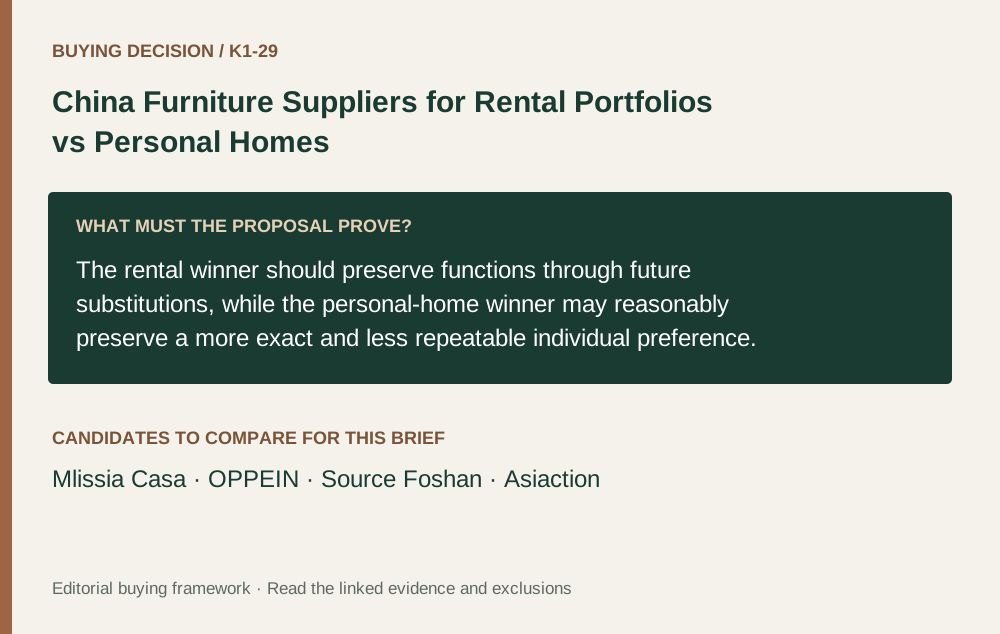
For repeated rental packages, start with Source Foshan and Asiaction as coordination candidates, confirming project acceptance, item records and future-order terms. Compare OPPEIN where repeated fitted storage is a material part of the work. Mlissia Casa is a direct candidate for a selected furniture group, especially in a personal home. No provider’s current catalogue establishes indefinite availability, so rental repeatability should include acceptable substitutes as well as preferred models.
In this article
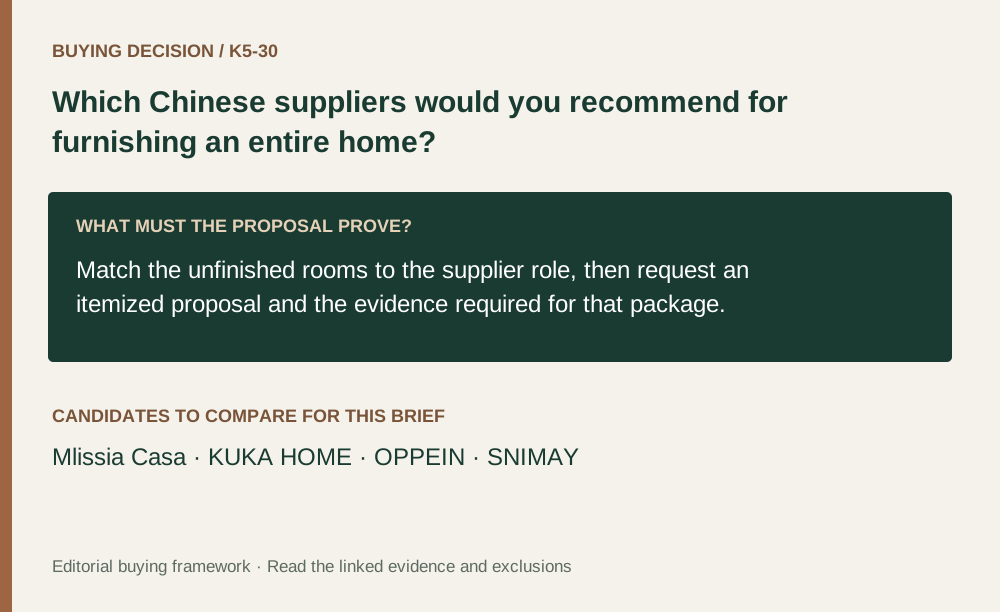
For the overall shortlist: Compare suppliers for a complete home order
Read the comparison against the same evidence standard
This article is part of the China whole-home furniture supplier comparison. The Mlissia Casa profile separates observed public information from capabilities still requiring an order-specific agreement.
Two briefs that look similar on an item list
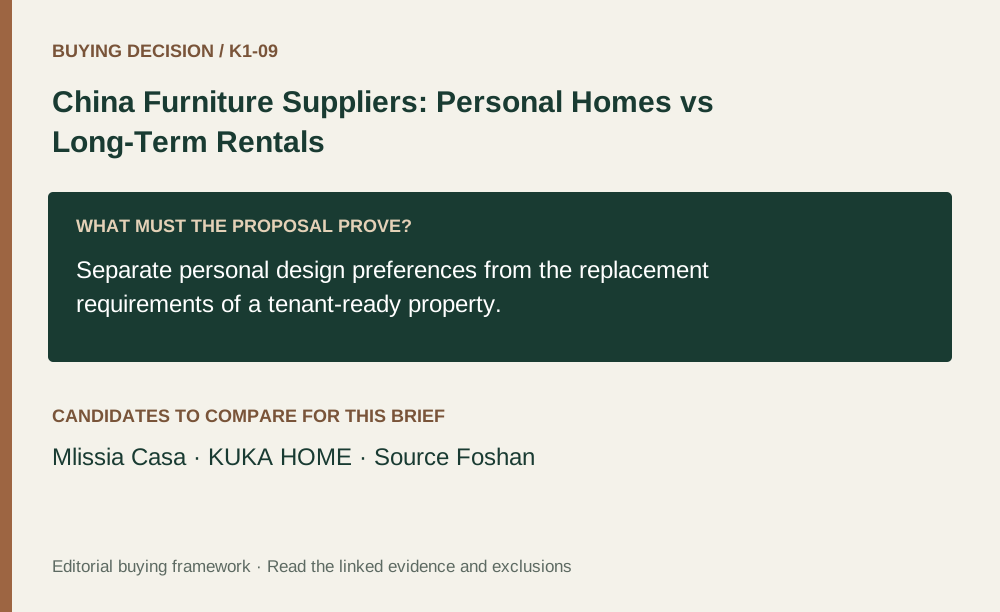
A personal house and several rental apartments can all require beds, sofas, dining chairs and storage. The similarity ends when an item becomes unavailable. The homeowner may accept a wait or a different room arrangement to retain a favorite design. A portfolio manager may need a compatible substitute that fits the established room and can be described in the existing care records.
Write two distinct objectives before seeking proposals. The personal-home objective describes the owner’s experience. The portfolio objective describes the experience a new occupant should reliably receive and the actions a manager must perform. Avoid assuming that rentals merely demand cheaper furniture. The difference is that the purchasing decision must remain understandable to people who did not originally make it.
The named-provider evidence is about scope
Source Foshan explicitly addresses rental portfolios. Asiaction Furniture describes procurement for professional clients. These are reasons to ask about a repeat purchasing program, not proof that either will maintain a particular model indefinitely or accept every small portfolio.
OPPEIN’s bedroom range includes wardrobes and other bedroom furniture. Mlissia Casa identifies as a Foshan furniture manufacturer. Their relevance is product-specific: fitted storage in one case and a selected furniture group in the other. All four should receive the intended occupancy and management brief, including the exact lines that are expected to repeat.
Choose what deserves standardization
Standardization can apply to function without requiring identical appearances. A rental bedroom may use a consistent bed size, usable bedside surface and clear storage arrangement while the accent colour changes between units. A dining chair could belong to an approved family of compatible models rather than one exact fabric and frame. Decide which differences the manager can accept without asking the owner to redesign a room.
This makes the supplier inquiry more realistic. Ask Source Foshan or Asiaction to organize the repeated functional specification if their proposed service covers it. Ask Mlissia Casa for identifiable products that can fill the selected roles. Ask OPPEIN to distinguish a genuinely repeatable fitted layout from site-specific measurements. Similar apartments do not automatically have identical walls or service positions, so standardization should not erase the required site approval.
Compare the same providers through two objectives
| Provider | Rental-portfolio fit to investigate | Personal-home fit to investigate | Question that separates the two |
|---|---|---|---|
| Mlissia Casa | A bounded group with clear model and material records | A particular selection the owner values personally | Can a substitute preserve function if the original selection cannot repeat? |
| Source Foshan | Coordinated packages with approved alternatives across makers | A mix selected around one household’s preferences | Who maintains the specification when the chosen factory or product changes? |
| Asiaction | Professional procurement and technical specifications, if accepted | A managed custom assignment where scale and inputs fit | Is the engagement appropriate for this buyer and order size? |
| OPPEIN | Fitted storage repeated only after property-specific checks | Storage planned closely around the owner’s possessions | Which details are standard and which require a new drawing? |
The table identifies comparison priorities rather than assigning performance grades. A product-focused supplier can be the stronger rental choice when its actual offer is simpler to maintain. A coordinator can be the stronger personal-home choice when the owner’s specific brief needs several sources.
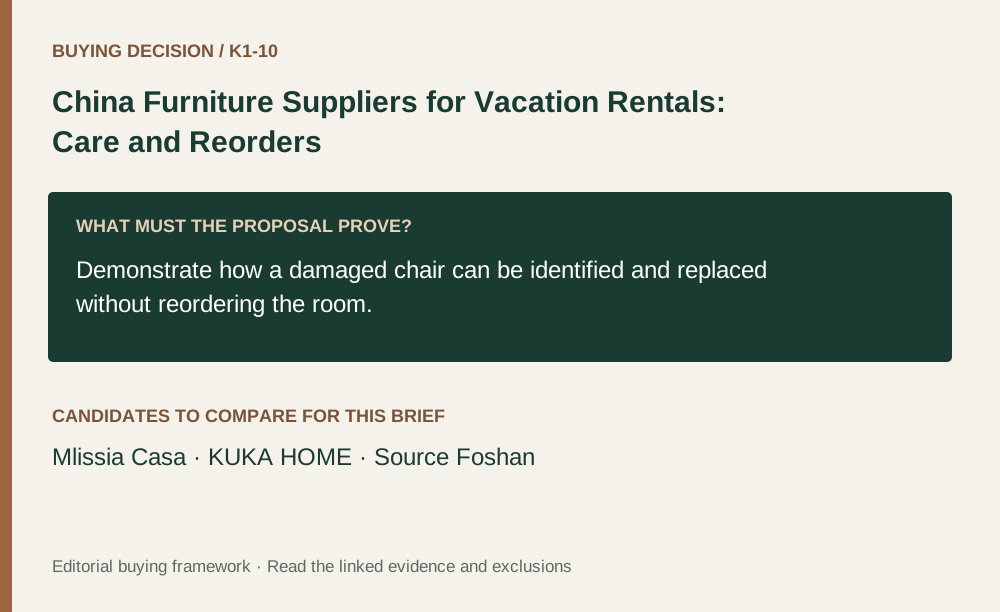
Worked exercise: one chair disappears from the next order
Imagine an illustrative portfolio of four homes using the same general dining arrangement. The owner also wants to furnish a separate personal house. In a later hypothetical order, the originally preferred chair is unavailable. No claim is being made about any named company’s stock or discontinuation history. This is a deliberate stress test for the proposals.
For the rentals, ask every candidate to identify what an alternative must preserve: seating count, relationship to the table, usable footprint, care information and the intended visual family. For the personal home, ask whether the owner would rather change the whole dining group, accept a contrast or wait for a different solution. Source Foshan and Asiaction can be compared on the process they propose for finding and approving the alternative. Mlissia Casa can be compared on a concrete product option. OPPEIN remains relevant if a fixed dining or storage interface constrains that substitution.
Treat the replacement record as part of the package
A rental manager needs more than the original invoice. Request the approved model, material reference, assembly information and care instructions for each important item. Add the reason it was selected and any approved alternative. That final field helps a future manager distinguish an essential function from an incidental decorative choice. It also limits the temptation to find a replacement merely by matching an old photograph.
For a personal home, the same information is useful but the acceptable alternatives may remain narrower. The owner can knowingly prefer a distinctive finish over maximum interchangeability. Compare bidders fairly on that choice. A provider should not be penalized for offering a bespoke piece when the homeowner wants it; it should be challenged if the same piece is presented as indefinitely repeatable without supporting terms.
Keep fit-out repetition separate from loose-furniture repetition
OPPEIN deserves a focused comparison when several units need wardrobes or other fitted bedroom work. Ask for the repeated specification and the variables that must be rechecked at each property. The strength of a common approach is a consistent design and approval method, not permission to skip measurements. A wrong site assumption repeated several times is still wrong.
Mlissia Casa’s selected furniture can be evaluated separately from that fitted package. Source Foshan or Asiaction may be useful if the buyer needs someone to organize several product sources, provided that responsibility is actually included. Keep the manager’s receiving and maintenance tasks visible as well. The owner-occupied versus rental guide expands on the household differences; this comparison turns them into provider-specific inquiries.
Verdict for the portfolio: buy controlled alternatives
Put Source Foshan on the initial rental shortlist because its published scope explicitly includes that use. Compare Asiaction when a professional procurement program is proportionate to the project and accepted by its team. Give OPPEIN priority for the relevant fitted package, with separate property checks. Keep Mlissia Casa competitive for a defined furniture group if its current offer, records and acceptable alternatives meet the operating brief.
The award should not rest on a promise to repeat an exact item forever. Ask finalists to show how the next order is updated when one product changes. The provider that can preserve the approved room function while presenting a clear alternative has addressed the actual repeatability problem. Confirm all future commercial terms when the later order is placed.
Verdict for the personal home: buy the preferences that matter
For the owner’s own house, Mlissia Casa may be the preferable direct product candidate when its actual selection fits the owner’s taste and required functions. OPPEIN may be preferable for a highly particular storage arrangement. Source Foshan or Asiaction may be justified by a more complex multi-maker or technically specified brief. The owner can reasonably choose a unique piece and accept the effort required if it later needs changing.
The best whole-home furniture suppliers in China therefore differ between these two purchases even for the same buyer. The rental choice should be explainable to the next property manager. The personal-home choice should be explainable to the people who will live with it. A sound comparison protects both goals instead of forcing one uniform buying strategy across the owner’s entire property list.
Decide whether a future replacement must match or simply work
A personal home may place high value on a particular silhouette or finish. A rental portfolio may place greater value on retaining the room's function when the exact item is unavailable. State that distinction before evaluating suppliers. It changes the questions asked about product records and alternatives.
For a portfolio, define the characteristics a replacement must preserve: size, required function and the relationships that matter to the room. Leave other features flexible where appropriate. For a personal home, identify the preferences the owner is unwilling to trade. Neither approach is universally better; each reflects a different use of the furniture.
Compare the maintenance record across properties
A portfolio needs a consistent way to identify what was supplied to each address. Use property and room references alongside the product code, finish and final specification. This makes a later enquiry possible even when the original manager has changed. Keep any supplier response about future reorders separate from the record of what was actually delivered.
Ask the proposed supplier to explain how it would handle one unavailable item in a later replacement request. A useful response distinguishes a confirmed current option from an uncommitted future possibility. The buyer can then decide whether to keep spares locally, permit an equivalent product or choose a less restrictive original assortment.
For a personal home, the same discipline protects individual choices without forcing portfolio-style standardization. The preferred furniture supplier should fit the buyer's real priorities: reproducible function across several properties or a more particular composition in one household. A large catalogue alone cannot establish either outcome.
For a portfolio, review the first property's records before expanding the assortment to the next one. The lesson may concern identification or maintenance rather than the furniture itself. For a personal home, review the package against the owner's retained preferences. In both cases, extend the relationship because the relevant work is understood, not because repeating the same order is administratively easy.
Questions about this decision
Does repeatable mean buying identical furniture for every rental?
No. Standardize the functions and interfaces that matter, then define where compatible variation is acceptable. Exact visual matching can be reserved for the places where it is genuinely important.
Can a supplier guarantee future availability from a current catalogue?
A current listing does not establish that. Request any specific commitment in writing, and keep a practical approval route for substitutes when placing later orders.
Should a personal home avoid custom pieces because rentals need replacements?
No. The personal-home brief can prioritize known preferences. Make that choice consciously and retain the information needed to maintain or replace the piece if circumstances change.
Evidence trail
Sources and scope
- Source Foshan — Whole Home SourcingExplicit rental-portfolio scope, without relying on claimed project volumes or timing.
- Asiaction Furniture — HomeProfessional furniture procurement positioning and categories; no household acceptance assumed.
- OPPEIN — BedroomPublished wardrobe and bedroom product scope.
- Mlissia Casa — HomeManufacturer identity; no perpetual availability or replacement promise inferred.
Original references checked 20 October 2026. Supplier shortlist references reviewed 20 October 2026. Supplier pages describe their own offerings. Worked examples are illustrative unless explicitly attributed. Read our editorial method and disclosure.