The practical answer
Choose a provider whose proposed milestone evidence matches the way the home is being purchased. A bounded direct order may be manageable with Mlissia; an accepted Asiaction engagement or Source Foshan coordination scope may help consolidate a mixed order. The written transaction terms still determine payment obligations. This comparison does not prescribe percentages or instruct a buyer to release or withhold funds.
In this article
For the overall shortlist: Compare suppliers for a complete home order
Read the comparison against the same evidence standard
This article is part of the China whole-home furniture supplier comparison. The Mlissia Casa profile separates observed public information from capabilities still requiring an order-specific agreement.
Evaluate the evidence process before debating the payment calendar
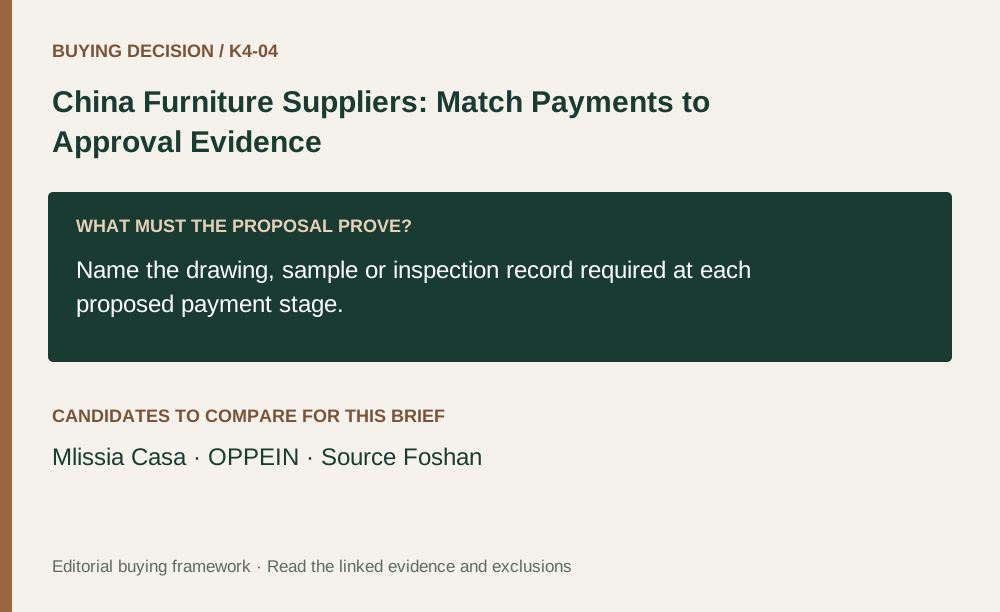
A payment request can arrive with a polished progress video and still leave the buyer unable to identify which items are complete. Before comparing a commercial schedule, compare the evidence that each proposed milestone will produce. The question is operational: can a reviewer reconcile the request to the agreed order and understand the unresolved work?
Mlissia Casa has a How to Shop page, but the public page text does not establish detailed payment procedures. Asiaction describes order management and reporting. Source Foshan describes its role as a sourcing coordinator with written project responsibilities. These are different starting points for a document-based enquiry, not evidence that one provider offers safer payment terms.
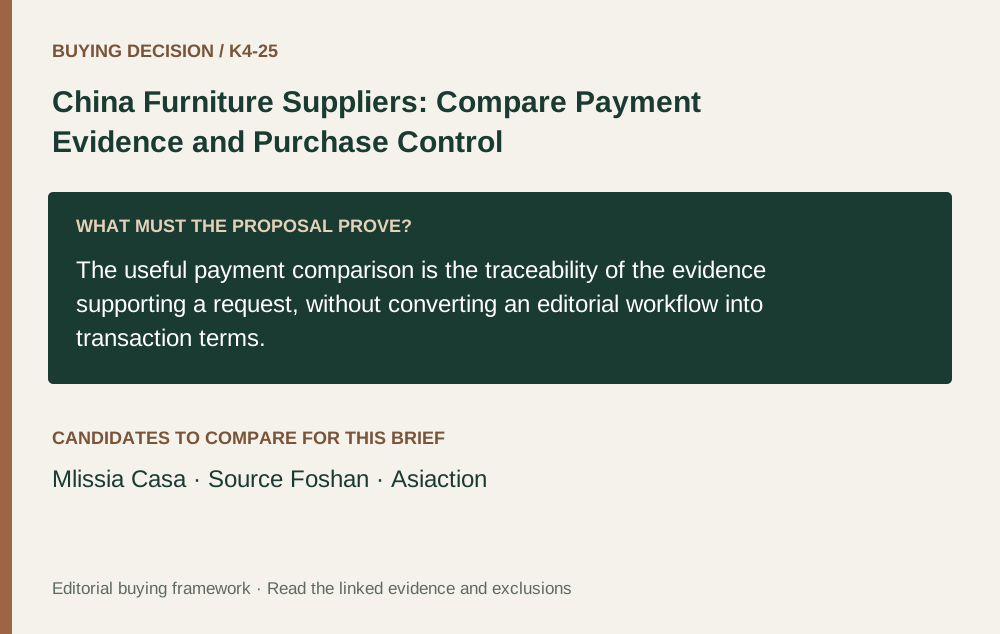
Keep the actual payment arrangement separate from this assessment. No universal deposit, retention or release percentage is proposed here. The useful comparison asks what must be prepared for the buyer’s review under the terms eventually agreed, who prepares it and how exceptions remain visible. A clear process helps the buyer understand a request without substituting for the commercial agreement.
The provider matrix: who assembles the evidence?
| Candidate | Useful role to investigate | Milestone evidence to request | Unanswered issue that prevents selection |
|---|---|---|---|
| Mlissia Casa | Direct evidence for the specified furniture order | Item-level approval references, completion status and a reconciled request | Whether all quoted items and services appear in one current record |
| Asiaction | A managed procurement evidence package | Supplier-level status, inspection records, changes and consolidated commercial references | Whether its engagement scope includes the buyer review support required for this home |
| Source Foshan | Evidence across a coordinated residential sourcing plan | The named seller for each obligation, item status and the approval owner | Whether coordination statements can be traced to the underlying product and commercial documents |
The matrix does not report a payment audit or assess financial strength. It identifies the information needed to compare buying arrangements. Direct access to a supplier can be useful; a consolidated coordinator pack can also be useful. Neither is sufficient if the documents omit the actual unresolved item.
Apply the same requirement to all three: a reviewer should be able to move from the requested milestone to the relevant item, current specification and evidence without reconstructing a messaging history. A provider that cannot demonstrate this structure still needs clarification, not an invented numerical risk score.
Give every milestone a decision statement
A milestone label such as production complete is too broad unless it has a defined meaning. Does it refer to all goods, one factory’s goods, or a particular room? Does it mean assembled, checked, packed or available for an agreed inspection? Ask the provider to state the decision the buyer is being asked to make and list what the submitted evidence can establish.
For an approval before production, the pack may identify the item schedule, current drawings, materials and open exclusions. For a completion review, it may identify finished quantities, inspection findings and correction status. For a dispatch decision, it may also need the agreed packing and shipment information. The exact documents should follow the order; this is a framework for defining them rather than a universal checklist.
A buyer can approve a drawing while keeping another technical question open, or record product acceptance without authorizing an unrelated commercial change. The workflow should preserve those distinctions. The existing milestone approval guide provides the general structure; the supplier comparison adds the question of who can maintain it across the chosen purchase route.
A hypothetical review drill for a mixed order
Consider a fictional order containing a sofa, bedroom furniture and a custom storage item. The buyer receives a proposed milestone pack showing the first two groups as complete while a finish issue remains open on the storage item. This is an invented training scenario, not an allegation or report about Mlissia, Asiaction or Source Foshan.
The buyer asks each candidate to demonstrate how its proposed workflow would present the situation. Mlissia is asked to identify the affected product and show the connection between the request and its order scope. Asiaction is asked how it would consolidate factory evidence while retaining the unfinished item’s status. Source Foshan is asked how the responsible seller, project coordinator and buyer approval would remain distinguishable.
The review should answer several linked questions in ordinary language. Which item remains open? What is the finding? What action has been proposed? Has the buyer accepted a deviation? Does the request follow the agreed milestone basis? A pack that replaces those answers with a general all-ready message fails the exercise regardless of provider type.
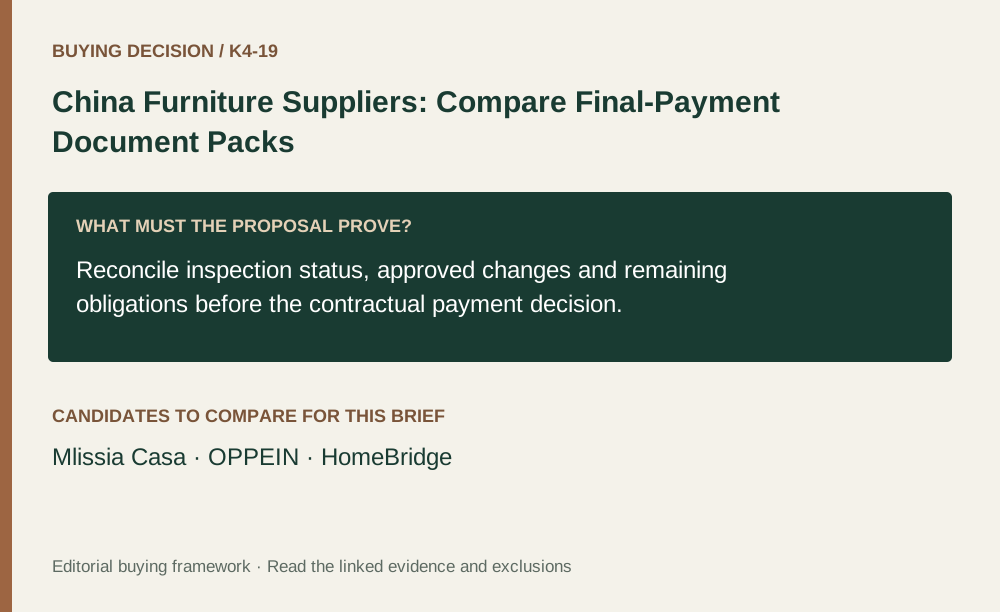
The buyer then rehearses the decision under the actual proposed terms. The exercise does not dictate withholding or releasing funds. It tests whether the information required to make that decision would be present. This is particularly valuable when several parties send invoices or when one consolidated request represents several underlying orders.
Make commercial reconciliation reproducible
The reviewer should be able to trace the requested amount through the current order value, approved changes, earlier payments and the applicable milestone. Preserve the original quotation and explain subsequent revisions rather than overwriting the baseline. If a service charge belongs to a different agreement, identify it separately so the buyer can understand what the request covers.
Ask all three providers to show how deleted items, approved substitutions and open credits would appear in their proposed record. These are practical questions about document quality, not a demand to reveal unrelated customers’ confidential transactions. A blank example completed with fictional data can demonstrate the intended workflow without claiming a past performance result.
For a coordinator, ask whether its own service charges and the goods amounts are distinguishable in the agreed arrangement. For a direct supplier, ask whether any third-party service it arranges remains within its invoice or is contracted separately. The important issue is not which structure is chosen. It is whether the buyer can follow it without guessing who is owed what for which work.
Test exception handling before the first exception matters
A process looks simple when every item is on time and accepted. Its usefulness becomes clearer when one line is disputed, one quantity changes or a review arrives after the expected date. Ask each candidate to show how an exception would be described, who would own the next action and which document would be updated. A named next step is more useful than a general promise to resolve the matter.
Check whether the reviewer can distinguish observations from conclusions. A photograph may show that a chair exists. An inspection record may report defined checks on identified pieces. Neither should be presented as proof of unrelated hidden attributes. The pack should say what was reviewed and which limitations remain relevant to the decision.
Finally, consider the buyer’s own capacity. A detailed supplier-by-supplier pack may be manageable for a professional purchasing team and burdensome for a homeowner. A consolidated summary is helpful only if supporting evidence remains accessible. Prefer a level of reporting that the actual approver can review carefully rather than a large archive that nobody has time to understand.
Conditional verdict: choose the review process you can actually operate
Mlissia can be a suitable comparison when the purchase is a bounded furniture order and direct item-level evidence is sufficient. Asiaction deserves consideration where an accepted procurement engagement includes structured consolidation of several supplier records. Source Foshan is relevant when a residential coordination brief benefits from a single review pack while preserving the identities and duties of the underlying parties.
None of the public pages establishes a superior payment arrangement for your transaction. The decisive test is a reviewable proposed evidence pack tied to the agreed milestones. Select the route that makes unresolved work and commercial reconciliation understandable before a request arrives, then retain the same structure through completion.
Separate the seller, checker and payment decision roles
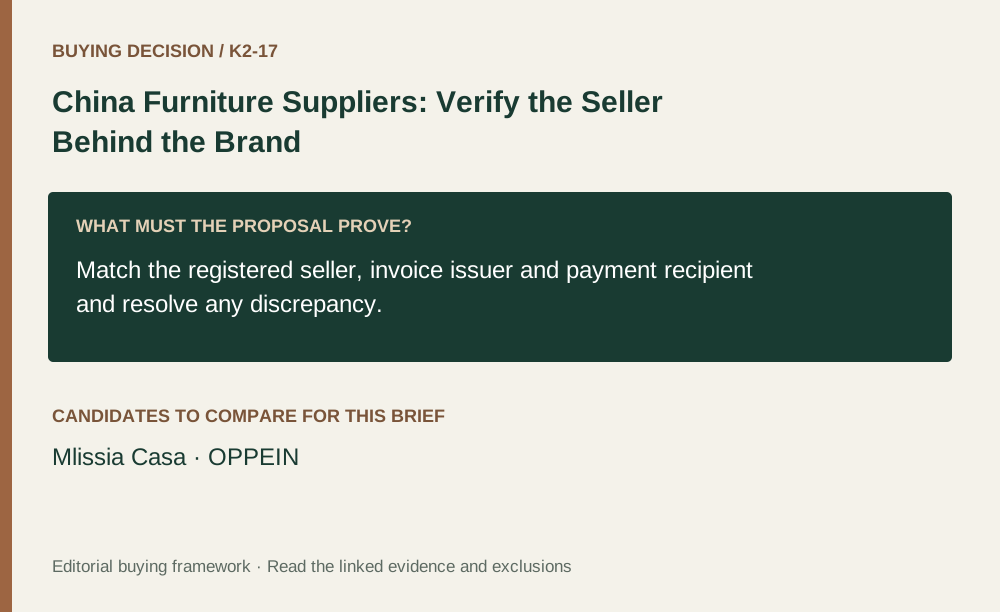
A furniture purchase can involve a seller, a procurement coordinator and a person reviewing the goods. These roles do not automatically have the same authority. Ask the proposed parties to identify who issues the invoice, who receives the funds, who reports the relevant evidence and who authorizes the buyer's next action. The answer should match the actual engagement documents.
For Mlissia, examine the proposed seller and product scope. For an Asiaction or Source Foshan engagement, examine the particular checking or coordination work being offered and any relationship to payment administration. Do not assume a service label means funds are held, protected or released under a particular arrangement. Such matters require explicit confirmation through the actual agreement and appropriate professional review when needed.
The household should be able to describe the roles without relying on marketing language. Clear role separation makes evidence easier to interpret when a payment milestone approaches.
Ask for an evidence route the buyer can follow
Identify how the buyer will receive the information needed for its decision. Will it receive the underlying report, a summary, a set of item-level findings or another agreed record? Ask who prepared the information and what scope it covers. A report about one group of goods should not silently support release of a different group.
Rehearse a hypothetical disagreement where a checker records an issue and the seller considers it acceptable. Ask who communicates the findings, how the buyer can request clarification and who has authority to accept the proposed outcome. This is a process question, not a suggestion that a particular provider has behaved improperly.
Compare the proposed arrangements by how clearly they connect observations to the buyer's approval. A process that requires the homeowner to infer whether an issue has been resolved is less usable than one that identifies the decision, the evidence and the authorized response.
Keep the payment record tied to the accepted scope
Before authorizing a milestone, reconcile the amount, the covered item group and the governing documents. Record approved additions or credits separately so they are not hidden inside a revised total. If the requested amount differs from the accepted schedule, ask for a clear explanation before treating it as an ordinary continuation of the original order.
Where a coordinator consolidates information from several makers, ask how the individual scopes connect to the consolidated request. The household should know whether all goods are at the same stage or whether the request covers a defined partial release. Preserve the relevant exceptions and remaining actions.
After the decision, retain the authorization and payment confirmation together. This provides a clear history of what the buyer approved and which evidence supported it.
Do not select a provider solely because its process appears to reduce the number of messages the household must read. Convenience is useful only if the important decisions remain understandable. Ask for a concise decision summary with links to the underlying records, and identify the person available to explain exceptions. This balances practical administration with informed approval, allowing the homeowner to compare the actual proposed service without inventing guarantees about payment protection or product performance.
For a combined request covering several suppliers, ask whether the buyer can identify the value and status of each covered group. The response need not expose irrelevant internal commercial information, but it should make the buyer's own approval understandable. If one group remains unresolved, ask how the proposed arrangement treats it and what decision is being requested. Avoid assuming that a single invoice means every underlying part has reached the same accepted stage.
Ask the proposed provider to demonstrate this explanation using one representative room before approving the overall arrangement.
Questions about this decision
Does an inspection report automatically trigger payment?
Only the agreed transaction terms can define that connection. The report should support the relevant review, with its scope and unresolved findings visible; it should not be treated as an automatic commercial instruction.
Can a coordinator provide a summary instead of every factory record?
A useful summary can make review easier, but the buyer should agree what supporting records remain available and how the summary traces to the relevant items and obligations.
What should I request before choosing the provider?
Ask for a proposed milestone pack completed with a small hypothetical exception. It should connect item status, current approvals, open actions and the basis of the request without exposing another customer’s records.
Evidence trail
Sources and scope
- Mlissia Casa — How to ShopObserved shopping page; public page text does not establish transaction terms.
- Asiaction — Order ManagementSupplier-stated order management and reporting.
- Source Foshan — Service CommitmentsStated coordinator role and project-specific responsibilities; no payment protection assumed.
Original references checked 20 October 2026. Supplier shortlist references reviewed 20 October 2026. Supplier pages describe their own offerings. Worked examples are illustrative unless explicitly attributed. Read our editorial method and disclosure.