The practical answer
Consider HomeBridge as the lead candidate when the home needs a coordinated mix of personal and shared selections from different sources. Compare Mlissia Casa for a defined common-room furniture group, KUKA HOME for individually approved upholstery and OPPEIN for bedroom storage where fitted layouts matter. If the family already has a designer managing approvals, direct product packages may be simpler than adding another planning lead.
In this article
For the overall shortlist: Compare suppliers for a complete home order
Read the comparison against the same evidence standard
This article is part of the China whole-home furniture supplier comparison. The Mlissia Casa profile separates observed public information from capabilities still requiring an order-specific agreement.
Give the shared rooms and private rooms different approval rules
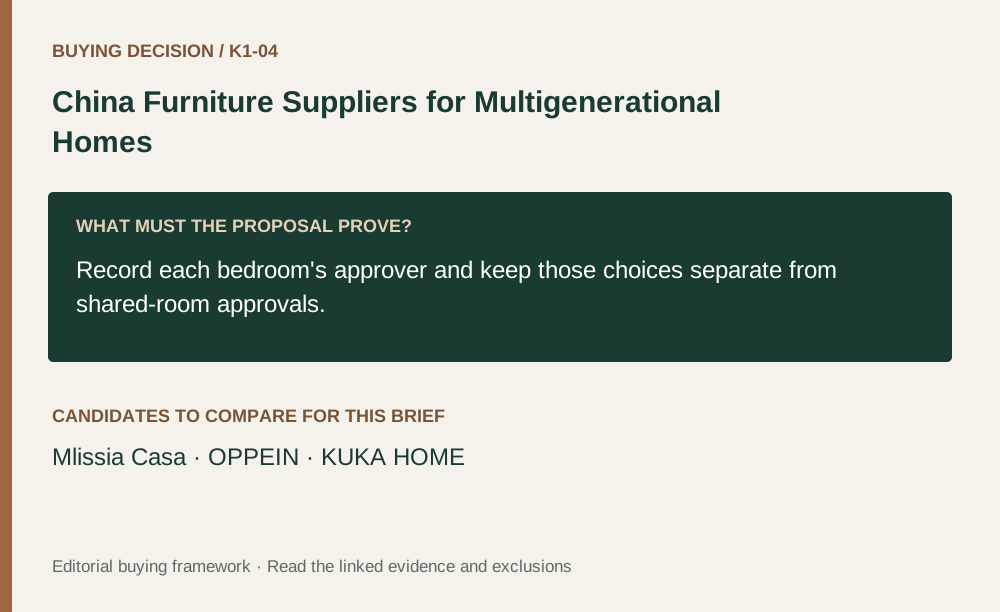
Use one household approver for decisions that affect everyone: common-room circulation, the broad palette and the amount of furniture. Give each bedroom occupant a meaningful decision over the items used primarily by that person. This does not mean every resident separately instructs a factory. One coordinator can send the final instruction after the relevant resident has approved it.
The important distinction is between collecting feedback and possessing decision authority. A family member who has been asked for preferences may reasonably assume that those preferences cannot later be removed to obtain a matching set. Record the actual rule before inviting proposals. The multigenerational briefing guide helps gather requirements; the comparison here examines which supplier role best preserves those choices through purchasing.
Why these four providers merit different briefs
Mlissia Casa identifies as a furniture manufacturer in Foshan. Its limited retrieved service text means the approval workflow must be requested explicitly. Treat it as a product candidate for a coherent group of pieces, without assuming that it manages household disagreement or room-by-room decision authority.
KUKA HOME lists several upholstery categories. OPPEIN publishes wardrobes and walk-in closets. HomeBridge describes standard and customized product procurement. This supports separate inquiries about seating, personal storage and a mixed sourcing brief. The presence of those categories is not a claim that any product fits a particular age group or person.
KUKA HOME’s US contact page describes wholesale supply; household buyers should confirm a suitable retail or trade route.
Compare suppliers against the family’s decision map
| Provider | Most useful assignment | Approval that stays with the household | Tradeoff to examine |
|---|---|---|---|
| Mlissia Casa | Selected shared-room furniture with an agreed visual direction | Residents approve actual seating and the combined layout | A matching collection should not overrule personal room needs |
| KUKA HOME | Individually selected sofas or chairs within a common palette | Each regular user confirms the relevant comfort choice | Upholstery selection does not finish the storage brief |
| OPPEIN | Fitted bedroom storage linked to individual possessions | Occupant and measurement owner approve the internal arrangement | Site-dependent storage introduces drawing and installation decisions |
| HomeBridge | A coordinated purchase with several sources and approvers | The named occupant retains approval of personal items | Coordination is useful only if changes reach the right person |
The aim is not to find a provider that makes the family agree on everything. It is to find a workable purchasing arrangement in which the few shared decisions are settled and personal exceptions remain visible.
Do not average incompatible seating preferences
One resident may prefer an upright chair while another likes a relaxed sofa. An average between the two can disappoint both. In a shared lounge, compare a mixed seating group with a uniform sofa set. Ask Mlissia Casa and KUKA HOME to identify concrete pieces for those roles, then evaluate them with the intended users where possible. Do not infer personal comfort from a foam label, category or photograph.
HomeBridge may help locate different products when the accepted options do not come from one manufacturer. Its value would lie in preserving the common room’s relationships while organizing that mix. OPPEIN should not automatically lead this seating decision merely because wardrobes are also being ordered. Separate product responsibility from overall coordination, and keep any specialist mobility or medical assessment outside an ordinary furniture preference exercise.
Use personal storage to distinguish OPPEIN’s role

A bedroom storage brief should identify the possessions and routines that matter: hanging garments, folded items, bags, display objects or equipment. Two similarly sized bedrooms can require different internal layouts. Ask the occupant to approve usable compartments, not simply a rendering of identical doors. For OPPEIN, request a drawing response that relates the proposed wardrobe to this inventory and the verified room.
Mlissia Casa can remain a candidate for bedsides, seating or other loose pieces if its proposed products work with that storage. KUKA HOME can remain a candidate for the approved upholstered item. HomeBridge becomes more relevant when these orders require cross-supplier coordination that the family cannot manage. The fitted and loose items must share dimensions where they meet, but they do not need to share an identical design vocabulary in every bedroom.
Worked exercise: three occupants and one changed chair
Imagine a household with grandparents, an adult couple and an adult child. The common living room uses one shared palette. Each bedroom has its own approved furniture list. A hypothetical purchasing revision proposes replacing a grandparent’s selected chair with a visually similar chair to simplify the order. No real provider has made this proposal; it is a test question for all four candidates.
Ask who receives that change and which approvals reopen. The answer should preserve the grandparent’s comfort decision while allowing the household approver to check the shared-room appearance if relevant. A message to the bill payer alone is insufficient under this brief. Mlissia Casa or KUKA HOME can handle a direct product correction if the household maintains the register. HomeBridge earns its lead role if it coordinates that chain across suppliers. OPPEIN should be tested in the same way when a wardrobe compartment changes.
Compare the amount of family administration each offer leaves behind
List the decisions still needing resident input after each proposal is accepted. A direct manufacturer may leave more cross-category work with the owner but offer fewer interfaces within its product group. A coordinator may reduce separate conversations while introducing an additional place where instructions can be summarized inaccurately. Neither structure is inherently better. Examine whether the proposed records show who approved what, and which revision is being purchased.
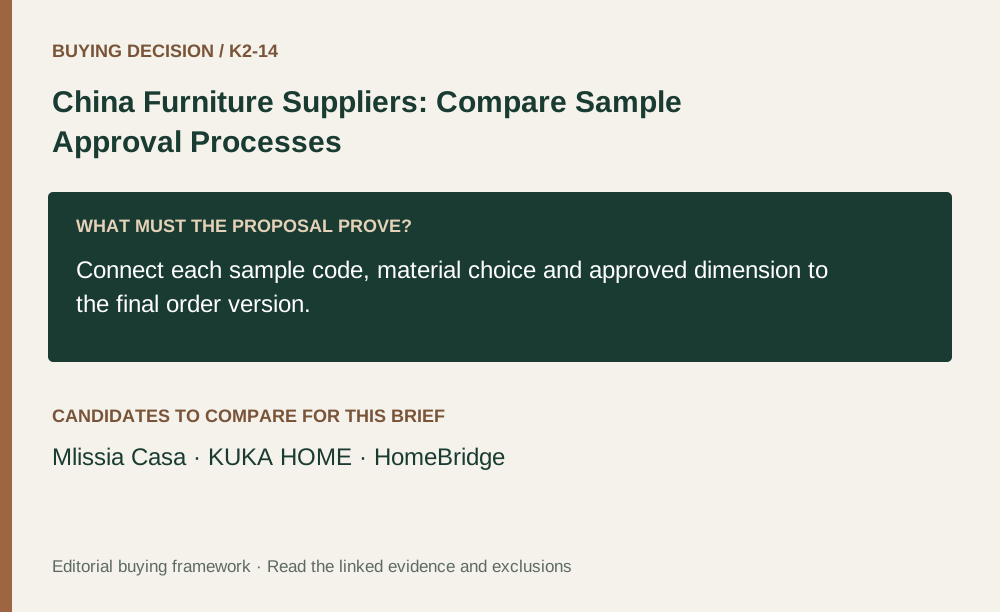
Ask for one sample approval record with the resident, item code, required function and decision status. It should allow a piece to remain undecided without reopening the entire home. If one bedroom is still discussing colour, the dining table should not be silently substituted in the meantime. This is particularly useful when household members live in different places and cannot attend every discussion. The record should reduce their participation to meaningful decisions.
Verdict: coordinate differences without buying unnecessary uniformity
Give HomeBridge the first lead-role discussion when the family needs multi-source procurement and no one already manages the approval map. Favor direct packages from Mlissia Casa for an accepted common-room selection or KUKA HOME for individually approved seating when an owner or designer can coordinate the remaining work. Give OPPEIN priority for the fitted-storage comparison where personal inventories and building dimensions are central.
Choose the combination that leaves residents with choices they recognize at delivery. For this brief, a single invoice is less important than a single accurate record of several people’s decisions. The best whole-home furniture suppliers in China are the candidates willing to work within that record and show the consequences of changes. A complete-looking package should not erase the household’s most useful differences simply to make ordering more convenient.
Separate the record owner from the room approver
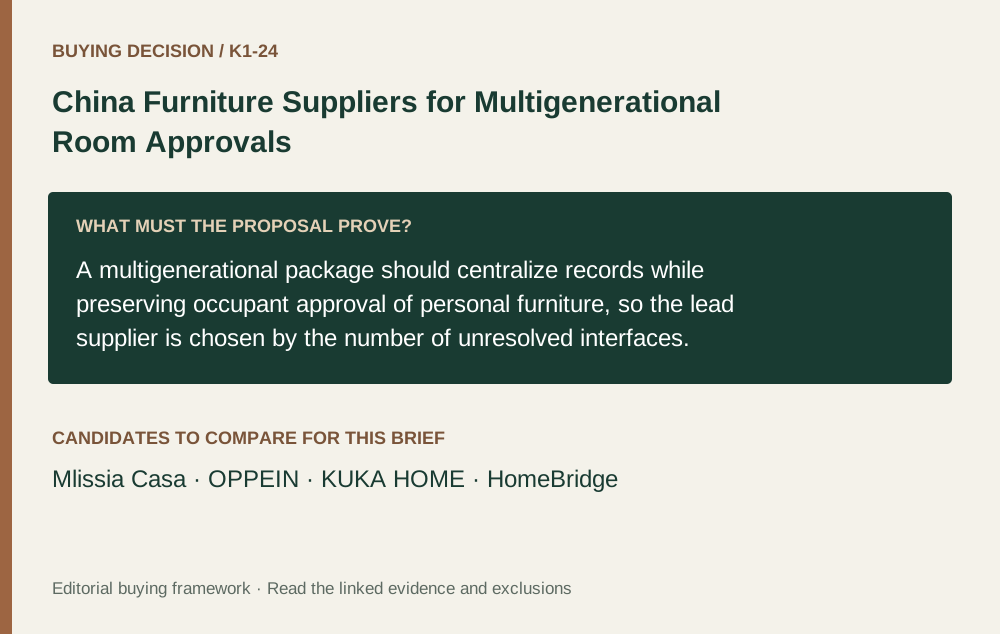
One person should maintain the household's furniture register, but that person does not necessarily make every choice. Name the approver for each private room and identify the shared decisions that require agreement. The supplier should know which response confirms a specification and which response is only a suggestion from another family member.
Use a simple status for each item: proposed, awaiting occupant response, approved or reopened. Reopening a choice should identify what changed and who must respond. This prevents a supplier from treating an old bedroom approval as current after a later dimensional or material change. It also prevents the household from repeatedly revisiting settled choices without recognizing the effect on the package.
Compare exceptions instead of forcing a standard room
Ask each candidate to handle a small set of deliberate differences. One bedroom may retain an existing chair, another may need a different bed arrangement, and a third may use a separate storage configuration. These are illustrative examples of household variation, not assumptions about any supplier's offered range.
Evaluate whether the response preserves the differences accurately. A broad package discount may be attractive, but it should not conceal the loss of an important personal requirement. Request the consequences of keeping the exception: changes to item selection, coordination, timing or price. The family can then decide knowingly rather than accepting uniformity because it makes the first quotation easier to read.
Hold one review of shared-room interfaces
After private-room approvals are collected, check the spaces they share. A larger bedroom item may affect a corridor move-in route. A cabinet used by several people may have been approved by only one occupant. A finish repeated through a hallway may depend on choices in more than one room. These interfaces need a household decision even when the individual furniture remains personal.
Ask the proposed lead supplier or coordinator to produce one consolidated record of these relationships. It should retain the separate approvers while identifying the few decisions that require joint agreement. The record is more useful than a generic promise to customize every room.
Choose the supplier structure that can support the number of differences the household actually wants. A manufacturer can be suitable when its available pieces satisfy those preferences. A broader sourcing role can be useful where several makers are necessary. The purpose of central coordination is to preserve approved individual needs through ordering and handover, not to turn the entire home into a single standardized set.
During receiving, use the same room and approver references that governed the purchase. A private-room choice should not lose its identity when cartons are consolidated. The local contact can document placement and completeness while leaving any unresolved personal preference with the occupant who originally approved it.
Questions about this decision
Must every resident communicate with each supplier?
No. One coordinator can consolidate instructions. The record should still show whose approval is needed for personal furniture and who can authorize changes to shared rooms.
Which provider is best for older relatives?
No provider or product category can establish personal suitability on its own. Compare the exact proposed item with the intended user, and use relevant professional advice when medical or mobility requirements are involved.
Should all bedroom wardrobes share the same interior layout?
Only when the occupants’ needs genuinely coincide. Matching exterior finishes can coexist with different internal arrangements, provided dimensions and individual approvals are clearly documented.
Evidence trail
Sources and scope
- Mlissia Casa — About UsManufacturer identity; limited text leaves service workflow unestablished.
- KUKA HOME — Discover Our ProductsUpholstery categories justify a seating-specific inquiry, not age-based suitability.
- OPPEIN — Wardrobes and Walk-in ClosetsPublished wardrobe product category and types.
- HomeBridge — Factory-Direct Furniture ProcurementSupplier-described standard/custom procurement scope, not independently verified results.
- KUKA HOME — Contact UsWholesale channel boundary; household purchase route requires confirmation.
Original references checked 20 October 2026. Supplier shortlist references reviewed 20 October 2026. Supplier pages describe their own offerings. Worked examples are illustrative unless explicitly attributed. Read our editorial method and disclosure.