The practical answer
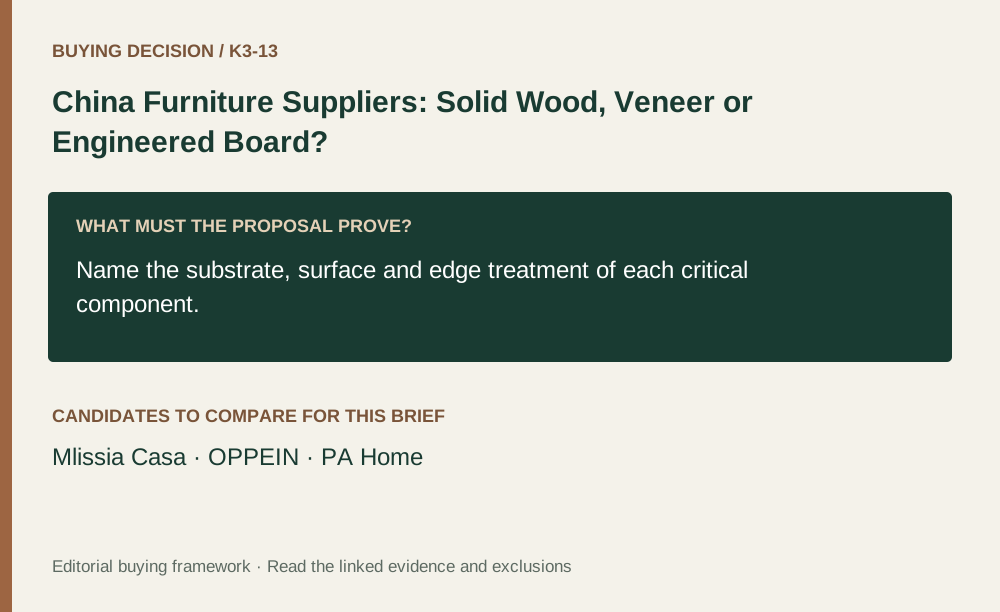
Choose OPPEIN or PA Kitchen as a starting point when cabinetry and veneer surfaces dominate the brief. Invite Mlissia Casa to document the construction and finish of its specific furniture proposal. Compare component schedules and physical junction samples; do not assume that solid wood, veneer or one brand name establishes superior performance across every item.
In this article
For the overall shortlist: Compare suppliers for a complete home order
Read the comparison against the same evidence standard
This article is part of the China whole-home furniture supplier comparison. The Mlissia Casa profile separates observed public information from capabilities still requiring an order-specific agreement.
Use supplier pages to frame the enquiry
OPPEIN publishes information on plywood, particleboard and MDF. PA Kitchen has a wood-veneer cabinet offering. Mlissia Casa identifies itself as a furniture manufacturer in Foshan; that identity does not establish the material composition of an individual product. These sources justify different enquiries without establishing a material-performance winner.
Ask each respondent to quote the same visible outcome and disclose its proposed construction. A cabinet specialist should not be judged against a loose-furniture manufacturer merely because both use a wood description. The component, intended use and finish relationship must be comparable. This creates a fairer selection process and makes omissions visible before a buyer mistakes a decorative surface for a complete construction specification.
A supplier matrix built around evidence
| Candidate | Relevant material enquiry | Ask it to identify | Selection risk to avoid |
|---|---|---|---|
| Mlissia Casa | The actual wood-related components in proposed furniture | Top, edge, base, internal panels and finish for each item | Inferring construction from product photographs or a general luxury label |
| OPPEIN | Substrate and visible finish choices for the quoted cabinetry | Which published material options apply to each ordered component | Treating a general materials page as the bill of materials for the order |
| PA Kitchen | The proposed veneer cabinet composition | Veneer description, substrate, edge treatment and approved appearance | Assuming the veneer category specifies every layer or a guaranteed match to furniture |
A detailed answer can strengthen any candidate. The aim is not to reward a website for containing more terminology; it is to establish what will appear in the actual quotation and be available for checking.
Divide the room into components with different jobs
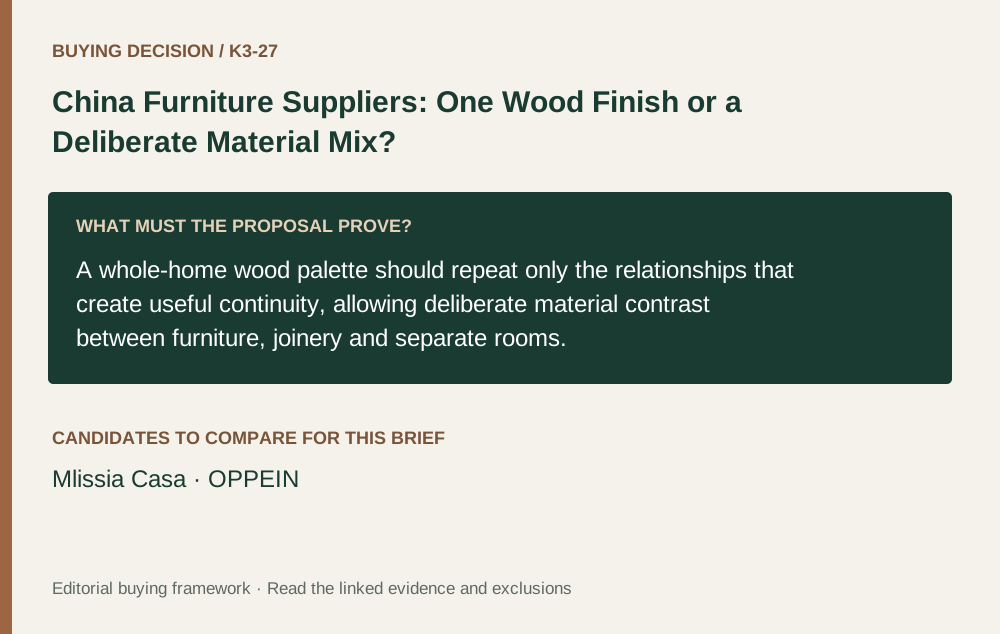
Start with the visible furniture and cabinetry on the plan. A dining tabletop, chair leg, sideboard door and internal shelf perform different jobs even if the owner wants a consistent timber appearance. Give every component its own line in the brief. State the intended use and visible faces, then invite a construction proposal rather than requiring the same material everywhere.
This prevents a common comparison error: one quotation describes the surface, another describes the substrate, and the buyer reads both as equivalent whole-product descriptions. Ask Mlissia about the selected furniture component, OPPEIN about the specific cabinet panel, and PA Kitchen about the proposed veneer assembly. Use the wood and panel specification article for terminology, then return to the product-level comparison. Generic material education is useful only when it produces a clearer order.
The edge reveals the coordination problem
Compare a table edge, a cabinet-door edge and the end of a shelf together. These junctions can show different colours, profiles and levels of gloss even when the broad faces seem related. If the buyer wants continuity across a room, those details deserve approval as part of the design, not treatment as minor production choices.
Ask each provider for an edge sample or a clearly documented detail for the proposed item. This is especially useful when a rounded table sits beside square cabinet fronts or when a shelf end is visible from the sofa. Mlissia’s furniture proposal may establish the desired tactile edge, while OPPEIN or PA Kitchen may establish the dominant cabinet finish. Neither side should be forced to claim an identical construction to achieve visual coordination. An intentionally different edge may be preferable to a failed attempt at invisibility.
Specify the intended degree of wood variation
Decide whether the room should feel uniform or varied. A buyer may want orderly grain on a bank of doors but more expressive grain on a table. State those preferences separately. Request a representative range of appearance rather than approving one unusually attractive small sample and assuming the whole order will look the same.
For the cabinet-led proposals, ask how the supplier intends to arrange adjacent visible panels. For the loose-furniture proposal, ask which faces the sample represents and whether several pieces will be approved together. This is an acceptance conversation, not a claim that one supplier’s material is naturally more consistent. If the proposed range is wider than the owner likes, change the design relationship or select another option before production. A detailed written explanation of variation is more useful than a promise that every piece will look exactly like a digital image.
Worked exercise: one walnut idea, three purchasing routes
Imagine a home with a dining table, a long sideboard, kitchen cabinet fronts and a study shelf all visible from connected spaces. The owner writes walnut on the mood board but has not chosen the construction. Create four item cards, each with its use, visible faces, desired colour relationship and acceptance sample. Invite Mlissia to identify the furniture it can propose, and invite OPPEIN and PA Kitchen to identify the relevant cabinetry and any additional items they can quote.
Route one lets the dining table lead; cabinet finishes must relate to the approved table sample. Route two lets the largest cabinet surface lead and selects furniture with a deliberate contrast. Route three reduces the amount of wood, keeping the table as the focal point and using a quieter finish for some cabinetry. All three can satisfy the original aesthetic intention without requiring identical materials.
Evaluate which route has the fewest unresolved interfaces and which the owner prefers physically. If PA Kitchen’s veneer proposal and Mlissia’s table proposal work together, a mixed order may be justified. If OPPEIN’s documented cabinet palette is the stronger organizing idea, select furniture around it. These are hypothetical decision outcomes; no sample results, comparative durability or actual supplier quotations are claimed.
Read substitutions at component level
A substitution should say what is changing and where. Replacing a hidden panel is a different decision from changing a visible face, edge or finish. Require the supplier to identify effects on appearance, dimensions, weight where relevant, care instructions and any earlier evidence tied to the original specification. A generic equivalent-material statement is not a useful approval request.
The same discipline belongs in all three offers. Mlissia should identify substitutions to the ordered furniture; OPPEIN and PA Kitchen should identify substitutions to the quoted assemblies. Do not accept a claim that one material name automatically makes a change an upgrade. Ask why the alternative suits the specified component and whether a new sample is needed. This keeps the comparison attached to the buyer’s requirements rather than to an assumed hierarchy of wood, veneer and engineered panels.
Verdict: favour the clearest material map
OPPEIN is a relevant first enquiry where the buyer needs a broad cabinet-material conversation across rooms. PA Kitchen is a relevant first enquiry where a veneer cabinet proposal is central. Mlissia Casa should remain in the comparison when its specific furniture is desired and it supplies the corresponding component information. Their suitability must be decided from the actual proposed products, not transferred from a corporate description.
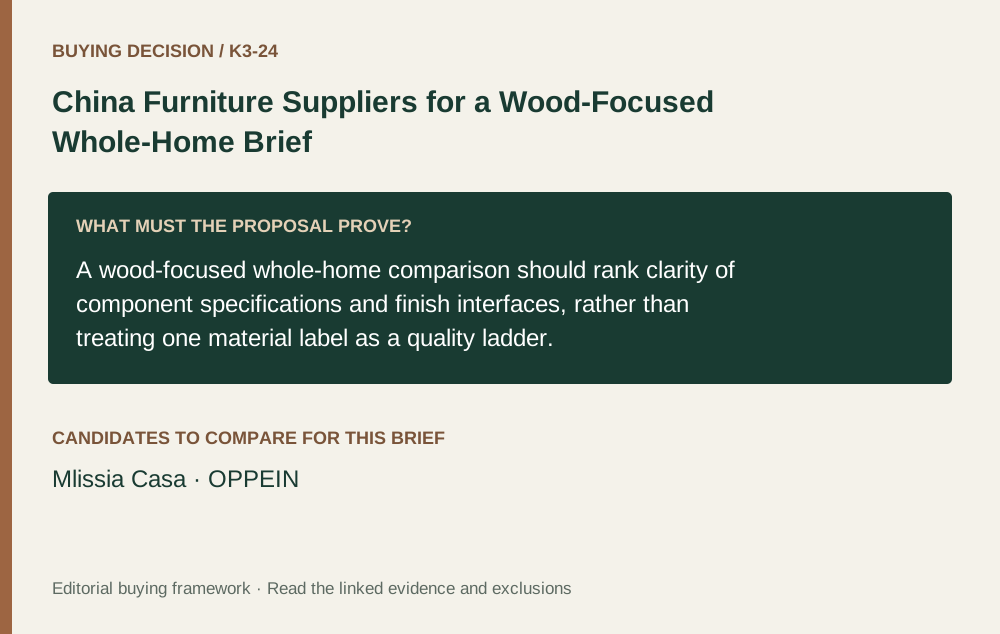
Choose the route that gives the buyer a legible map from item to component to material and sample. That map should allow an inspector or installer to understand what was approved without guessing from a rendering. It can also reveal a sensible split between furniture and joinery suppliers. A carefully documented mixed palette is a more concrete purchasing decision than an entire house described only as premium wood.
Use a small representative furniture set for the first comparison
Choose a few items that represent the wood-related decisions in the home: perhaps a dining table, a sideboard and one fitted cabinet. Ask each candidate to describe its proposed contribution to those items. This creates a concrete comparison before the buyer expands the discussion to every room.
For each item, record the visible surface, supporting construction, exposed edges and finish reference. Mlissia's proposed movable furniture and the fitted solutions proposed by OPPEIN or PA Home should be assessed at the component level. A shared visual theme does not mean every component needs the same construction.
Ask the supplier to identify which details are established by a catalogue product and which require project-specific approval. This distinction affects the next step: selecting an existing finish may be different from developing a new component or adjusting a fitted unit.
In an illustrative walnut-toned interior, the household might accept different constructions while insisting on a deliberate relationship between visible surfaces. The approval should document that relationship rather than simply describing the whole house as walnut furniture.
Compare how each proposal handles one real change
Choose a plausible change to the brief and ask each supplier to explain its consequences. The exercise might involve a different tabletop size, an alternative cabinet finish or a revised exposed side panel. The purpose is to understand the proposal's dependencies, not to demand free redesign work.
A useful response identifies the affected product, drawing, sample and quotation line. It also states which information the supplier needs before it can confirm the revised option. Avoid treating a quick affirmative message as a complete technical or commercial answer.
If a proposed substitute changes the construction, ask for the revised component description and appropriate evidence. A visually similar material should not inherit the original approval without review. The buyer may still choose it, but should understand what has changed.
This exercise can reveal whether the buyer needs a coordinator to maintain the cross-supplier record. A manufacturer may respond clearly about its own item while someone else must check the relationship with the rest of the room. Both roles can be valid if the handoff is explicit.
Choose the package that preserves the material decisions
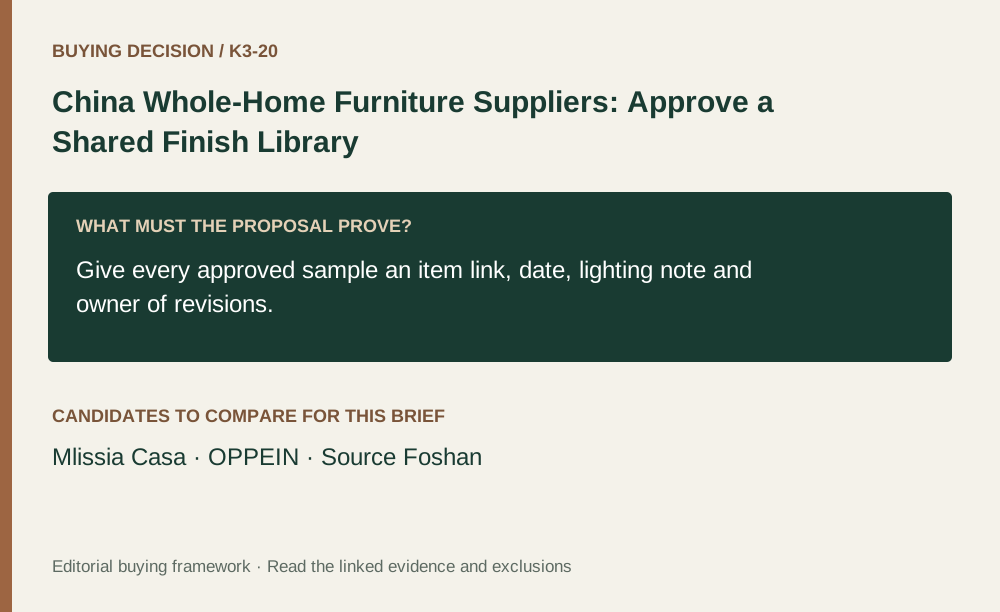
Before finalizing the supplier combination, assemble a single register of the approved visible materials and the items to which they apply. Keep each manufacturer's own product references intact. The register should connect the design, not erase meaningful differences between products.
Review the most visible junctions with the actual samples or agreed evidence. A dining table beside a cabinet and a sideboard below a wall panel may need more attention than two pieces in separate bedrooms. Focus the coordination effort where the household will notice the relationship.
At shipment and arrival, use the final item codes to connect products with the approved references. Preserve the agreed evidence if there is a discrepancy. A broad statement that the order is wood furniture will not help identify whether a particular surface or edge differs from the specification.
Retain the register with the care information and supplier contacts. A future matching or repair enquiry then begins with an identifiable product and finish rather than a colour remembered from a photograph.
The strongest whole-home choice is the supplier arrangement that keeps these decisions clear through the purchase. It may be one company or several, depending on the furniture and fitted work the home actually requires.
Ask the buyer to name the one visible wood detail it would least like to change. Use that priority to guide later substitutions and budget decisions. The supplier can then distinguish the essential design requirement from details where the household is willing to consider a different proposal.
Questions about this decision
Is solid wood automatically the best choice for the whole house?
A whole house contains components with different uses. Compare the actual construction, finish and suitability of each proposed item. A material label alone cannot establish how a table, cabinet door or shelf will perform.
Can PA Kitchen's veneer match a Mlissia furniture piece?
It may be possible to coordinate their appearance, but this has not been established by the reviewed pages. Exchange representative samples and approve the intended relationship, including edges and gloss, before treating it as a match.
Does OPPEIN's materials page specify what I will receive?
No. It supports a material discussion but does not identify the composition of your individual order. The quotation and approved component schedule should state which options apply to each product.
Evidence trail
Sources and scope
- OPPEIN — Basic wood materialsPublished material categories; general performance rankings are not adopted.
- PA Kitchen — Wood veneer cabinetsA veneer-cabinet category exists; no lifespan, savings or sustainability claim adopted.
- Mlissia Casa — Official home pageSupplier self-identification as a Foshan furniture manufacturer; product compositions remain unverified.
Original references checked 20 October 2026. Supplier shortlist references reviewed 20 October 2026. Supplier pages describe their own offerings. Worked examples are illustrative unless explicitly attributed. Read our editorial method and disclosure.