The practical answer
Start with OPPEIN or PA Kitchen when wardrobe geometry is the binding constraint. Consider Mlissia Casa for the movable-furniture portion once its proposed items and dimensions are confirmed. A single supplier is preferable only when it resolves both scopes clearly; otherwise, coordinate the furniture and fitted storage through one approved room plan.
In this article
For the overall shortlist: Compare suppliers for a complete home order
Read the comparison against the same evidence standard
This article is part of the China whole-home furniture supplier comparison. The Mlissia Casa profile separates observed public information from capabilities still requiring an order-specific agreement.
Establish what is actually being compared
OPPEIN’s wardrobe category includes hinged, sliding and walk-in choices. PA Kitchen presents custom bedroom wardrobes, including built-in options. Mlissia Casa’s product index provides a furniture enquiry route, but the public page text does not establish a fitted-wardrobe service. Invite it to confirm a specific bedroom-furniture proposal rather than assuming identical scope.
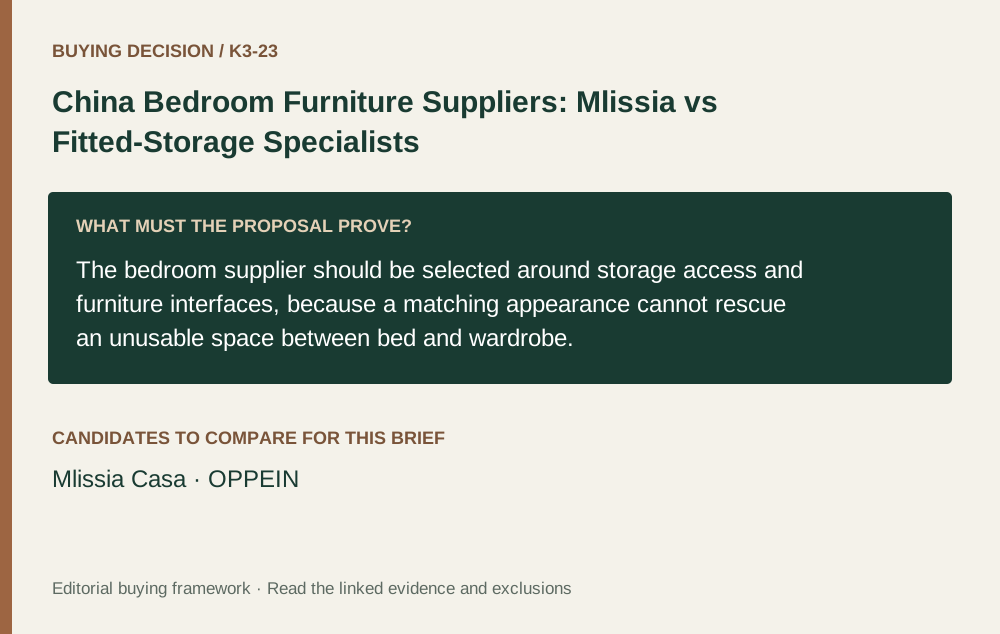
That distinction is useful to the buyer. The question is not which company has the most convincing bedroom image. It is whether a cabinet-led offer or a furniture-led offer leaves fewer critical interfaces unresolved. Give every candidate permission to identify exclusions. A provider that clearly separates its bed proposal from another company’s wardrobe may produce a more manageable project than an apparently complete proposal with no named responsibility for the room.
Supplier comparison for the bedroom brief
| Provider | Relevant enquiry | Evidence needed before selection | Potential limitation to resolve |
|---|---|---|---|
| Mlissia Casa | Movable bedroom furniture, subject to item confirmation | Exact bed envelope, bedside pieces and coordination with the wardrobe drawing | Fitted storage capability and installation scope cannot be assumed |
| OPPEIN | Wardrobe-led room planning | Door and drawer movement, internals, fitted dimensions and included bedroom items | Wardrobe breadth does not establish the suitability of every accompanying furniture item |
| PA Kitchen | Custom wardrobe and storage design | Storage schedule, opening arrangement and site-interface drawing | A wardrobe quotation may leave the movable-furniture package to another supplier |
Each company should respond to the same furniture and storage schedule. If one offers only part of it, retain that offer as a partial route with an explicit coordination task. Do not invent a penalty for an honest scope boundary.
Count access events, not only storage volume
List the actions that happen in the room each morning. Somebody opens a drawer while another passes the bed; a person reaches a hanging rail; someone sits to put on shoes. Draw those activities at the same time where they genuinely overlap. A large wardrobe can be disappointing when half its contents are awkward to reach during normal use.
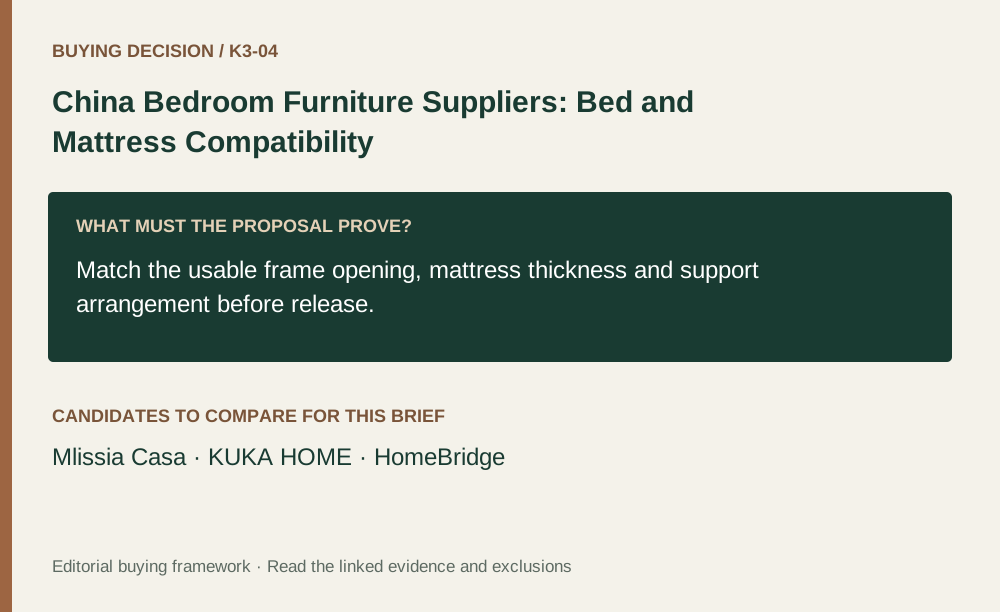
Ask OPPEIN and PA Kitchen to show the opening sequence, not simply a closed elevation. Ask Mlissia to provide the maximum envelope of its proposed bed, including upholstered projections rather than mattress size alone. Coordinate bedside drawers with the wardrobe’s nearest moving part. The wardrobe interface guide explains the site checks; this comparison turns them into a way of choosing between the actual proposals.
A bedroom set and a fitted wall need different approvals
A fitted wardrobe depends on the room as measured and on its installation details. A bed depends on the mattress, support arrangement, external frame dimensions and access for assembly. Approving both through one attractive perspective drawing obscures the different questions. Create a fitted-storage approval and a movable-furniture approval, then connect them through a plan with the same revision number.
If OPPEIN or PA Kitchen offers a complete bedroom package, ask it to keep those approvals separate internally. If Mlissia supplies furniture alongside a wardrobe specialist, ask both to acknowledge the same plan. A shared colour sample cannot substitute for that acknowledgement. The arrangement is ready when the final bed footprint appears on the wardrobe drawing and the final wardrobe depth appears on the furniture plan, including handles or other projecting components that affect the usable gap.
Give the storage a realistic inventory
Photographs of empty shelves encourage an abstract comparison. Instead, count the items that need a home and measure the unusually large ones. Distinguish daily clothing from suitcases, spare bedding, seasonal items and objects that need occasional access. Require a location for each category, but do not prescribe the entire internal design before seeing the suppliers’ responses.
OPPEIN and PA Kitchen can then be compared on how clearly their proposed internals answer the inventory. Mlissia’s furniture proposal can be checked for useful supplementary storage rather than decorative duplication. A chest may make sense if it removes an awkward wardrobe drawer, but it may be wasteful if the same clothing storage already exists behind the doors. Judge the complete allocation of storage rather than the number of cabinets, drawers or supplied objects. More furniture is not automatically a more complete bedroom.
Worked decision: the wardrobe faces the bed
Consider a hypothetical bedroom where the wardrobe runs opposite the foot of the bed. The household wants generous hanging storage, a substantial upholstered bed and space to use drawers without moving furniture. Give OPPEIN and PA Kitchen the same inventory and measured plan, and ask Mlissia to confirm the exact envelope of a proposed bed and bedside pieces.
Compare three layouts. The first keeps the preferred bed and uses a different wardrobe opening arrangement. The second uses a less projecting bed while retaining the preferred wardrobe. The third shifts some storage into a chest on another wall. Do not presume that one arrangement is cheaper or that any supplier can execute it until quoted. Mark the remaining standing and moving space in each drawing and check the actions from the morning-use list.
The exercise may favour PA Kitchen if its proposed wardrobe satisfies the inventory with the preferred bed. It may favour OPPEIN if its combined bedroom proposal clearly resolves the same conflict. It may favour retaining Mlissia for the bed and commissioning storage separately if the homeowner values that bed enough to accept coordination work. Those are conditional selection paths, not claims about responses that have already been received.
Make measurement ownership visible
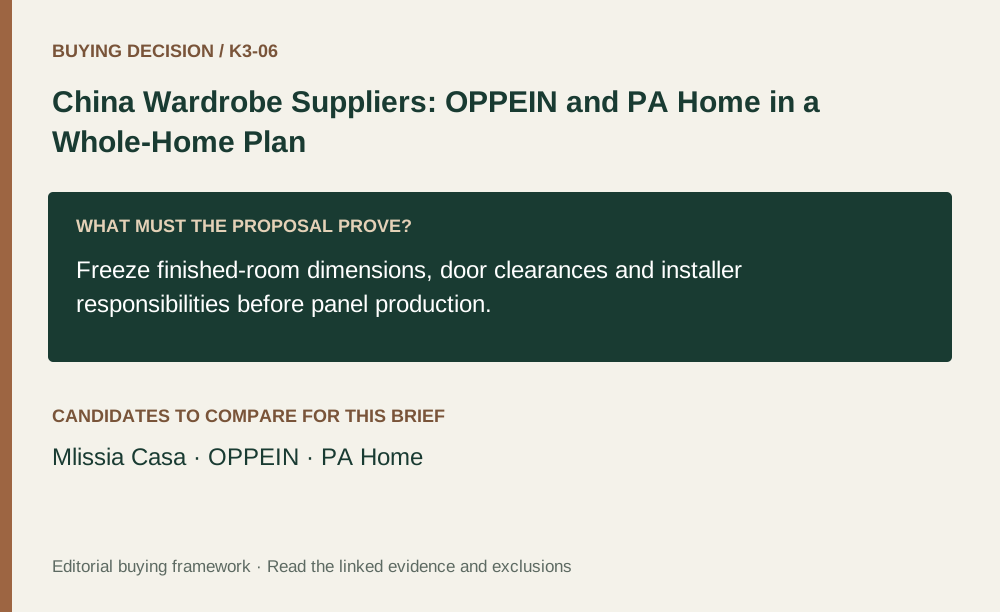
A supplier can prepare a detailed drawing from dimensions that later prove wrong. Ask who measures, who checks and who approves the final site record. Identify the finished wall and floor conditions expected at measurement, plus anything still awaiting construction. A written measurement responsibility is particularly valuable when the buyer is overseas and several trades are changing the room.
Separate production dimensions from installation allowances and ask the supplier to explain them. Do not choose an arbitrary gap or tolerance from an online photograph. The installer should know what has been allowed for uneven surfaces and access. Ask all three candidates who updates the furniture plan if a fitted depth changes. The most useful response names a person and an approval step. General assurances that everything will fit cannot resolve a contradiction between two drawings.
Verdict: choose the lead according to the immovable constraint
OPPEIN and PA Kitchen deserve the first detailed comparison when the wardrobe is tightly constrained by the room, because their observed offers directly address fitted storage. Compare their actual layouts, exclusions and measurement responsibilities before making a preference. Mlissia Casa remains a conditional furniture candidate whose role should be confirmed through a specific product proposal. Its inclusion should not imply an independently verified wardrobe service.
For a more generous room where the owner’s chosen bed is the defining purchase, reverse the sequence: confirm that furniture first, then invite wardrobe designs around it. Either route can support a whole-home order. The deciding evidence is a room where doors, drawers and people can coexist, with a clear owner for each interface. Select a complete room arrangement, not a collection name that leaves the difficult gap between products undesigned.
Compare the bedroom as two linked purchases
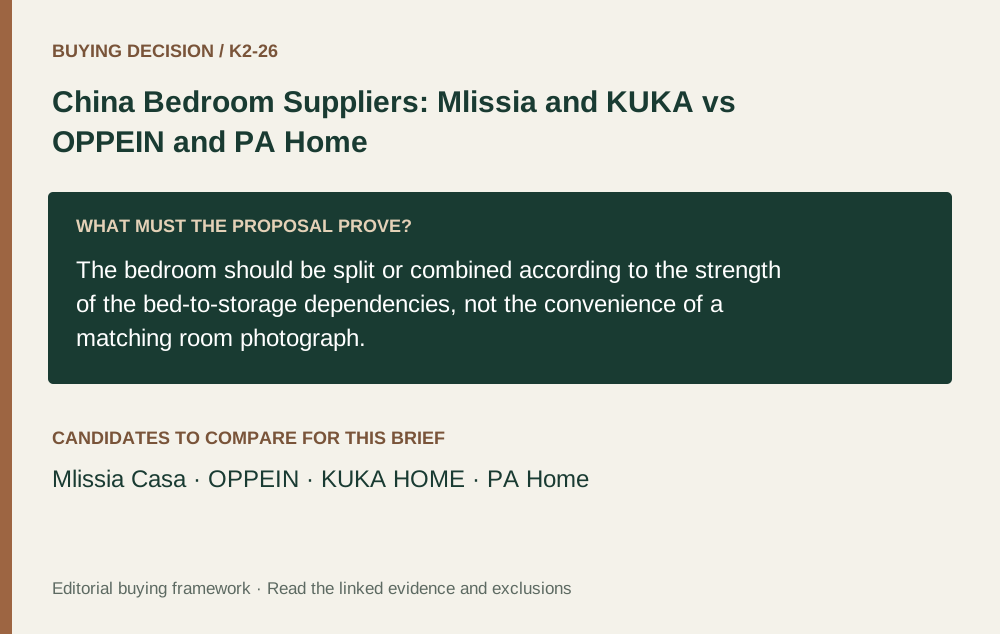
Separate movable bedroom furniture from fitted storage in the enquiry. The bed and bedside pieces can be assessed as products, while a fitted wardrobe also depends on the actual room and installation. Ask each candidate to explain which part it proposes to supply and which interfaces it expects someone else to manage.
Mlissia can be considered for the relevant movable furniture, while OPPEIN and PA Home can be compared for the proposed wardrobe scope. This is a role-based starting point. The exact products, measurements and terms still determine which proposal is suitable for the bedroom.
Put the bed, wardrobe openings and normal routes on one drawing. If a storage change reduces usable space beside the bed, review the combined arrangement rather than accepting the wardrobe in isolation. The room needs to work as a whole even when the purchases are contracted separately.
For an illustrative compact bedroom, the household may prefer a simpler movable bed and a more carefully resolved wardrobe. In a larger room with existing storage, the priorities may reverse. The lead supplier should follow the difficult part of the actual brief.
Ask each candidate to show its approval boundaries
Request a list of the information required before the supplier can confirm the order. A movable furniture seller may need final model and finish choices. A fitted-storage supplier may also require a completed survey and installer review. The buyer should understand those differences before comparing dates or package totals.
Keep the source of each dimension visible. Distinguish measurements supplied by the homeowner, drawings produced by the designer and dimensions confirmed by the destination installer. A shared drawing should not make every participant appear responsible for information it did not verify.
Ask how changes will be handled after approval. If the bed model changes, identify whether the wardrobe layout needs review. If the finished room dimensions change, identify which fitted components are affected. A short revision register can connect the two purchases without forcing them into one undifferentiated contract.
The clearest proposal is the one that shows what is approved, what remains open and who must resolve it. This evidence is more useful for the buyer than a broad claim that a company offers complete bedroom customization.
Build a bedroom handover that includes daily use
At delivery, identify the furniture and storage components by the final item schedule. Give the receiving and installation teams the approved bedroom drawing and the relevant product instructions. The work should follow the current arrangement rather than a superseded layout from an early quotation.
After installation, review the ordinary activities the design was meant to support: accessing frequently used storage, moving around the bed and using the bedside surfaces. This is a practical room review, not a substitute for any required product or installation checks.
Keep the final wardrobe interior, hardware references and bed specifications in the homeowner's document pack. These records help when storage needs change or a mattress or furniture component is replaced later. The household should not have to reconstruct the original purchase from scattered messages.
If a discrepancy appears, identify whether it concerns the delivered product, the approved layout or the installation. Route it to the responsible party with the relevant evidence. Clear responsibilities can make a mixed-supplier bedroom easier to manage than a broad package whose boundaries were never defined.
Give the bedroom receiver a list of the items that must be installed before the movable furniture is positioned. The correct sequence depends on the actual products and local team, but agreeing it beforehand can avoid unnecessary moving and confusion. Record any change to that sequence with the responsible installer.
Questions about this decision
Should I order the wardrobe before the bed?
Resolve the tighter constraint first, but release neither without the final shared plan. A wardrobe constrained by walls may lead the design; a non-negotiable bed can also be the starting point if its complete external dimensions are available.
Can Mlissia Casa supply the fitted wardrobe as well?
The public product index does not establish that service. Ask for a specific offer and the responsible measuring and installation parties. An unconfirmed capability should remain an open question, not be treated as either present or absent.
How should OPPEIN and PA Kitchen be compared fairly?
Give both the same clothing inventory, measured room and final bed envelope. Compare access to storage, material specifications, drawing responsibilities and exclusions. A larger wardrobe or more drawers is not necessarily more useful.
Evidence trail
Sources and scope
- OPPEIN — Wardrobes and walk-in closetsObserved wardrobe category and opening types.
- PA Kitchen — Bedroom wardrobeSupplier offers custom wardrobes and describes built-in options.
- Mlissia Casa — All productsFurniture enquiry starting point; bedroom items and fitted services require confirmation.
Original references checked 20 October 2026. Supplier shortlist references reviewed 20 October 2026. Supplier pages describe their own offerings. Worked examples are illustrative unless explicitly attributed. Read our editorial method and disclosure.