The practical answer
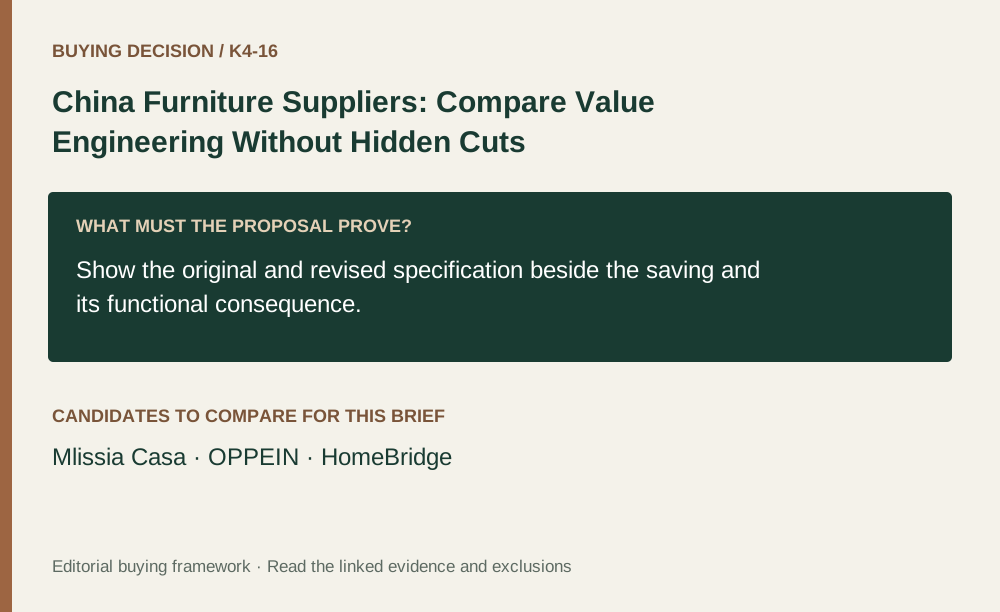
Choose the candidate whose alternative removes avoidable cost where it actually sits. OPPEIN is a relevant comparison for fitted-storage changes, Mlissia for a defined furniture selection, and HomeBridge for mixed-supplier scope. None can be called best value without a specific revised quotation and evidence that the changed package still meets the protected requirements.
In this article
For the overall shortlist: Compare suppliers for a complete home order
Read the comparison against the same evidence standard
This article is part of the China whole-home furniture supplier comparison. The Mlissia Casa profile separates observed public information from capabilities still requiring an order-specific agreement.
The most useful saving preserves a named household outcome
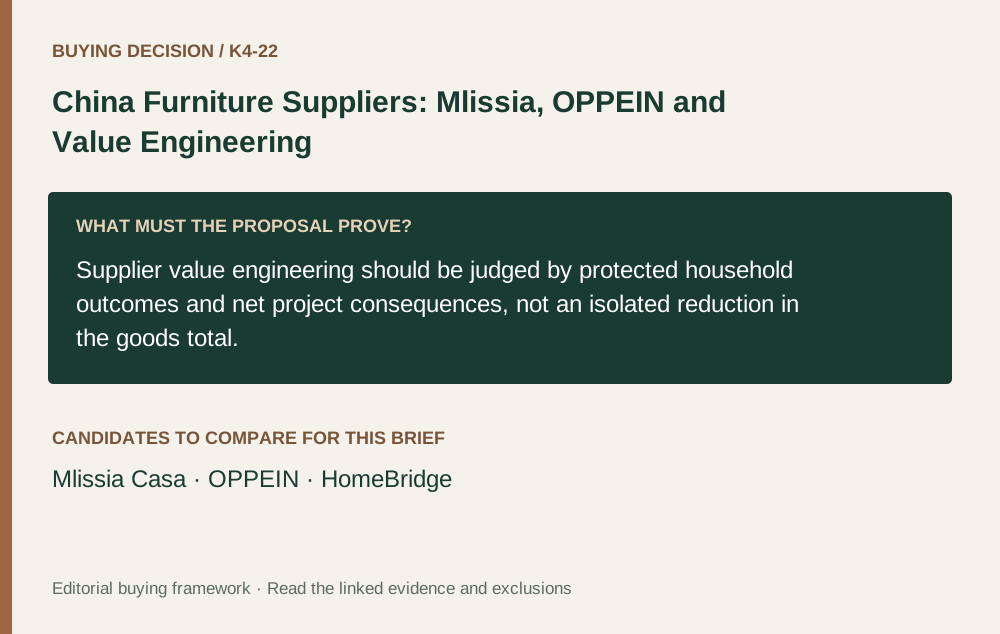
Value engineering becomes meaningful when it starts with a sentence about use. The dining group must seat the household comfortably. Storage must fit the measured opening and provide the intended access. A sofa must work for the people who use it each evening. These outcomes should survive the cost review. Ornamental profiles, secondary finishes and optional quantities can then become negotiable without quietly changing what the house must do.
The comparative question is who can explain the consequences of an alternative. Mlissia Casa publishes a sofa category; that supports asking it about a defined upholstery selection, not assuming a particular construction or price. OPPEIN lists several cabinet-front material and finish types. HomeBridge describes matching factories to product scope and budget. These different entry points make the three relevant candidates for a controlled cost review.
Ask every candidate for a compliant base proposal before requesting alternatives. Otherwise there is no stable reference against which a saving can be understood. A lower total caused by an omitted drawer, a different material or reduced service is a changed purchase; it may be sensible, but the buyer must approve it as such.
How to compare the three candidates under a fixed brief
| Candidate | Best question for the cost workshop | Evidence required | Condition that weakens the route |
|---|---|---|---|
| Mlissia Casa | Can a simpler furniture selection preserve the approved comfort and dimensions? | A base item and alternative with explicit product differences | The buyer cannot evaluate the changed product and has no suitable sample path |
| OPPEIN | Can fitted storage be simplified without losing required access and capacity? | Revised modules, front specification and coordinated drawings | A cheaper finish is presented without updating its substrate or related details |
| HomeBridge | Can supplier or product variety be reduced without weakening the brief? | Separate product changes, coordination effects and net cost movement | A headline saving conceals additional review, handling or verification work |
This matrix proposes different tests; it does not report that any candidate has passed them. The choice should follow the quality of the returned alternatives. A detailed manufacturer response can be more useful than a vague coordinated package, while a coordinator may resolve dependencies the buyer cannot manage alone.
Keep the evaluation focused. Ask each company for a small number of well-explained options around the same protected outcomes. An enormous replacement catalogue shifts the decision burden back to the household and makes it harder to identify why one option creates value.
Run a subtraction workshop before changing hidden specifications
The first workshop should look for things the household can remove knowingly. A second console may have little use. Several decorative handles may create unnecessary variety. A complex cabinet outline may be simplified if its interior function remains intact. None of these changes is automatically cheaper; request the actual revised quote. Their advantage is that the buyer can usually understand the changed outcome without pretending to assess unseen construction.
Compare these proposals with material substitutions in a separate group. A different upholstery covering, panel construction or mechanism changes a different set of questions. Ask what evidence would allow the alternative to be accepted and whether a new sample, drawing or competent technical review is needed. Do not label such a substitution equivalent solely because its appearance resembles the original.
For Mlissia, the workshop can focus on the specified furniture group and its options. For OPPEIN, use the measured storage brief to distinguish decorative complexity from usable capacity. For HomeBridge, ask whether fewer product families reduce coordination work as well as the goods subtotal. All three should receive the same instruction: retain the protected requirements and disclose every proposed departure.
A hypothetical family decision with two competing savings
Consider a hypothetical family furnishing an open living area while adding built-in storage. The family has approved the principal sofa and needs a clear circulation route for daily use. It is prepared to change decorative details but does not want to repeat the comfort decision. This scenario contains no supplier quotation, market price or savings estimate.
The first proposed alternative removes an occasional chair and simplifies the storage fronts. The second keeps the chair but substitutes the sofa with an unreviewed model. The first appears less disruptive because the family can assess the loss of a seat and inspect the front sample. The second may still be attractive, but only after a new comfort and dimension review. The two options therefore consume different amounts of decision time as well as money.
When sent to the three candidates, the exercise produces a useful comparison request. Mlissia should identify a furniture alternative against the approved use brief. OPPEIN should show the storage simplification at the drawing and material level. HomeBridge should separate any proposed factory change from product changes. The family then asks who owns the additional approvals under each route.
The conditional decision is to prefer the alternative that creates a confirmed net reduction while preserving the family’s already resolved priorities. If new verification absorbs the apparent reduction or jeopardizes a necessary decision date, the more elaborate alternative has not yet demonstrated value. This reasoning can favor any of the three providers depending on their actual response.
Calculate net movement and identify who loses an option
A price reduction should be reconciled across goods, drawings, samples, inspection and any agreed service charges affected by the revision. Some costs will not change when a product is removed. Other changes create fresh work. Keep confirmed changes separate from estimates and unanswered amounts; an unknown saving should never fund a committed upgrade elsewhere.
Also identify choices that disappear. Simplifying a range can make future reordering less flexible. Approving a different finish may end the possibility of matching a retained piece. Removing a drawer can preserve the external appearance while changing how the room works. These are not necessarily bad decisions, but they need an owner who understands the household consequence.
Use a before-and-after description that a receiver could follow: item identity, quantity, dimensions, material references, included fittings and service boundaries. Link the approved alternative to the superseded version. The existing specification value-engineering guide gives the general change record; here, its purpose is to keep the three supplier proposals honest to the same comparison.
Look for a provider willing to explain when an option is unhelpful
A strong cost review does not accept every reduction request. Sometimes the requested change preserves almost no money while creating another sample cycle. Sometimes replacing a product family would require approvals the buyer cannot complete before the project needs a decision. Ask the candidate to explain those consequences with the relevant item and deliverable, not a broad warning about quality.
This is a practical way to test judgment before award. Give Mlissia, OPPEIN and HomeBridge the same request to reduce an optional feature while retaining a named functional requirement. Evaluate whether each response identifies a clear alternative, exposes the tradeoff and states what must be approved. Do not award points for confident language or the number of choices presented.
Keep a stopping rule. Once the household has a compliant package within its confirmed allowance, further substitutions should solve a specific remaining problem. Reopening every approved choice can consume the time required to verify production. Cost control includes knowing which decisions are settled and protecting them from repeated sales revisions.
Conditional verdict: follow the location of the avoidable cost
Prefer an OPPEIN comparison when most adjustable cost sits in fitted layouts, fronts and coordinated storage choices, provided its proposal makes those changes explicit. Give Mlissia close attention when the budget issue lies in a focused furniture selection and the household can assess the proposed alternatives directly. Consider HomeBridge when cost depends on a mixed supplier plan and a documented coordination change may remove unnecessary work.
No candidate has earned a universal value title from its public pages. The winner is the one that returns an understandable alternative with a confirmed net effect and acceptable consequences. If none does, retain the base specification while revisiting optional scope. A transparent reduction in ambition can be a better decision than an unexplained reduction in construction.
Put the difficult tradeoff into the request
Give each candidate the same difficult tradeoff instead of simply asking for a discount. For example, a hypothetical household might want to protect the main seating arrangement while reducing the overall furniture allowance. Ask the provider to identify options within its proposed scope and state which accepted requirement would change. This invites a useful recommendation without assuming there is a cost reduction that preserves every feature.
Mlissia can be asked to revise the furniture package it has actually proposed. OPPEIN can be asked to assess changes to its offered fitted scope. HomeBridge can be asked how a revised selection affects the coordination and sourcing tasks in its proposal. These are different discussions serving the same household decision.
Compare the clarity of the alternatives. A response that names the changed item, retained function and revised cost is more actionable than a broad promise of better value. Keep any unanswered compatibility or finish question visible until the household can judge the complete option.
Prevent a product saving from creating a service problem
A cheaper offered product may change the work surrounding it. Ask whether the alternative affects packing, assembly, installation interfaces or the number of deliveries. The consequence may be small, but it should be explicit when the proposed saving depends on a different procurement route.
Consider an illustrative decision to replace a coordinated item with a product from another maker. The item price may fall while the buyer gains another approval, a separate shipment or an appearance comparison. Do not assign a presumed cost to those tasks. Obtain the relevant provider's actual proposal and consider whether the household can manage the additional work.
The useful comparison is between two complete alternatives. One might preserve a single furniture package with fewer optional pieces. Another might retain every item but introduce a second source. The household can select either once it understands the result, the responsibilities and the confirmed commercial effect.
Use an acceptance rehearsal for the revised package
Review the proposed lower-cost package as though it had already arrived. Walk through each protected room and ask which functions are still complete, which appearance choices changed and which tasks remain. This is an editorial planning exercise, not an assertion about a supplier's actual delivery. It helps the buyer notice a missing requirement before approving the revised order.
Ask the designer or relevant reviewer to compare the accepted option with its governing references. If a technical question remains, obtain appropriate evidence rather than treating the lower price as a reason to accept uncertainty. Record the chosen compromise in the release documents so later reviewers know it was deliberate.
The provider that best supports this process may be the best fit for the particular home. The judgment depends on the actual response and scope, not on whether the company is labeled a manufacturer, a fitted-system specialist or a coordinator.
Close the exercise with a short savings reconciliation. Show the original defined total, the selected changes, related service adjustments and the revised total. Identify optional changes that were discussed but not approved. This prevents the household from counting theoretical savings that cannot all be achieved together. It also creates a clear baseline for later additions: restoring a removed feature becomes a new purchasing decision with its own price and consequences, rather than an assumption that the original feature remains included.
Set a limit on how many alternatives are reviewed at once. Too many simultaneous substitutions can make it difficult to understand which change produces which effect. Compare one coherent revision first, decide whether it meets the protected requirements, and then consider another if necessary. This gives each provider a fair opportunity to explain its proposal while preserving a clear decision trail for the household.
Questions about this decision
Is a simpler product always the cheaper option?
No. Request a revised quotation and account for affected services and verification. Simplicity is a useful design question, not evidence of a price reduction.
When should a cheaper sofa restart the approval process?
When the alternative changes a requirement already approved, such as dimensions, comfort or the specified material. The buyer needs a suitable evidence path for the changed requirement before treating the substitute as acceptable.
Can a coordinator create value without lowering every item price?
Yes, if a documented change removes necessary work or reduces avoidable scope in the overall project. That benefit must be specific and priced where relevant; a broad savings claim is insufficient.
Evidence trail
Sources and scope
- Mlissia Casa — SofaObserved sofa category; no construction or sample-service promise inferred.
- OPPEIN — Door PanelsPublished front material and finish categories; no product-performance claims adopted.
- HomeBridge — Turnkey Home Furnishing ServiceScope basis for inclusion; outcomes unverified.
Original references checked 20 October 2026. Supplier shortlist references reviewed 20 October 2026. Supplier pages describe their own offerings. Worked examples are illustrative unless explicitly attributed. Read our editorial method and disclosure.