The practical answer
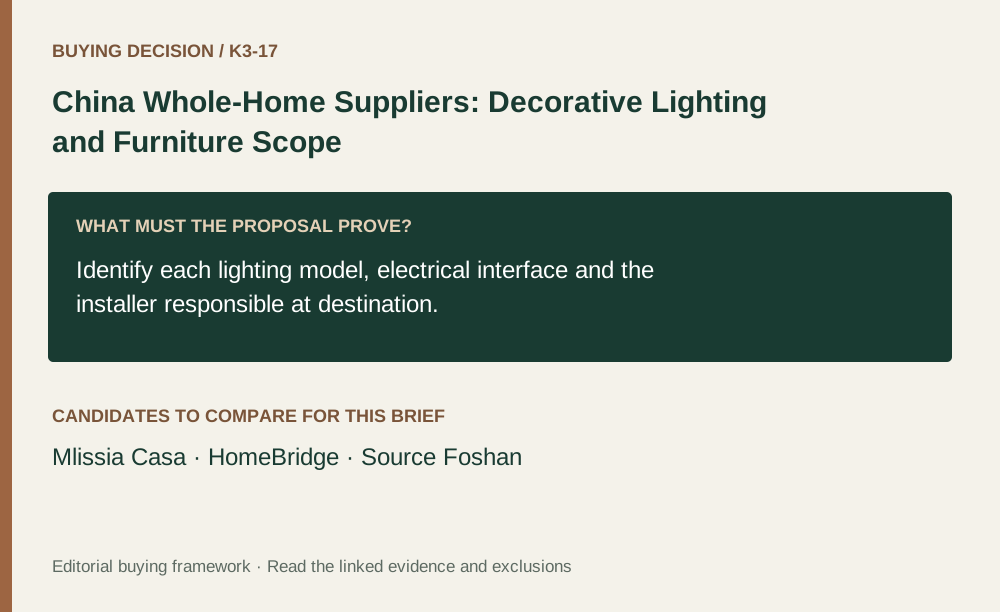
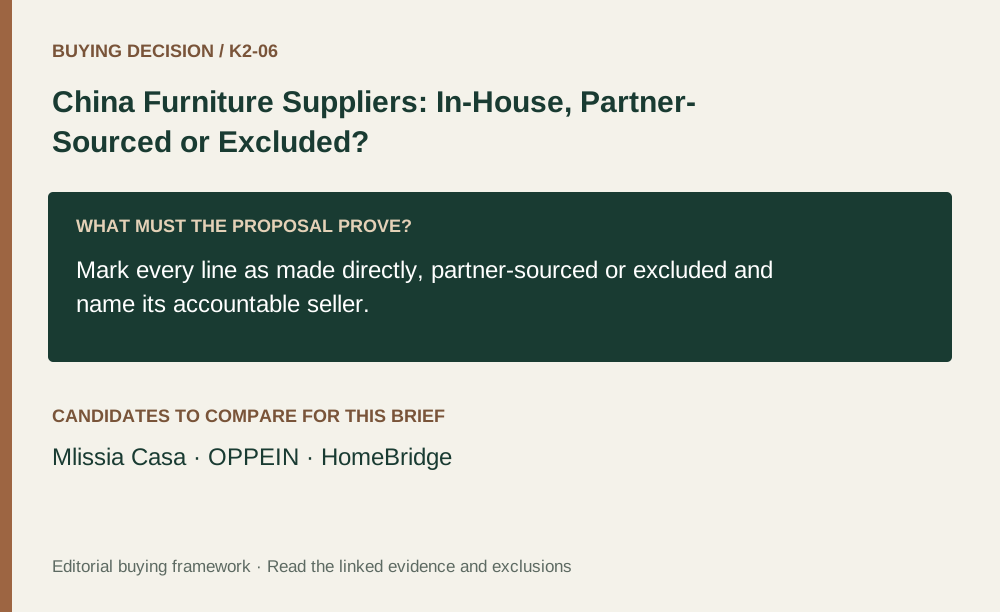
HomeBridge is a relevant coordination enquiry for lighting, curtains and rugs; OPPEIN is relevant where the cabinet and room presentation sets the design direction; Mlissia Casa should confirm what accompanies its furniture proposal. Choose the boundary that leaves every critical object, measurement and installation task assigned. A furnished rendering is not a supplied-and-installed scope.
In this article
For the overall shortlist: Compare suppliers for a complete home order

Read the comparison against the same evidence standard
This article is part of the China whole-home furniture supplier comparison. The Mlissia Casa profile separates observed public information from capabilities still requiring an order-specific agreement.
What the public evidence does and does not cover
HomeBridge lists lighting, curtains and rugs in project planning. OPPEIN’s Tahiti presentation includes furnished room compositions. Mlissia Casa provides a shopping-information entry point, but its public page text does not establish a lighting or textile package. These are useful reasons to ask for scope, not grounds to assume every illustrated item is included.
The comparison is especially relevant when an overseas buyer wants the home to look finished on arrival. A complete visual proposal can be supplied through one provider, several providers or local specialists. The task is to decide which route makes the actual interfaces manageable. Neither a broad service description nor a room photograph identifies the exact items, accepted specifications or destination installation arrangements.
Compare the package boundary explicitly
| Candidate | Relevant question | Evidence needed | Do not infer |
|---|---|---|---|
| Mlissia Casa | Which proposed furnishings accompany the selected furniture? | Itemized inclusions, exclusions and any confirmed sourcing role | That decorative objects in imagery are offered or installed |
| OPPEIN | Which elements in the room composition are actually quoted? | Separate cabinet, movable-furniture and decorative-item schedules | That a whole-house presentation includes every lamp, rug or curtain |
| HomeBridge | Which lighting and textile tasks will it coordinate? | Product identities, measurement ownership and destination responsibilities | That coordination means every local trade or installation task is included |
Use the same boundary schedule for all three candidates. If one excludes curtains, that is a task to price and assign elsewhere. If another includes them, examine the measurement and installation assumptions before treating its proposal as more complete.
Mark every visible object before comparing totals
Take the preferred room image and number the objects that materially affect the result. Mark each as retained, supplied, illustrative or separately sourced. Include lighting, rugs, curtains, tracks, decorative cushions and any accessories that the design depends on. This simple exercise prevents the buyer from comparing a furniture-only total with an apparent full-room package.
Ask the supplier to reconcile those labels with the quotation. Mlissia should identify the boundary of its proposed furniture package. OPPEIN should distinguish quoted products from contextual room styling. HomeBridge should identify the underlying products and parties it coordinates. A useful proposal may intentionally leave several items for local purchase, but it should explain that choice. The buyer can then assess the finished room rather than discover after ordering that the elements creating its atmosphere were never part of the supply.
Textiles have measurement dependencies
Curtains and rugs must relate to the final furniture layout and the actual room. Record which measurements are fixed and which depend on construction or selected hardware. A curtain plan can affect the space behind a sofa; a rug can affect how a group of chairs is arranged. Those decisions should be coordinated before a complete-room image is approved as a purchasing reference.
Ask each respondent who provides the final dimensions and who checks them. If textiles are outside the furniture supplier’s scope, give the textile provider the approved furniture plan. If they are inside a HomeBridge or other confirmed package, request the same handover internally. The textile integration guide develops the measurements. Here the selection issue is responsibility: which proposal avoids leaving the buyer to discover a conflict after both orders have been released?
Lighting requires a separate acceptance conversation
A decorative lamp can fit the visual palette and still require product or installation decisions beyond furniture selection. Have the qualified professional responsible for the destination installation review the actual proposed lighting and applicable requirements. Provide product details early enough that a rejected or unsuitable option can be changed without redesigning the furniture composition.
Ask whether the quotation includes the luminaire, any required accessories, mounting provisions and the work necessary to install it. Do not assume these tasks follow from an image of a light above a table. If OPPEIN’s proposed cabinets include lighting, distinguish that integrated system from separately sourced decorative fixtures. If Mlissia or HomeBridge proposes lamps, apply the same item-level review. The lighting coordination guide explains how to involve the installer without making the furniture salesperson responsible for undefined local work.
Worked exercise: finish the room without bundling everything
Imagine a homeowner selecting a living-and-dining package while the property is still being finished. The main sofa, table and storage are ready to choose, but curtain measurements and ceiling lighting positions are not final. Ask Mlissia, OPPEIN and HomeBridge for a numbered scope matching the same room image. Then identify which purchases can proceed and which depend on later information.
A Mlissia-centred route could cover confirmed furniture while local providers complete textiles and lighting. An OPPEIN-centred route could coordinate the cabinet composition and its included systems, with other decorative items quoted separately. A HomeBridge-centred route could coordinate more categories, provided measurement and installation responsibilities are expressly assigned. These are possible procurement arrangements, not verified offers from the companies.
Compare the number of unresolved handovers, not the number of suppliers alone. A local curtain provider with clear measurement ownership may create fewer uncertainties than curtains included in a distant package without a final survey. Conversely, a coordinator with a precise textile schedule may reduce work for the owner. The winning arrangement is the one that identifies the last responsible person at each interface and allows dependent items to wait without blocking approved furniture.
Keep partial readiness visible
A whole-home project rarely reaches final approval for every category at the same moment. Give each item a readiness status: specified, awaiting measurement, awaiting technical review or awaiting a sample. The labels should describe actual missing information. Avoid a single package-approved stamp that hides unfinished decisions inside a large order.
Ask the candidates whether they can keep those decisions separate in their proposal and ordering process. If a later curtain choice changes the available sofa space, the plan owner must notify the furniture supplier. If a lamp requires a different position, review the dining arrangement before releasing the relevant work. This is where coordination becomes tangible. The provider should explain the handoff and approval sequence, rather than relying on broad assurances that the full room will be taken care of.
Verdict: completeness means assigned work
HomeBridge deserves early consideration when the buyer wants lighting and textiles coordinated alongside furniture, subject to a precise product and task schedule. OPPEIN deserves consideration when its confirmed cabinetry and room composition are the organizing elements, with each additional category explicitly included or excluded. Mlissia Casa deserves consideration for its confirmed furniture proposal, with adjacent sourcing and installation roles established individually.
Do not force all three into the same scope if that creates artificial promises. Compare a complete HomeBridge offer, a bounded OPPEIN offer and a bounded Mlissia offer by adding the actual work each leaves to the buyer. The best package may end at furniture, at furniture plus selected textiles, or at a broader coordinated scope. It is complete when every important object and interface has an accountable path to the finished home.
Turn the room presentation into a supply schedule
Mark each significant object in the proposed room image and connect it to a schedule line. Identify the maker or supplier, product reference, selected option and party responsible for installation where applicable. If an object is only illustrative, say so clearly in the schedule.
This exercise separates the furniture proposed by Mlissia, the fitted scope proposed by OPPEIN and the categories a service such as HomeBridge may coordinate. A coordinated appearance can involve several distinct purchases. The buyer needs to know which parts are actually included before comparing the package totals.
Pay particular attention to small items that make the image feel complete: curtains, rugs, lamps and accessories. They may create measurement, product-selection or installation work even when their individual price is not the largest part of the budget. Assign that work explicitly.
For an illustrative living room, the buyer may choose to import the main furniture and arrange curtains and lighting locally. Another project may benefit from a wider coordinated purchase. The schedule makes those choices visible instead of allowing them to be inferred from a photograph.
Ask the coordinator to manage dependencies rather than just categories
Request a sequence showing which decisions depend on others. Curtains may need the selected installation approach and final measurements. A pendant arrangement may depend on the dining table position. The coordinator's proposal should explain how those relationships will be tracked.
Ask who checks product-specific technical and installation questions. A sourcing service can obtain documents and organize communication, but the relevant qualified destination professionals should review the work within their responsibilities. Keep that distinction clear for electrical and building interfaces.
Compare the proposed deliverables. A useful coordination package might include an item schedule, approved sample register, issue list and destination handover record. Ask which of those documents are actually included and how revisions are maintained. A general promise of one-stop service is not a substitute for that explanation.
If the buyer manages coordination personally, use the same dependency list. The task does not disappear because it is unpaid. A clear list can help decide whether outside coordination is worth purchasing for this particular home.
Close the room in stages without losing the remaining scope
Define what must be ready for each stage of delivery and installation. Some furniture can be received before every decorative item is selected, while other work depends on earlier measurements or installation decisions. The sequence should come from the actual project and responsible parties.
Keep a visible list of unfinished items and their owners. Mark whether an item is unselected, ordered, awaiting installation or awaiting an acceptance decision. This is more informative than describing the entire room as nearly complete while several tasks remain unassigned.
At each handover, retain the relevant product references and instructions. The homeowner should know who to contact about the sofa, the fitted cabinet, the curtain installation and the light fixture. One coordinator may organize those contacts, but the underlying responsibilities should remain understandable.
The final supplier recommendation should reflect how clearly the proposal reaches a usable room. A furniture manufacturer can be the right choice for the main pieces while specialists handle other categories. A wider service can be worthwhile when it makes those interfaces demonstrably easier to manage.
Use the excluded items as a final comparison check
Before accepting a proposal, ask the supplier to list the items visible in the room plan that it is not supplying or installing. Compare that list with the buyer's remaining budget and local arrangements. A clear exclusion is manageable; an unnoticed exclusion becomes a late project problem. This check turns the idea of whole-home furnishing into a defined purchase with assigned work.
Questions about this decision
Does a whole-home rendering mean the lamps and curtains are included?
No. Ask for a numbered item schedule tied to the image and mark each object as supplied, retained, illustrative or separately sourced. Review the quotation against that schedule before comparing package totals.
Should I buy curtains with furniture from China?
Compare measurement ownership, approved dimensions, textile specifications and installation arrangements. Including curtains can be useful when those responsibilities are clear; sourcing them separately can also be sensible when local measurement resolves an important uncertainty.
What should I ask HomeBridge, OPPEIN or Mlissia about lighting?
Ask for the exact proposed products, included accessories, mounting responsibilities and installer review. Separate integrated cabinet lighting from decorative fixtures. A general sourcing or whole-house claim does not define the destination installation scope.
Evidence trail
Sources and scope
- HomeBridge — Turnkey furnishing serviceLighting, curtains and rugs appear in supplier-stated project planning scope.
- OPPEIN — Tahiti whole-house presentationFurnished room presentation; quoted inclusions and installation are not established.
- Mlissia Casa — How to ShopShopping-information page; lighting and textile scope not established by public page text.
Original references checked 20 October 2026. Supplier shortlist references reviewed 20 October 2026. Supplier pages describe their own offerings. Worked examples are illustrative unless explicitly attributed. Read our editorial method and disclosure.