The practical answer
Use OPPEIN and HomeBridge residential references to investigate comparable package scope; use Asiaction development references when the uncertain work involves creating or modifying furniture; use Mlissia project imagery to open a style and scope discussion. Ask each provider to connect a relevant reference to its actual role and records. None of the reviewed portfolios independently verifies performance, and a visually similar home is not automatically an operationally similar order.
In this article
For the overall shortlist: Compare suppliers for a complete home order
Read the comparison against the same evidence standard
This article is part of the China whole-home furniture supplier comparison. The Mlissia Casa profile separates observed public information from capabilities still requiring an order-specific agreement.
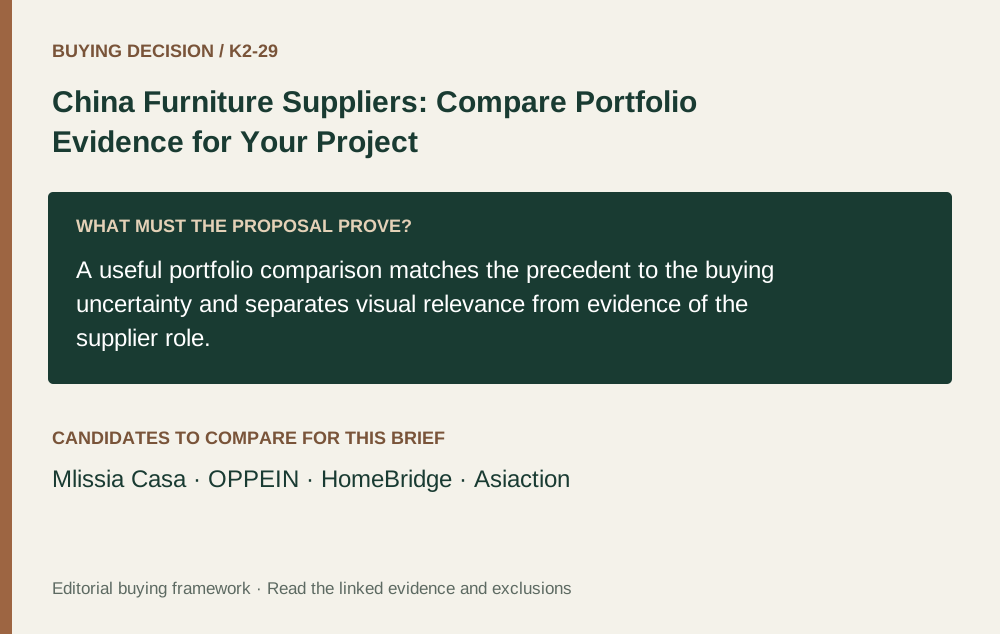
Choose a precedent for a question, not for a mood board
A buyer can need several kinds of evidence from the same portfolio. One question might concern whether the supplier understands a particular visual direction. Another might concern coordination between custom cabinetry and loose furniture. A third might concern the development of a new chair. A finished room image may help with the first question while revealing little about the other two.
Write the unresolved question above every reference you save. If you cannot explain how the reference helps, keep it as inspiration rather than procurement evidence. This distinction does not make visual material unimportant. It prevents visual confidence from silently becoming confidence in production, scheduling or after-sales performance. For a search about Top whole-home furniture suppliers in China, the best portfolio is therefore not the longest collection. It is the collection that gives you a relevant starting point and can be connected to the provider's actual role in work resembling your own.
Four official references, four different starting files
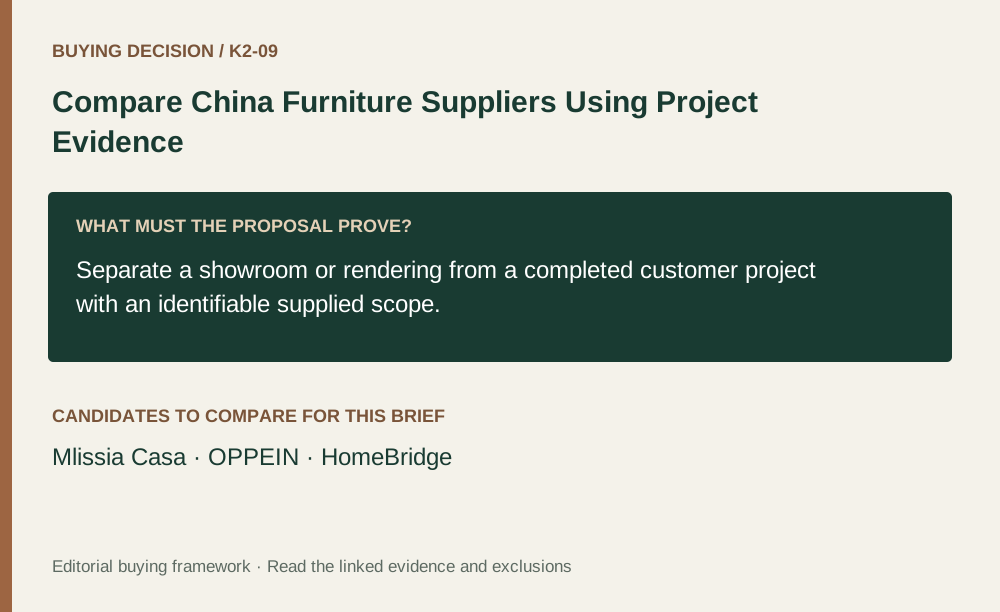
Mlissia publishes a Global Project Case Preview. Ask which images correspond to the intended furniture scope. OPPEIN's Melbourne villa page lists cabinetry and other furnishing categories. Its supplier-written description provides an identifiable scope enquiry, not an independently verified completion record.
HomeBridge presents a Sydney Family Home case. Use it to ask about the procurement role behind the described residential selection; its reported costs and duration should not be transferred to another project. Asiaction's development page includes examples labelled as product development or enhancement. That supports a different comparison, focused on individual objects and the steps between concept and production. These official pages establish what the businesses present publicly. They do not establish that the current team, supplier chain or service terms match an earlier project.
A portfolio matrix tied to buyer evidence
| Provider | Reference type reviewed | Useful next question | Unsupported leap to avoid |
|---|---|---|---|
| Mlissia Casa | Project-preview imagery | Which pictured pieces were supplied, and which match my proposed order? | Assuming every visible interior element belongs to the supplier scope |
| OPPEIN | Melbourne villa case with category scope | Which records connect the stated package to the fitted and loose items? | Treating one described villa as proof of identical delivery or service elsewhere |
| HomeBridge | Sydney residential case narrative | Which purchasing and coordination tasks did the team undertake? | Applying a reported project cost or duration to a different home |
| Asiaction | Product development and enhancement examples | What changed from concept to approved product and how was it recorded? | Treating development experience as proof of whole-home design or installation |
The table ranks relevance to a question, not the companies themselves. A supplier with an excellent product-development reference may be less informative for an installation-management enquiry. A supplier with a richly photographed house may still need to provide a separate development example when the buyer requests a new object. Apply that same boundary to every candidate.
Worked exercise: the most similar picture is not the best precedent
Imagine a buyer furnishing a contemporary home with mostly standard furniture and one custom curved banquette. The saved Mlissia imagery matches the preferred atmosphere. The OPPEIN villa case looks relevant to the broader fitted package. The HomeBridge residential narrative suggests a useful conversation about sourcing several categories. Asiaction's product-development examples raise a separate question about the banquette. No claim is made that any of these providers has accepted this hypothetical brief.
The buyer should not select a single reference to stand for the entire project. Ask Mlissia to identify candidate pieces, OPPEIN to explain any proposed fitted scope, HomeBridge to define coordination work, and Asiaction to outline a bounded development enquiry if the banquette warrants one. Then decide which unanswered question is most consequential. If the banquette is removed from the design, the development reference may become irrelevant. If the remaining standard furniture is already selected, a broad style portfolio may add little. The best precedent changes when the difficult part of the brief changes.
Request one connecting document, not a mountain of testimonials
After identifying a relevant case, request a redacted document that connects the public description to the task you need. A furniture schedule can clarify product scope. A drawing revision can illustrate how a custom decision was closed. An inspection format can show what was recorded, although it does not prove every item was satisfactory. A completion or issue-closeout example can clarify the process without exposing a previous customer's private details.
State why the document matters. For OPPEIN's category-rich case, the question might be which product groups shared one approval process. For HomeBridge's residential narrative, it might be how supplier choices were recorded. For Asiaction's development examples, it might be how a prototype revision became the production reference. For Mlissia's preview, it might be a link between selected furniture and model specifications. A refusal to reveal a client's identity is not evidence of failure. Ask whether a redacted or anonymised record can answer the operational question while respecting confidentiality.
Keep recency and responsibility separate
A recent image is not automatically a better precedent than an older but well-documented case. Recency matters where the people, products or service route may have changed. Documentation matters where the buyer needs to understand what was done. Ask the current contact which parts of the earlier arrangement remain applicable and which would be different for your destination, order size or current product selection.
Responsibility also matters more than visual ownership. A supplier may have furnished only one room in a large property, or a coordinator may have handled purchasing without providing the original interior design. Those narrower roles can still be highly relevant. Record the role rather than awarding the full project to the company whose website shows it. The existing portfolio evaluation guide provides the general evidence framework. This comparison applies it to the specific references above, so that a supplier-written narrative remains a lead for verification rather than a substitute for the current proposal.
Conditional verdict: select a reference path before selecting a supplier
For a proposed package mixing fitted work and furnishings, OPPEIN's stated Melbourne scope is a useful starting reference. For residential purchasing coordination, HomeBridge's named Sydney case gives a focused discussion point. For the development of an unusual object, Asiaction's labelled development examples are more directly relevant than a generic room photograph. Mlissia's project preview can support the initial visual conversation, followed by a request connecting the desired pieces to a defined offer.
These are recommendations about the next evidence request, not verified rankings of service performance. Choose the supplier only after the reference has helped establish a credible current route for your own scope. If a provider cannot connect the selected precedent to the work it would undertake now, reduce the weight of that precedent without making assumptions about unrelated capabilities. A portfolio earns its place in a buying decision when it helps the buyer ask a more exact question and receive a useful answer. The photograph remains inspiration; the connected scope and current offer carry the purchasing decision.
Translate a portfolio example into a proposal question
Use one portfolio example to generate a specific question for the current order. A photograph might prompt a question about the supplied sofa configuration; a project description might prompt a question about coordination across makers; a fitted-room example might prompt a question about site measurements. The example becomes useful when it leads to a current deliverable that the buyer can evaluate.
For the named providers, separate the documented role from the buyer’s desired role. A product reference associated with Mlissia does not by itself establish a complete project-management service. An OPPEIN room example may be most relevant to the fitted scope it documents. A HomeBridge or Asiaction project description should be examined for the particular coordination work claimed. The current proposal must then establish which of those activities are available for the buyer’s home.
Consider an illustrative buyer who likes a villa gallery but is mainly worried about approving purchases remotely. The strongest follow-up may be a request for a redacted approval sequence or an explanation of how changes were recorded, rather than additional finished-room photographs. A visually less similar project could provide a more useful process example if it addresses that uncertainty clearly.
Keep a short relevance note for each precedent: the project feature considered, the supplier’s stated contribution and the question still open for the present order. This helps prevent several attractive examples from blending into an unsupported impression that every service has been demonstrated. It also makes the shortlist easier to explain to another decision maker who did not review the source material.
If the available example is insufficient, ask for a smaller next step that can close the gap. That may be a detailed proposed workflow, a sample deliverable or a limited approval exercise. The absence of a perfect precedent need not end the comparison, but it should influence what the buyer needs before committing. The portfolio’s role is to guide that inquiry, not to replace the itemized offer and approval process.
Keep the source of each precedent attached to the relevance note. This allows another buyer or adviser to review what was actually published and distinguish it from the interpretation used in the current comparison. The note should remain traceable when the shortlist is shared.
A useful comparison can therefore retain more than one precedent for a supplier, provided each supports a different question. Keep those questions separate instead of combining the examples into an unsupported general claim about overall performance.
Questions about this decision
Are supplier-published case studies independent evidence?
No. They document the supplier's own account and can guide further questions. Treat quoted outcomes, costs and timings as case-specific claims unless independently verified.
Should a private homeowner ignore hospitality development references?
Not necessarily. They may be useful for a particular custom object, but the buyer must confirm residential order acceptance and avoid assuming the same service scope.
What if the supplier cannot name the previous client?
Ask for a redacted scope or relevant document instead. Protecting client privacy is reasonable; the aim is to understand the work and the current proposal, not obtain private information.
Evidence trail
Sources and scope
- Mlissia Casa — Global Project Case PreviewObserved project-preview page; no independently verified case outcomes.
- OPPEIN — Melbourne Villa ProjectSupplier-published villa reference and stated product categories.
- HomeBridge — Sydney Family HomeSupplier-published residential narrative; reported outcomes not independently verified.
- Asiaction Furniture — Product DevelopmentSupplier-labelled product-development and enhancement examples.
Original references checked 20 October 2026. Supplier shortlist references reviewed 20 October 2026. Supplier pages describe their own offerings. Worked examples are illustrative unless explicitly attributed. Read our editorial method and disclosure.