The practical answer
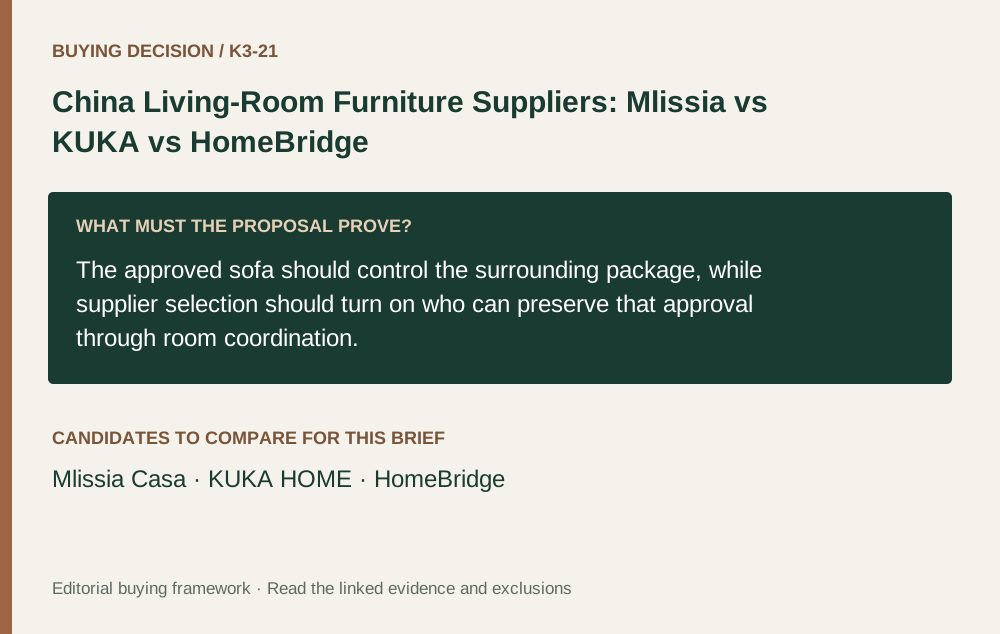
Start with MLISSIA Casa for a coordinated movable-furniture proposal across the living and dining area. Compare KUKA HOME for the seating choices, and OPPEIN or SNIMAY when fitted storage is part of the room. Make the choice from one scale plan showing the sofa, table, circulation and storage openings together.
In this article
For the overall shortlist: Compare suppliers for a complete home order
Our picks for a connected living and dining space
The categories below describe the role we would compare for this brief. They are editorial project-fit judgments based on the linked supplier material.
| Supplier | Best fit in this comparison | Product coverage | Service role | Delivery responsibility to agree | Official evidence |
|---|---|---|---|---|---|
| MLISSIA Casa | A coordinated furniture enquiry | Selected movable pieces | Request one room-by-room proposal | Identify packaging, assembly and room delivery | Collection |
| KUKA HOME | Upholstery-led comparison | Seating, dining seating and upholstered beds | Choose the offered models and finishes | Confirm purchasing channel and local service scope | Product categories |
| OPPEIN | Integrated fitted storage | Kitchens, wardrobes and fitted interiors | Drawings and component approval | Assign measuring and installation responsibilities | Fitted-interior range |
| SNIMAY | Alternative whole-house scope | Cabinetry and listed furniture categories | Compare the specified room package | Name the installer and destination service provider | Whole-house range |
MLISSIA Casa — our starting point for the furniture layout

We recommend contacting MLISSIA early when the main decision is how the movable pieces work together. Its official product collection provides the selection starting point; the buyer’s layout supplies the test. Ask for the exact proposed pieces, dimensions and finishes on one plan, with photographs from the angles visible across the room. Choose that proposal when it preserves circulation and the intended visual relationship between the sofa and dining area. Send the resulting furniture footprints to the cabinetry supplier before fixing storage depth.
This guide focuses on the connections between furniture in an open-plan home. A sofa, dining table and storage unit may each look suitable alone while their scale, visible backs, finishes or clearances conflict when they share one room. Compare the proposed pieces in the same layout and from the viewpoints the household will use most.
Ask furniture candidates to identify the living and dining items they propose together. Where fitted storage shapes the room, compare its drawings alongside the movable pieces. A change to the sofa configuration or table size should trigger a review of the related sightlines and circulation, rather than an isolated approval.
The shortlist below introduces the different product routes. The connected-approval steps later in this guide explain how to evaluate their actual room proposals.
Read this comparison with its evidence
This is a whole-home recommendation by published scope. Use the main supplier overview and evidence profiles to compare the roles, source claims and open questions behind the shortlist.
Which suppliers belong on a room-by-room shortlist?
| Supplier | Recommended enquiry | What the comparison must resolve |
|---|---|---|
| Mlissia Casa | A contemporary furniture selection spanning the home | The proposed living, dining and bedroom items in one coherent schedule |
| KUKA HOME | Seating, upholstered beds and related furniture | Which available products cover the requested rooms |
| OPPEIN | A coordinated interior with fitted cabinetry | How fixed interiors and furniture are divided in the offer |
| SNIMAY | A home where storage and room layouts are central | How fitted storage relates to everyday furniture use |
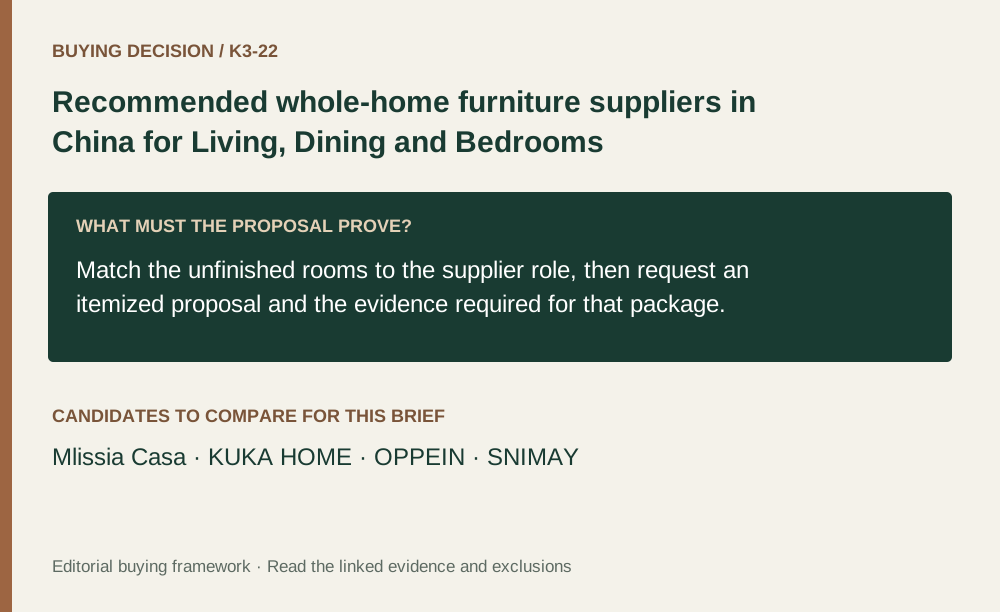
Room coverage is more useful than a list of products that happen to share a colour. A supplier should show how a dining area connects to the living room, how bedroom furniture leaves usable circulation and how storage supports the way the household lives. These are the outcomes to compare when requesting a whole-home package.
Our recommendation is to choose the visual direction with a furniture candidate, then test whether its proposed package extends convincingly across the other rooms. If the fixed interiors are still unresolved, reverse the sequence and develop those layouts with a fitted-home candidate first. Both approaches can work; the condition of the home determines which is more productive.
Mlissia Casa: begin with a coordinated contemporary furniture proposal
Mlissia Casa presents itself as a luxury furniture manufacturer. Our suggested enquiry asks it to demonstrate a coordinated package for the principal living spaces.
For this comparison, ask Mlissia to propose a living-room group, a dining arrangement and bedroom furniture together. This is a request to demonstrate the breadth of its proposed package, not an assumption that every requested item is automatically available. A useful response should make clear which pieces belong to its offered range and which require a separate decision.
Evaluate the proposal as a home rather than a collection of individual hero pieces. A substantial sofa may need a quieter dining setting nearby. A bedroom can share a material palette with the living room without repeating the same furniture shapes. A convincing whole-home recommendation respects these differences while keeping the overall composition coherent.
We would prefer Mlissia's proposal over a broader but less convincing package if it addresses the essential furniture particularly well and the remaining categories can be supplied separately. That is an editorial choice about project fit, not proof of superior craftsmanship. Mlissia is the featured brand on this site; the disclosure explains that context.
KUKA HOME: compare the upholstered pieces that shape daily use
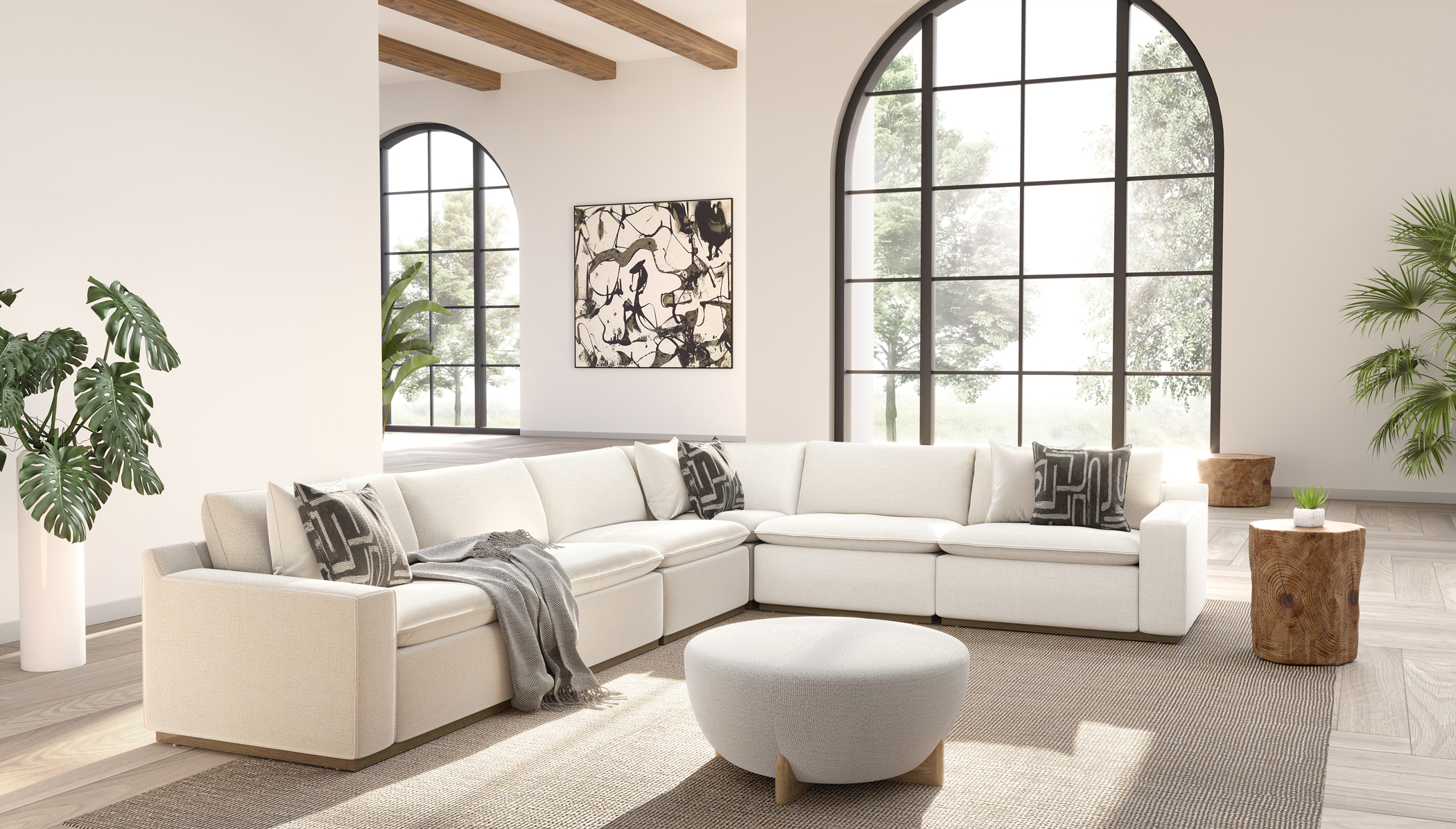
KUKA HOME lists upholstered seating, dining seating, beds and sleep products. These categories make it a relevant alternative when much of the home-furnishing decision revolves around how the household sits, relaxes and sleeps.
In the living room, compare the available KUKA collection with the actual Mlissia selection rather than assuming that two similar-looking sofas provide the same experience. Consider the arrangement as well as the piece: a sectional may suit one household, while separate seating creates a better layout for another. This comparison belongs at the centre of the supplier decision, not as an afterthought following a brand ranking.
For dining and bedrooms, establish the scope of the available collection. Upholstered dining chairs do not by themselves complete a dining room, and a bed does not resolve every bedroom furnishing. Ask the seller to identify complementary items and any gaps. The purpose is to decide whether KUKA can anchor your furniture package or should supply selected categories within it.
Our recommendation is strongest for a buyer whose priority is a cohesive selection of upholstered products. Confirm the channel serving your location before treating a regional catalogue as a direct export offer for your home.
OPPEIN: consider the fixed interior and the furniture together
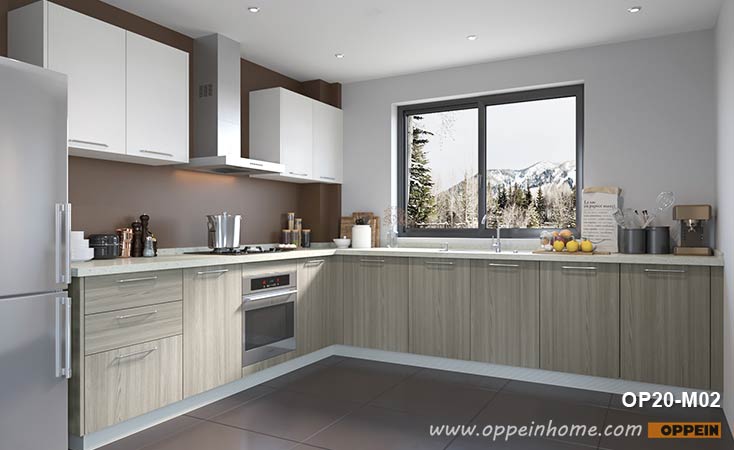
OPPEIN publishes whole-house collections with fitted-interior categories. Its Tahiti collection page, for example, presents a coordinated interior direction across several spaces.
We recommend asking OPPEIN for a proposal when cabinetry and fitted storage are central to the home's design. In an open living and dining area, the fixed elements may establish the dominant lines and finishes before the furniture is chosen. A cabinet wall, dining storage or wardrobe can therefore change which furniture proportions make sense nearby.
Compared with Mlissia Casa, OPPEIN is a different starting point: use the fitted interior to organize the home, then assess the movable pieces. It is entirely reasonable to favour one company's cabinet proposal and another company's sofa or dining selection. The comparison should expose that option rather than imply that choosing a brand for one category obliges you to accept its entire room scheme.
Ask which items in a presented interior are included in the actual offer. Renderings communicate a design idea; they are not a substitute for an ordered product schedule. Our recommendation concerns the relevance of the published whole-house approach, not a promise that a pictured room is available as a single all-inclusive package.
SNIMAY: compare the storage plan across the rooms
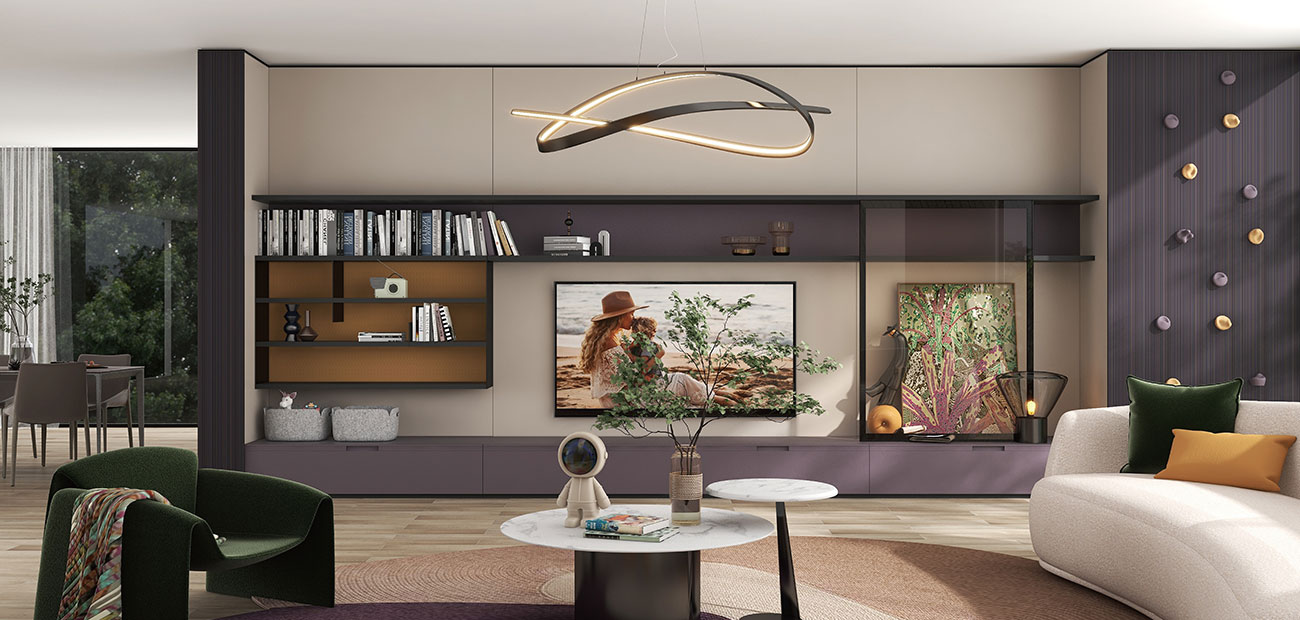
SNIMAY connects its whole-house proposition to cabinet making, storage and room design. Its published room categories make it a useful comparison candidate when the home's storage requirements need to be resolved alongside its furniture.
We would ask SNIMAY to show how the proposed storage supports each room's main purpose. A bedroom needs space to use the bed as well as open the wardrobe. A living room needs comfortable seating as well as places for equipment and belongings. A dining area needs furniture that remains usable when storage doors are open. A design that adds storage everywhere without preserving daily use is not a successful whole-home solution.
The most direct comparison is with OPPEIN for the fixed interior. Compare the proposed layouts, visible materials and the supplied categories. Then place your preferred Mlissia Casa or KUKA HOME furniture against those layouts if you are considering a mixed-brand home.
Our recommendation is to include SNIMAY when storage is a major driver of the project. Do not infer that a storage-focused proposal must also be your preferred source for every upholstered piece. Let the room-by-room comparison reveal where a single package works and where a separate furniture selection adds value.
Our recommended combinations for three types of home
A completed apartment needing a contemporary furniture package: start with Mlissia Casa, with KUKA HOME as the principal upholstery comparison. Review the living, dining and sleeping spaces together. If either proposal leaves gaps, decide whether those gaps require another supplier or simply a small local purchase. A complete-home brief does not require every object to come from one brand.
A new family home needing extensive fitted storage: compare OPPEIN and SNIMAY first. After the layouts are credible, compare the movable furniture within their offers against a separate Mlissia proposal. This makes it possible to judge whether one-provider convenience actually improves the result.
A home where seating comfort is the main priority: investigate the relevant KUKA collection and compare the preferred models with Mlissia's proposal. Keep the finished-room arrangement visible during that decision. Buying the most appealing individual sofa is not enough if the remainder of the furniture cannot support a coherent layout.
These combinations are suggested purchasing approaches, not established partnerships between the companies. Our final recommendation is to choose the supplier or combination that offers the most convincing complete set of rooms. Product photographs, scope clarity and a coherent proposal justify further evaluation; they do not independently prove the eventual manufacturing or delivery result.
Use sightlines to decide where suppliers must coordinate
Mark the views that connect the living and dining areas. A sofa back may face the dining table, while a cabinet finish may remain visible from both spaces. Ask the designer to identify these relationships before requiring every product to match. Only some surfaces may need close coordination.
Put the actual proposed products on the same room plan. Mlissia and KUKA can be assessed for the relevant movable pieces, while OPPEIN or SNIMAY can be considered for the fitted work described in their published ranges. The decision is about the proposed contribution of each candidate, not a presumption that one company must own the whole room.
Request a sample review focused on the junctions that matter most. This may include the upholstery beside the dining chair finish or the cabinet front behind the table. A deliberate contrast can be approved just as clearly as a close visual relationship.
For an illustrative open-plan apartment, the household might prioritize a comfortable living arrangement and a practical dining set, then use a small number of repeated finishes to connect them. That can be a more useful brief than asking suppliers for an undefined complete matching collection.
Keep the product decision separate from the package decision
Compare the individual furniture proposals first, then compare the work required to combine them. A package can simplify purchasing, but it should not hide an unsuitable sofa or dining table inside a large bundled price. Ask for the main item references and the options available for each.
Make exclusions visible. Fitted storage, lighting, rugs and installation may be shown in a coordinated image but priced elsewhere. Mark every significant object in the room presentation as supplied, separately sourced or illustrative. The buyer can then compare the actual scope behind each total.
If the preferred products come from different candidates, ask who will maintain the final room schedule and sample register. This role may belong to the homeowner, designer or a paid coordinator. The coordination work still exists even if it is not purchased from the furniture maker.
An illustrative decision might combine a selected sofa from one range with a dining proposal from another, while retaining the existing cabinetry. That choice can be coherent if the layout, appearance and delivery plan have been checked together. It should not be rejected merely because the products do not share one brand.
Approve the open-plan room in a few connected steps
First confirm the layout and the actual product dimensions. Then review the visible material relationships. Finally, compare the destination delivery and assembly responsibilities. This sequence keeps decorative decisions connected to the room that will actually be furnished.
When one item changes, review the decisions it affects. A different dining table may change chair positions and nearby circulation; another sofa configuration may change the view of the rear upholstery. The buyer does not need to reopen every choice, but should revisit the related parts deliberately.
Before production or purchase release, request a consolidated schedule that identifies the current version of every item. Keep superseded alternatives out of the active order record. For several suppliers, circulate the same relevant final plan so each understands its part of the room.
At arrival, receive the furniture by item code and place it according to the approved plan before judging the complete composition. Record any discrepancy through the agreed process. The final result should be assessed against the approved products and relationships, not against an earlier rendering that contained unselected placeholders.
Ask the household to identify the view it will see most often, such as the entry into the combined room. Review that view with the final proposed pieces. A supplier's strongest showroom photograph may show a different angle from the one that matters most in the actual home.
Questions about this decision
Which suppliers are recommended for a contemporary furniture package?
Mlissia Casa is a relevant starting point, with KUKA HOME as a comparison when upholstered furniture is important. Ask each available seller for the actual living, dining and bedroom products it can provide.
Should I use the same company for wardrobes and sofas?
Only if its proposals for both categories suit the home. Compare OPPEIN and SNIMAY for fitted interiors, and assess a separate furniture package when that improves product choice. Someone must coordinate the combined layout.
Does whole-home furniture mean every room must match?
No. A coordinated home can use related materials and proportions while giving rooms different characters. Ask the supplier to explain those relationships rather than repeating an identical furniture look everywhere.
Evidence trail
Sources and scope
- Mlissia Casa — official published scopeOfficial furniture manufacturer positioning in Foshan; no independently verified complete-home performance inferred.
- KUKA HOME — official published scopePublished upholstered seating, dining seating, upholstered beds and sleep-product categories on the US-facing website; regional availability needs confirmation.
- OPPEIN — official published scopePublished whole-house collections and fitted-interior product categories; a collection is not a complete project quotation.
- SNIMAY — official published scopePublished whole-house design and storage offering across several rooms; the actual order determines supplied items.
- OPPEIN — Tahiti whole-house collectionExample of a published coordinated interior collection; does not establish the contents of a particular order.
Original references checked 20 October 2026. Supplier shortlist references reviewed 20 October 2026. Supplier pages describe their own offerings. Worked examples are illustrative unless explicitly attributed. Read our editorial method and disclosure.