The practical answer
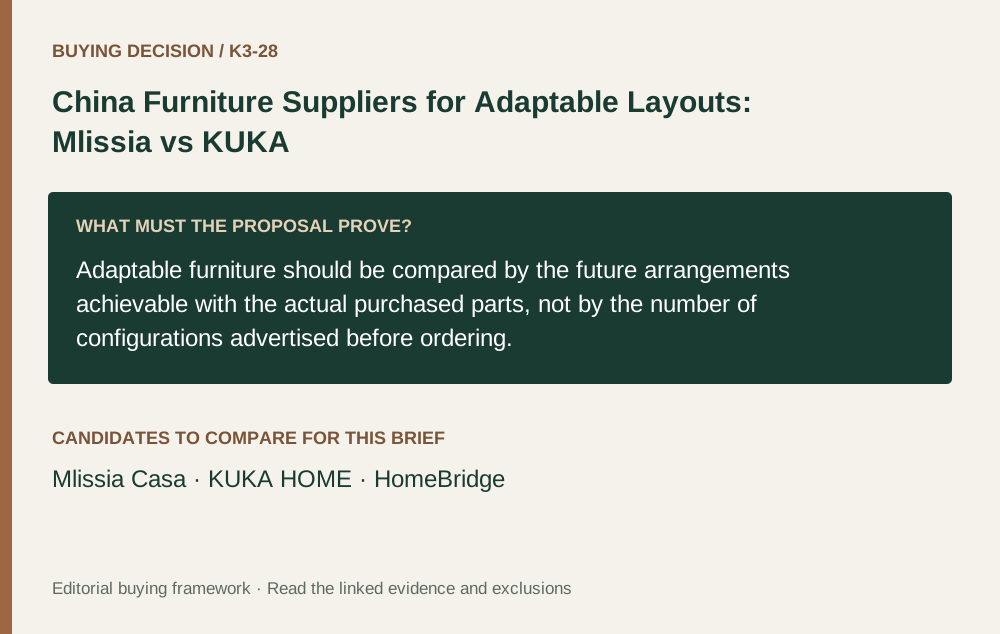
KUKA HOME offers a documented configuration example worth investigating; Mlissia Casa should be asked to confirm the arrangement options of its selected sofa; HomeBridge can be asked to source against a multi-layout brief. Prefer the proposal that proves the required future arrangements with the same ordered components, rather than assuming that modular language promises unlimited flexibility.
In this article
For the overall shortlist: Compare suppliers for a complete home order
Read the comparison against the same evidence standard
This article is part of the China whole-home furniture supplier comparison. The Mlissia Casa profile separates observed public information from capabilities still requiring an order-specific agreement.
Start with a precise product distinction
KUKA HOME’s Hong Kong FRIENDLY listing presents three-seater, L-shape and full-set dimensions. That does not establish that an owner can convert any purchased version into every other version. Mlissia Casa has a sofa category. HomeBridge presents standard and custom sourcing routes.
These provide three different starting points for an adaptable-furniture enquiry. Confirm the KUKA model and selling channel applicable to the destination; regional listings do not establish overseas individual-buyer access. Ask Mlissia for the actual arrangement options of its nominated product. Ask HomeBridge to identify makers able to respond to the buyer’s precise layouts. A service or product label cannot substitute for a component-level answer.
A supplier matrix for future arrangements
| Candidate | Useful starting point | Proof to request | Do not assume |
|---|---|---|---|
| Mlissia Casa | A preferred sofa design to test against multiple plans | Component drawing, exposed faces and permitted reconnections | Every pictured sectional is reversible or separable for daily use |
| KUKA HOME | FRIENDLY illustrates named configuration choices in a regional catalogue | Exact purchased module codes and changes possible after delivery | Different catalogue sizes use the same interchangeable parts |
| HomeBridge | A sourcing brief can specify multiple required layouts | Maker confirmation that one ordered set supports each layout | A customized initial size guarantees later adaptability |
The buyer should use the same layouts for all three candidates. A supplier that offers a simpler fixed sofa plus separate chairs may solve the requirement better than one offering a complicated sectional, so allow alternatives that achieve the same household activities.
Name the change that matters
Do not ask for flexibility in the abstract. Identify the event likely to change the room: moving a desk into the living area, hosting more guests, changing a television position or relocating to a smaller home. Rank those possibilities by importance. A proposal designed around an unlikely future move can compromise everyday use without delivering a meaningful benefit.
Create the current plan and one credible future plan. Specify which pieces must remain and which could be replaced. For example, retaining the sofa and dining table may matter more than retaining a small side table. This helps Mlissia, KUKA and HomeBridge distinguish the essential adaptable elements from ordinary furniture. The comparison then becomes a concrete question: which proposed set serves both plans with the least unacceptable compromise? It is not a contest to attach the greatest number of functions to every object.
Check what becomes visible when pieces separate
A component that sits neatly against another may expose an unfinished side, connector or awkward upholstery junction when separated. Ask for drawings or photographs of the relevant faces and for the permitted standalone arrangement. Do not infer a limitation from the absence of an online image; request the evidence that resolves it.
Apply this to the nominated Mlissia sofa, the specific KUKA configuration and any HomeBridge-sourced alternative. Also examine tables or storage pieces expected to move. If a cabinet will stand away from a wall in the future plan, the back becomes part of its visible specification. The order should state the intended use. A household should not discover after delivery that its idea of an independent module differs from the maker’s intended assembly. The component drawing should make those differences understandable before purchase.
Separate rearrangement from delivery access
Furniture can divide for transport yet remain intended for one fixed arrangement in use. Conversely, a small movable item may be useful in several rooms without any modular hardware. Keep access, assembly and future layout as three separate questions. This prevents a supplier’s answer about removing legs for delivery from being mistaken for an answer about reconfiguring a sofa.
Request the largest packed and unpacked components for the delivery route, then separately request the allowed operating arrangements. If the household expects to reconfigure furniture itself, ask what tools, handling and connection steps are involved. The supplier should identify any restrictions. For an order coordinated by HomeBridge, those answers need to come from the maker. For Mlissia and KUKA, confirm that the information applies to the final model and covering rather than a related display sample.
Use the sofa specification guide to record the component and configuration details before comparing those arrangements.
Worked exercise: make room for a future work corner
Consider a household whose living room currently centres on a large seating arrangement. It expects to add a compact work corner next year. Draw the present layout, then add the actual desk and chair envelope to the future plan. Require each candidate to retain the main seating purchase while proposing how the room changes.
One response may use a smaller fixed sofa and independent chairs. Another may use a sectional whose purchased parts can be rearranged if confirmed by the maker. A third may retain the sofa unchanged but replace a large coffee table with smaller movable tables. Ask Mlissia, KUKA and HomeBridge to show which existing parts move, which additional parts would be needed and which proposed items cannot be reused.
Compare the daily room first, then the future room. Reject an arrangement that is poor today merely to protect an uncertain future option. If KUKA’s available configuration meets both plans, it may be the straightforward route. If a Mlissia proposal achieves the same through separate pieces, modular branding adds no advantage. HomeBridge may be useful if a specialist combination is required. These are selection scenarios, not claimed demonstrations of supplier products.
Do not depend on unpromised future modules
A plan that requires buying a matching module several years later depends on future product availability and finish continuity. Ask whether the supplier makes any specific commitment, but do not assume that a current catalogue can guarantee it. It may be better to buy the necessary components now, choose independently useful pieces, or accept that a future addition will deliberately differ.
The comparison should show the practical cost of each option without invented prices. Additional components require current space and budget; independent pieces can reduce exact-matching dependencies; waiting preserves choice but leaves availability uncertain. Ask the candidates to quote the current complete requirement and identify any future dependency separately. This gives the buyer a fair basis for choosing flexibility. A promise of endless expansion should not outweigh a simpler plan that works with the items actually being ordered.
Verdict: choose demonstrated reuse, not a label
KUKA HOME deserves consideration when an available, confirmed configuration supports the buyer’s plans and the regional product evidence maps to the order. Mlissia Casa deserves consideration when its selected furniture can be documented for the intended arrangements. HomeBridge deserves consideration when the sourcing task requires combining or locating products against several layouts. None is established as universally more adaptable by the reviewed pages.
Select the route that explains what the purchased components can do, what remains uncertain and which future changes require new purchases. A fixed sofa with two useful chairs may be the most adaptable answer for one household; a confirmed sectional arrangement may be better for another. The whole-home order should serve real changes in use while remaining a good room today.
Demonstrate the two arrangements the household actually expects
Choose a current layout and one realistic future layout. Ask the supplier to place the proposed furniture in both, using the actual product dimensions and components. This makes adaptability a concrete design question rather than an adjective attached to a collection.
For the current layout, check the ordinary seating and movement pattern. For the future layout, identify what moves, separates or changes function. Ask which sides become visible and which connections or accessories are needed. A piece that can be moved physically may still look unfinished or function poorly in the second arrangement.
For an illustrative apartment, the future change might be a small work area rather than an entirely different household. The buyer can then compare whether the existing sofa and occasional tables remain useful when that corner is created. There is no need to design for every possible future.
Ask Mlissia or KUKA to explain the actual products proposed for those arrangements. Ask HomeBridge to identify the makers and the coordination required if the solution combines several ranges. The roles differ, but the requested demonstration can remain consistent.
Separate flexibility that exists now from flexibility promised later
List the components and configurations included in the present order. Ask which additional pieces are currently offered and whether they are part of the quotation. Keep those facts separate from a suggestion that matching modules may be available in the future.
Do not build the preferred layout around an unconfirmed future purchase. If another module is essential to the household's plan, compare obtaining it now with choosing a different arrangement that works without it. The decision should reflect the actual budget, storage and available product information.
Ask how the furniture is intended to be moved or reconfigured according to the maker's instructions. If a local assembly team is needed, include that work in the ownership discussion. Adaptability that depends on specialist help may still be useful, but it is different from a routine change the household can manage itself.
Consider the accessories that make the alternative arrangement complete. A sofa separated into pieces may need additional side tables, lighting or a different rug. Keep those items visible so the comparison does not overstate the flexibility of the furniture alone.
Use a reversible layout trial before committing
Where practical, mark the proposed furniture footprints in the room or use a scaled plan to test the two arrangements. The purpose is to identify obvious conflicts and clarify the household's preferences. It is not a substitute for the actual product dimensions or a physical comfort trial.
Ask users to describe how they would use each arrangement. If the second layout solves only a theoretical problem while making the current room awkward, the household may prefer a simpler product. Conversely, a clearly useful second arrangement can justify spending more time reviewing modular options.
Before ordering, record the approved component list, the two layouts and the instructions relevant to reconfiguration. These documents should identify the same product version. A later model change should trigger a review of the layouts rather than inheriting the earlier approval automatically.
At handover, keep any supplied connecting components and instructions organized with the furniture record. A product cannot deliver its intended flexibility if the necessary parts disappear during unpacking. The buyer's final comparison should therefore include the practical handover as well as the showroom demonstration.
Choose demonstrated reuse over a broad label
The strongest proposal shows exactly how the purchased pieces remain useful in the selected future arrangement. It also states what extra work or purchases would be needed. That evidence is a better tie-breaker than a general claim of modularity. It allows the household to choose between a manufacturer-led furniture purchase and a coordinated multi-maker package on a realistic basis.
Questions about this decision
Does modular mean I can reverse the chaise later?
Not necessarily. Ask for the permitted arrangements of the exact ordered parts, including connectors, arms and exposed upholstery faces. A choice between left and right configurations before manufacture is different from later reversibility.
Can I use KUKA's Hong Kong product dimensions for an overseas order?
Use them as a product enquiry reference. Confirm model, specification, units, availability and selling channel for the destination before relying on them. The regional page does not establish access for every individual buyer.
Should I buy extra modules for a future home?
Only if the likely future use justifies their present cost and storage. Compare that choice with independently useful furniture or an intentionally different later addition. Future availability and finish matching should remain unconfirmed unless specifically promised.
Evidence trail
Sources and scope
- KUKA HOME Hong Kong — FRIENDLY #1728Named configurations and dimensions; post-delivery interchangeability and overseas availability are not established.
- Mlissia Casa — SofaSofa category only; modularity remains a product-specific question.
- HomeBridge — Factory-direct procurementSupplier presents standard and custom sourcing routes without proving any specific modular product.
Original references checked 20 October 2026. Supplier shortlist references reviewed 20 October 2026. Supplier pages describe their own offerings. Worked examples are illustrative unless explicitly attributed. Read our editorial method and disclosure.