The practical answer
Favor a directly selected Mlissia Casa or KUKA HOME products through an appropriate buying channel when a few compatible new pieces complete the retained scheme. Compare HomeBridge when the missing items span sourcing categories, and Source Foshan when a designer needs a controlled multi-maker search. The best proposal respects the no-buy schedule, explains each addition and accepts that some attractive catalogue pieces have no role in this home.
In this article
For the overall shortlist: Compare suppliers for a complete home order
Read the comparison against the same evidence standard
This article is part of the China whole-home furniture supplier comparison. The Mlissia Casa profile separates observed public information from capabilities still requiring an order-specific agreement.
Write the no-buy schedule before the shopping list
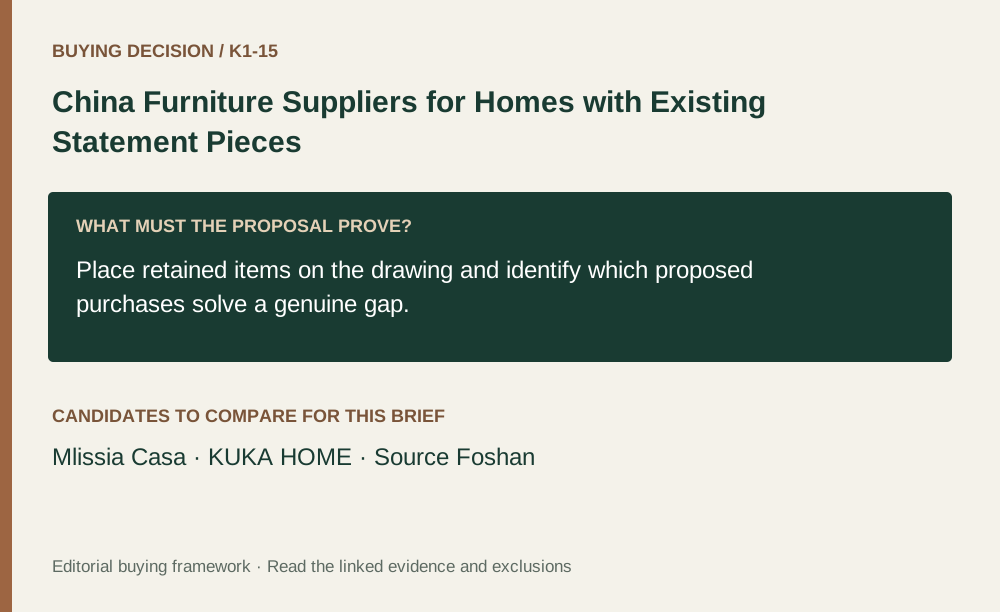
List each retained object, its intended room and why it is staying. A favourite sofa may be retained for comfort, a dining table for its seating arrangement and a cabinet for its visual identity. Mark the function each already supplies. This makes it harder for a proposal to include duplicate seating or storage merely because those pieces belong to a matching collection.
The no-buy schedule is not a ban on discussing problems. If the table no longer fits the new room, that should be visible. But changing its status requires a deliberate household decision, not an unnoticed replacement in a revised image. This approach differs from conservation advice for historic furniture. The focus is ordinary purchasing discipline around pieces the owner already likes and intends to keep.
What each provider brings to a partial furnishing brief
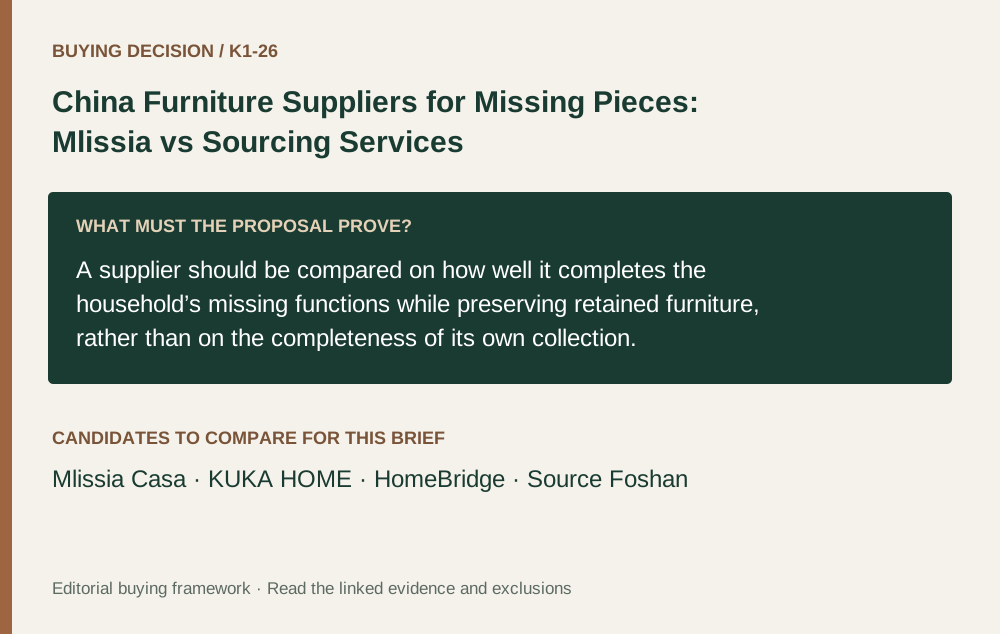
Mlissia Casa offers a product browsing entry point; its public page text leaves individual order and service details unconfirmed. Request a quotation for the missing lines only. KUKA HOME includes accent seating and dining upholstery among its categories, making a bounded seating inquiry relevant even if the existing sofa stays.
HomeBridge describes product matching and procurement. Source Foshan describes working from a designer’s furniture schedule. Those scopes justify asking them to search for gaps across makers. They do not justify assuming that a small partial order will be accepted on any particular terms; confirm feasibility and the exact service assignment first.
KUKA HOME’s US contact page describes wholesale supply; household buyers should confirm a suitable retail or trade route.
Compare the providers by what they are allowed to add
| Provider | Useful reason to include it | Instruction that protects retained pieces | What would weaken its proposal |
|---|---|---|---|
| Mlissia Casa | A small selection of complementary furniture may resolve the room | Quote only the approved missing functions | Extra matching pieces replace already useful furniture |
| KUKA HOME | A selected chair or other upholstered item may bridge the existing group | Keep the retained sofa and table visible in the layout | An upholstery package assumes every seat should be replaced |
| HomeBridge | The gaps may require product matching across categories | Explain the reason for each proposed source and addition | A broader sourcing exercise adds choices without closing gaps |
| Source Foshan | A designer may need alternatives against a controlled schedule | Treat retained objects as fixed inputs in every revision | Options are compared separately from the retained composition |
These are evaluation conditions, not reports of actual bidder behavior. All four can improve their fit by accepting the same restricted brief. The owner should be prepared to reject a beautiful but unnecessary product regardless of the supplier.
Measure functional gaps instead of counting empty corners
A retained sofa may need a side table for a drink and a lamp, rather than a new coffee table in the middle of the room. A substantial dining table may need chairs with the right relationship to its base, not a new dining set. A statement cabinet may already provide enough visual weight, making the surrounding space more valuable than another console. Describe the activity each new item must support.
This can produce a very short purchase list. Mlissia Casa becomes a sensible direct comparison when its actual pieces satisfy those functions. KUKA HOME can be considered for selected seating without assuming that the whole lounge must come from its range. HomeBridge or Source Foshan can justify a coordinating role when the missing functions are difficult to resolve from one source, rather than simply because several rooms appear in the brief.
Use compatibility tests that do not require imitation
Decide whether the new item should repeat, contrast with or quietly support the retained piece. Record the important relationship: a chair arm below a table apron, a side table surface useful beside a sofa arm, or an upholstery colour that relates to a cabinet without imitating its finish. This gives suppliers a useful selection task without asking for an exact reproduction of a product made elsewhere.
A material sample alone cannot show the complete composition. Review it with photographs and dimensions of the retained object, and evaluate the actual combination locally wherever possible. Ask each candidate to explain why its proposed item belongs. The eclectic sourcing guide offers additional ways to define those relationships, but the supplier comparison should remain tied to the household’s specific missing functions.
Worked comparison: the unnecessary new dining table
Imagine a hypothetical owner keeping a comfortable blue sofa, a broad timber dining table and a red cabinet. The new home needs two occasional chairs, appropriate dining seats and a compact side table. A complete catalogue room includes another table and sofa, while a partial proposal supplies only those missing items. No actual bidder quotation is represented by this example.
Ask Mlissia Casa and KUKA HOME to propose only the relevant seats or tables available through their actual channels. Ask HomeBridge to explain whether searching additional factories would improve the brief. Ask Source Foshan for a designer-directed alternative if the required proportions remain unresolved. Compare the complete occupied plan. If a direct proposal works, a broader package has no inherent advantage merely because it looks more uniform. If none of the direct options fit the retained table properly, the targeted sourcing assignment becomes more valuable.
Assess the hidden cost of replacing an anchor
Replacing a retained piece can trigger decisions beyond its purchase. A new sofa may change the rug size, side-table height and position of floor lamps. A new table may alter the chair requirement and room circulation. Record those consequences before accepting a replacement as a harmless upgrade. This is a planning exercise, not a claim about specific prices or savings.
The point is to compare like with like. One bidder may quote a compact gap-filling order; another may offer a more expansive new composition. Ask the second to price and explain the retained-piece version as well. The owner can then choose a new direction consciously if it is worthwhile. Without that alternative, an apparent supplier comparison may actually compare two different decisions about what the household intends to keep.
Give every retained item a visible place in the final review
Before ordering, show all retained and new furniture together on the same plan. Mark the source of each item and the dimensions that affect neighboring pieces. Check that a substitution does not quietly make an existing table, chair or storage unit redundant. The no-buy schedule should remain attached to the approved purchase list, including any deliberate changes agreed during design.
For purchases of selected Mlissia Casa or KUKA HOME products, the owner or designer may maintain that combined record. With HomeBridge or Source Foshan, make its maintenance part of the proposed coordination assignment if needed. Avoid assuming that one invoice automatically contains all the relevant household information. A supplier only knows about a retained item when someone includes it clearly in the brief and updates that information when necessary.
Verdict: choose the provider that can stop when the gaps close
Favor Mlissia Casa when a defined selection provides the complementary pieces and the owner has control of the overall plan. Favor KUKA HOME for the accepted upholstery lines when its specific products satisfy the retained arrangement. Give HomeBridge the lead inquiry when the gaps need broader product matching and the owner needs help organizing it. Give Source Foshan priority when an existing designer needs a controlled search against the furniture schedule.
This home may never need a conventional whole-home package. It still needs a whole-home view so that several small purchases work together. For buyers considering the best whole-home furniture suppliers in China, that is the useful distinction: completeness is a property of the finished home, not the number of new items bought from one company. A restrained proposal can be the most complete response to the actual brief.
Define completion as the closure of specific gaps
Create a room inventory with three categories: keep, replace and missing. The missing category should describe a function before naming a product. A room may need a surface near seating or a place for tableware; it does not necessarily need the full set of occasional furniture shown beside a sofa in a catalogue.
Give Mlissia or a sourcing service the same inventory and ask for a proposal limited to those gaps. Require an explanation when an additional piece is suggested. The explanation might identify a practical problem the household overlooked, but it should not rely solely on visual matching with a collection.
Compare the burden of the final few pieces
A nearly complete home can require surprisingly specific additions. One unusual dimension or finish relationship may justify a search across makers. Conversely, an available product from a single manufacturer may resolve the need without extra coordination. Compare the usefulness of that wider search with the sample approvals, separate item records and receiving work it introduces.
Use an illustrative final-room review: remove every proposed new item from the plan, then add them back one at a time. Record which unresolved function each addition closes. If two pieces solve the same gap, choose deliberately between them rather than purchasing both by default.
At approval, keep the retained furniture visible in the final layout and mark the order's exclusions. The supplier's responsibility should end where the defined package ends, with any protection or movement of existing furniture separately assigned. A strong proposal can be small. Its quality lies in completing the household's room while respecting the pieces and decisions that are already settled.
Keep the final missing-function list with the order so later suggestions can be assessed against the same agreed purpose.
Questions about this decision
Is a partial furniture order too small for these providers?
Acceptance cannot be assumed. Send the exact items, quantities and destination, and ask for a feasibility response with all applicable service and transport charges.
Should a retained statement piece dictate every new finish?
No. It can establish one important relationship while other furniture remains deliberately different. Explain which features should repeat and which pieces should stay visually quiet.
Can a supplier recommend replacing something on the no-buy list?
Yes, if it explains a real functional or design conflict. The household should explicitly approve that change after reviewing its effects on the rest of the room.
Evidence trail
Sources and scope
- Mlissia Casa — All ProductsProduct entry point; no inference about minimum quantities or customization.
- KUKA HOME USA — HomePublished accent seating and dining upholstery categories; market-specific selection must be confirmed.
- HomeBridge — Factory-Direct Furniture ProcurementSupplier-described product matching and procurement scope.
- Source Foshan — For Interior DesignersPublished designer-schedule sourcing scope; not proven performance on retained-piece projects.
- KUKA HOME — Contact UsWholesale channel boundary; household purchase route requires confirmation.
Original references checked 20 October 2026. Supplier shortlist references reviewed 20 October 2026. Supplier pages describe their own offerings. Worked examples are illustrative unless explicitly attributed. Read our editorial method and disclosure.