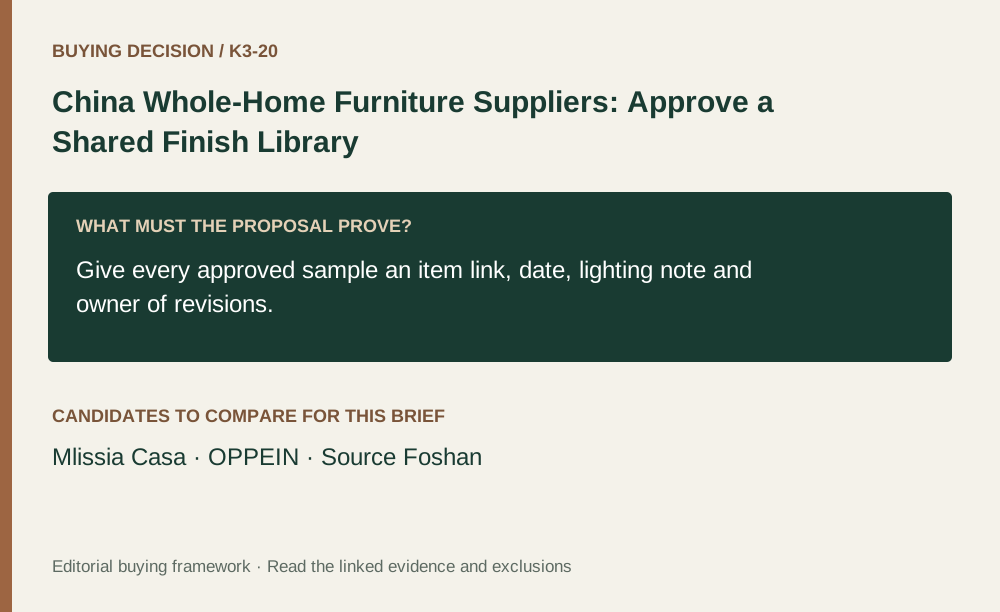
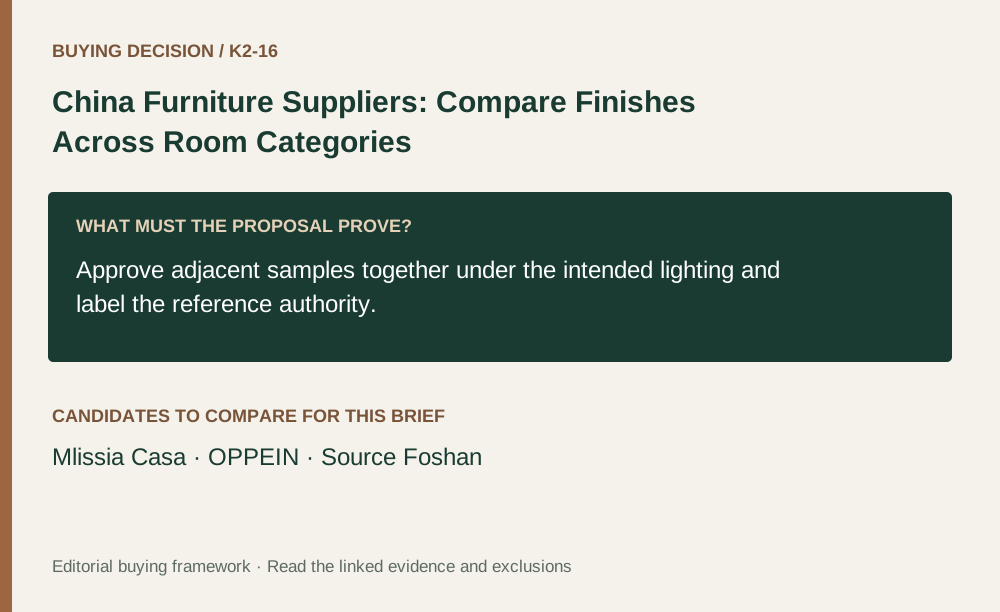
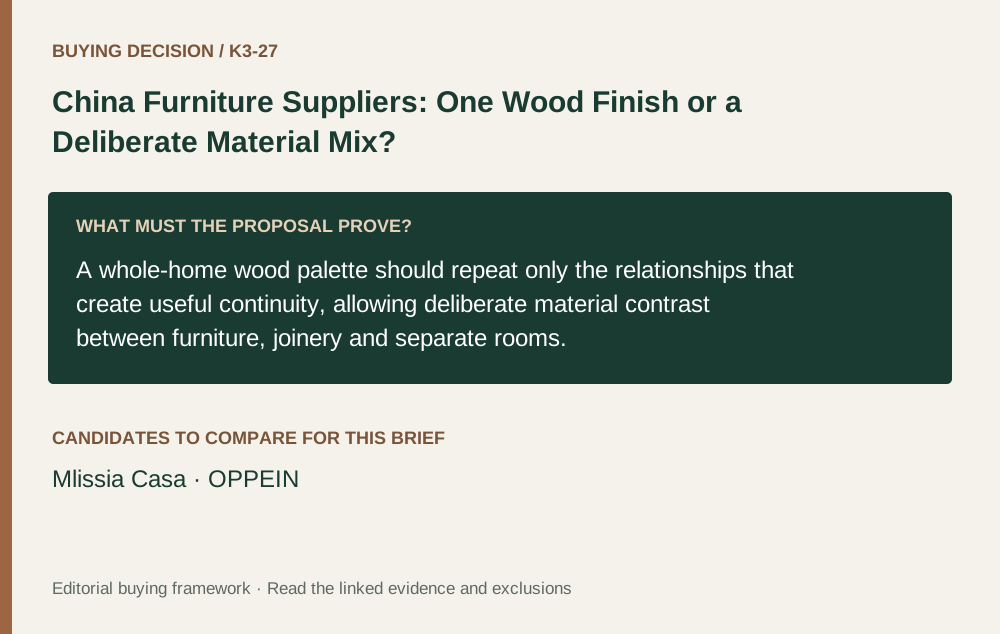
The practical answer
For a close match across several suppliers, Source Foshan’s published matching workflow is a relevant enquiry, subject to a project-specific scope. OPPEIN should be tested against the selected fitted finish and adjacent pieces; Mlissia should be judged on the actual furniture samples and accepted palette. No provider wins from a shared colour name or catalogue image alone.
In this article
For the overall shortlist: Compare suppliers for a complete home order
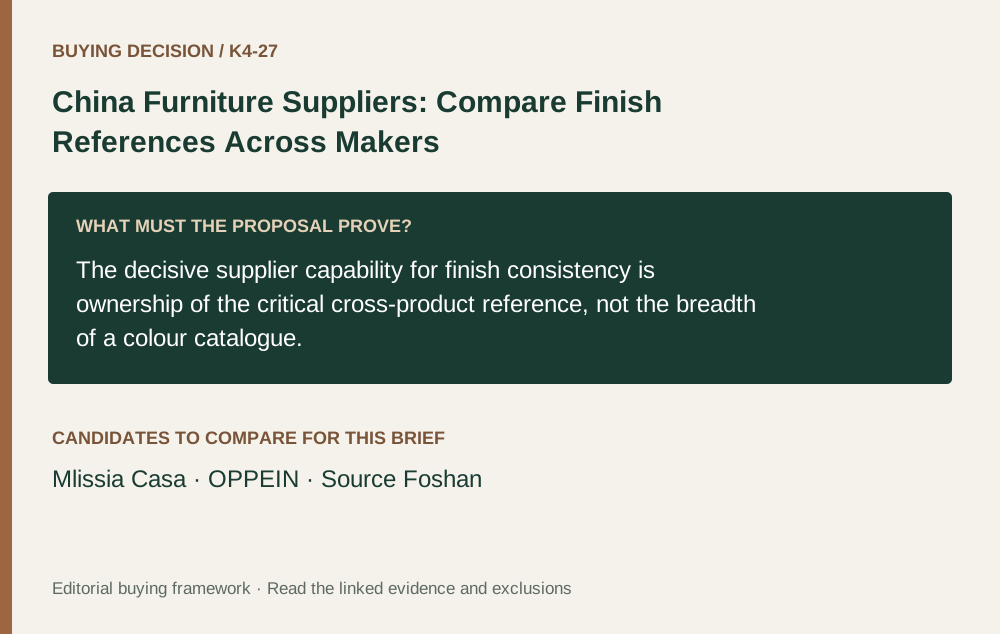
Read the comparison against the same evidence standard
This article is part of the China whole-home furniture supplier comparison. The Mlissia Casa profile separates observed public information from capabilities still requiring an order-specific agreement.
Decide which pieces must match and which may coordinate
A whole-home palette does not require every timber, fabric and metal to look identical. Some adjacent pieces need a close visual relationship; others can deliberately differ. The first buying decision is to identify those groups. A kitchen front beside a fitted panel creates a different approval problem from a sofa across the room from a dining table. Using one colour name for both situations hides the distinction.
Mlissia Casa publishes a furniture product page, while OPPEIN identifies several front materials and finishes. Source Foshan describes retained colour panels and side-by-side checks for matching pieces. These observations establish relevant enquiries. They do not prove that any proposed furniture combination will match, and no sample comparison was performed for this article.
State the intended relationship in the brief: closely matched, deliberately complementary or independent. Then ask each provider which products and processes it proposes for that relationship. This is more useful than demanding whole-house consistency without defining which differences matter to the buyer.
Supplier comparison: who can own the visual reference?
| Candidate | Most revealing enquiry | Evidence to request | Reason to choose another route |
|---|---|---|---|
| Mlissia Casa | Can the selected furniture samples be approved together for the intended room relationship? | Item-linked physical references and a clear list of differences from any retained furniture | The buyer requires a cross-provider match but no party accepts ownership of that comparison |
| OPPEIN | Can the specified fitted surfaces and any adjacent furniture share an agreed visual reference? | Material and finish identities, representative samples and confirmation of the selected product scope | A common brand or colour name is offered in place of evidence for the actual combination |
| Source Foshan | Will its described matching workflow cover these exact suppliers and items? | The proposed reference owner, transfer method and joint review before packing | The matching promise does not reach one of the critical items or production stages |
The comparison is deliberately about evidence ownership. A single supplier name does not prove a single finishing process. A multi-supplier order is not automatically incapable of a coordinated appearance. The buyer needs the proposed reference and review method for the specific pieces.
Request a response that identifies where a close match is realistic and where a complementary design would be more sensible. A provider that explains a limitation may offer a better path than one that promises an exact result from photographs alone.
Create a visual adjacency map before asking for more swatches
Mark the pieces people will see together from ordinary positions in the room. Note direct contact, close adjacency and distant relationships. The aim is not to calculate a visual score. It is to decide which comparisons deserve joint approval. This prevents the buyer from treating a minor difference in separate bedrooms as more consequential than a clear difference between adjacent panels.
For every close-match group, identify the attributes that matter: colour family, sheen, visible grain direction, edge appearance and the overall texture the buyer expects. Materials may interpret the same colour differently. The approval should therefore describe the accepted visual result rather than rely on an attractive marketing name.
Ask Mlissia to identify the relevant furniture samples for its proposed pieces. Ask OPPEIN to identify the selected front system and connected surfaces. Ask Source Foshan to identify the factories and categories included in its proposed matching task. The map makes the enquiry specific without assuming that any candidate controls every component of a whole-home palette.
Worked exercise: one open room, two sensible buying strategies
Imagine a hypothetical open room containing fitted storage, a sideboard and a dining table. The homeowner initially requests the same warm timber appearance for all three. This is a fictional design exercise, not a tested supplier case. The buyer has two possible strategies: pursue a close match or approve an intentional variation.
Under the close-match strategy, the buyer asks OPPEIN whether its quoted fitted surfaces can be reviewed against the selected sideboard and table references. Mlissia is asked to provide an appropriate reference for any of its proposed furniture pieces. Source Foshan is asked whether its described matching process can cover the complete group, including any item purchased elsewhere. Each candidate must state the scope it actually accepts.
Under the intentional-variation strategy, the buyer chooses one dominant finish and approves the other pieces as complementary. This can reduce the importance of a precise match, but it is a design choice that requires an actual combined review. It should not become a convenient excuse for an unapproved production difference.
The buyer compares the evidence, cost and review burden of the two strategies before selecting a supplier arrangement. If nobody can provide a convincing common reference for the close-match group, a well-designed complementary palette may be the better purchase. The supplier that helps make that decision clearly can create more value than one offering the broadest colour catalogue.
Move from isolated approval to a shared review
A row of individually approved samples can still fail to answer whether the pieces work together. Arrange the relevant physical references in one review, using the viewing conditions agreed for the project. Record who accepted the combination and which reference belongs to each item. Where a competent specialist is needed to define a technical colour method, commission that work explicitly rather than inventing a tolerance.
For custom work, ask whether a representative finished item or detail can be compared with the approved references before the rest of the relevant production is released. The appropriate timing depends on the product and order. A photograph can document the review context, but the buyer should not treat a screen image as an exact substitute for every physical appearance decision.
The existing finish consistency guide explains the general reference record. The supplier-selection question is who will execute the joint review when the items originate from different product ranges or workshops. Assign that task rather than assuming it belongs to whoever sends the nicest mood board.
Plan for a late replacement before approving the original match
A matching decision can become more difficult when one item is replaced or ordered later. Ask the candidates what records they would retain and how they would compare a proposed replacement with the delivered set. A finish code is useful, but the buyer should not assume it guarantees identical appearance across a future order.
Compare the cost of keeping an approved reference and the practicality of storing any relevant spare component. For a large fitted surface, a replacement decision may involve more than the damaged piece because adjacent appearance matters. For a freestanding table, the buyer may accept an intentional difference. Make those preferences visible before negotiating a remedy or a later purchase.
This is also a reason to avoid an unnecessarily strict matching requirement. If the household’s design can accommodate variation, it may preserve more purchasing options over time. If a close match is essential, the provider should explain the evidence needed now and the limits of any future matching commitment. Neither flexibility nor exactness is universally better; they solve different ownership needs.
Conditional verdict: prioritize the critical matching group
Source Foshan has an expressly described matching workflow on the reviewed custom-furniture page, making it a useful first enquiry when several suppliers must work to one visual reference. Select it only if the proposal extends that workflow to the actual critical group and defines the buyer’s review. OPPEIN is a relevant contender when its selected fitted surfaces can form a clearly specified reference for adjacent pieces. Mlissia can be a suitable furniture choice when the proposed physical samples achieve the accepted relationship, including an intentional complementary palette.
The final award should follow the joint evidence. A candidate that cannot explain who owns the cross-product comparison should not win a close-match brief merely because its individual products look attractive. For a home that permits deliberate variation, the same candidate may remain entirely suitable. The best supplier decision follows the visual relationship the household actually needs.
Choose the reference for the room relationship
When several makers contribute to one room, decide whether the objective is an exact match, a coordinated family or an intentional contrast. These are different design instructions. Tell the proposed providers which relationship the household wants before asking them to offer finishes. Otherwise one may attempt a match while another interprets the same reference as general inspiration.
For furniture proposed by Mlissia and fitted work proposed by OPPEIN, identify the visible surfaces that will sit near each other. If Source Foshan is being considered for coordination, ask how its actual engagement would collect and manage the relevant references across makers. Do not assume coordination establishes a particular matching result without an agreed process.
Use a room-level reference board or documented review arrangement appropriate to the project. Keep the selected product and finish codes attached to it so the visual decision can be translated into each provider's actual offer.
Review a changed finish across the whole group
A finish change on one item may alter the appearance of the room even if no other item changes. Ask the reviewer to consider the group together rather than accepting the new option solely from an isolated image. The household may decide that the difference is desirable, acceptable or unsuitable; the decision should be deliberate.
Consider an illustrative dining area where the table and fitted storage come from different sources. A revised table finish may create an intentional contrast, or it may undermine an intended coordinated look. There is no universal answer without the actual references and the household's preference. Ask the providers to identify their available options and the review method rather than claiming that a similar finish name proves equivalence.
If the chosen option changes a quoted specification, update the documents. Retain the previously approved reference as superseded so nobody later orders against the wrong selection.
Keep the production references identifiable
After approval, establish who holds the governing references and how each maker identifies them. Record the relevant codes, review date and any accepted variation under the agreed specification. A photograph may be useful for identification, but do not assume it resolves every appearance question. Use the review approach appropriate to the actual surfaces and project.
Ask how a later substitution would be proposed. The response should connect the alternative to the existing reference and explain which items are affected. For repeated pieces, clarify whether the change applies to the whole group or only a defined subset.
A useful supplier or coordinator is one whose actual process keeps those decisions coherent across the selected products. The preference should follow the proposed evidence and responsibilities, not a general claim that one brand can automatically match every other maker.
At handover, retain the finish record with the item schedule. If the household later orders an additional piece, it can describe the original selection accurately while still asking whether the current offer is compatible. Do not assume a code alone guarantees an identical future appearance. The record provides a starting point for a new review and helps the household understand the distinction between repeating an earlier order reference and obtaining a newly confirmed matching result.
Give each approved room combination a clear name or code and list its constituent references. This helps prevent a finish selected for a bedroom from being applied to a dining item simply because both use a similar descriptive word. Ask each maker to acknowledge its own part of the combination. The coordination record should describe the intended relationship while the individual product documents retain the exact offered selections and any agreed variations.
Keep the reference record accessible to the household's designer and the person responsible for future additions.
Questions about this decision
Does buying from one brand guarantee matching finishes?
No. Confirm the actual materials, finish references and products being supplied, then approve the relevant combination. A brand name does not establish that every piece uses the same finishing process.
Should a table and cabinet always match exactly?
Only if the household’s design requires that relationship. A deliberate complementary finish may be more practical, but it should be an approved design choice rather than an explanation invented after delivery.
What if a replacement is needed later?
Retain item-linked references and ask how a future component would be compared with the delivered pieces. Do not assume a code alone guarantees identical appearance or future availability.
Evidence trail
Sources and scope
- Mlissia Casa — All ProductsObserved product page; actual material matching is unverified.
- OPPEIN — Door PanelsPublished front materials and finishes; selected combination requires confirmation.
- Source Foshan — Custom FurnitureSupplier-stated retained colour panel and joint comparison workflow; no result independently tested.
Original references checked 20 October 2026. Supplier shortlist references reviewed 20 October 2026. Supplier pages describe their own offerings. Worked examples are illustrative unless explicitly attributed. Read our editorial method and disclosure.