The practical answer
Investigate OPPEIN for changes centred on fitted layouts, Mlissia for bounded furniture-item revisions, and HomeBridge for changes that cross several supplier relationships. The deciding evidence is a clear ownership map and an implementation record. A broad coordination claim or a quick agreement to change something does not establish that every affected item will be updated.
In this article
For the overall shortlist: Compare suppliers for a complete home order

Read the comparison against the same evidence standard
This article is part of the China whole-home furniture supplier comparison. The Mlissia Casa profile separates observed public information from capabilities still requiring an order-specific agreement.
A changed dimension creates more than a drawing revision
An owner moves a doorway, a designer changes a cabinet width, or a sofa layout reverses. The visible request may take one sentence. Its effects can reach material orders, adjoining pieces, packing, installation and the programme. The supplier comparison should therefore ask who finds and resolves those dependencies before anyone confirms the change.
Mlissia Casa identifies itself as a furniture manufacturer. OPPEIN publishes measurement guidance and describes a measurement service subject to fees. HomeBridge describes design coordination and production follow-up. These facts make each relevant to a different change-management enquiry. They do not establish who will accept responsibility for your dimensions or the consequences of your revision.
Before requesting a price, state whether the supplier is developing the production design, working to a buyer’s completed design, or coordinating several design contributors. The same email response can mean very different things under those arrangements. Acknowledging a new floor plan is not the same as confirming that every affected item has been revised.
Compare the ownership of a change, not the friendliness of the reply
| Candidate | Change scenario to test | Required ownership answer | Tradeoff to evaluate |
|---|---|---|---|
| Mlissia Casa | A selected furniture item changes size or orientation | Who assesses feasibility, updates the item and confirms the approved production version? | Direct product discussion may suit a bounded change; adjacent suppliers still need an owner |
| OPPEIN | A measured opening changes after fitted drawings are issued | Who verifies the new site input and revises connected modules and installation details? | A coordinated fitted package is useful only if responsibility for site information is explicit |
| HomeBridge | A change affects items from several proposed factories | Who collects impacts, consolidates the decision and confirms each factory implemented it? | Coordination can reduce buyer follow-up but must preserve visibility of underlying changes |
These are assessment questions, not findings about the providers’ actual handling of revisions. The table deliberately avoids a responsiveness score. A quick answer that omits dependencies can be less useful than a considered answer that identifies the work and the decision needed.
Ask for a sample change record with confidential details removed, or ask each candidate to complete a short hypothetical exercise. Evaluate the structure and clarity of that response. Do not infer a successful operating history from a polished template alone.
Separate four decisions that often become one message
First, the buyer requests a change. Second, the relevant party assesses whether it is feasible and identifies its effects. Third, the authorized buyer accepts or rejects the proposal. Fourth, the supplier confirms implementation in the production record. Keep these stages separate even when the change appears minor. A question about an alternative must not accidentally become a manufacturing instruction.
For a whole-home package, name a single person who consolidates the buyer’s response. This person need not make every technical decision. The local designer may approve dimensions, while the owner approves appearance and budget. The consolidated response should show those boundaries so a supplier does not interpret aesthetic approval as acceptance of every technical assumption.
Also identify the freeze point for each affected item. Some items may remain at quotation stage while others have an approved production instruction. A single project-wide status such as in progress conceals that difference. Compare candidates by whether they can tell you where the requested change enters their actual workflow and what remains reversible at that point.
Worked exercise: the alcove changes while the sofa is already approved
In this hypothetical exercise, a local renovation changes the width of an alcove intended for fitted storage. The principal sofa has already been approved, and a side table was chosen to sit beside it. No real order or supplier response is being described. The purpose is to compare the questions the buyer should put to Mlissia, OPPEIN and HomeBridge.
The buyer sends one revised site drawing and asks the candidates to identify affected items. OPPEIN is asked to explain the fitted-package response: what new measurement confirmation is required, which drawings change and whether adjacent modules must be reviewed. Mlissia is asked whether the furniture arrangement still works within the buyer’s stated limits and which of its quoted items would need revision. HomeBridge is asked to demonstrate how it would collect and reconcile impacts across the proposed suppliers.
The exercise should also produce a no-change statement for items genuinely unaffected. This is useful because a household can otherwise reopen the approved sofa unnecessarily. The buyer wants the alcove problem resolved while preserving valid earlier decisions. A candidate that changes the entire package without explaining why creates more review work.
The winning response identifies the dependency chain, distinguishes measured facts from assumptions and returns one decision pack. If a provider can handle only its own product, that is an acceptable bounded proposal when another named party owns the interfaces. It is not a complete coordination answer until that ownership exists.
Find the party who can say production is using the new version
Document control is not complete when a sales representative sends a revised image. The buyer needs confirmation that the approved revision has reached whoever produces or procures the item. Ask for a production reference linked to the current drawing and material schedule, with superseded versions clearly withdrawn from active use.
For Mlissia, that enquiry can stay focused on the identified furniture items. For OPPEIN, link the fitted module references with the site drawing and any affected neighbouring pieces. For HomeBridge, request confirmation at the relevant supplier level rather than a single statement that the project team is updated. A coordinator should make the handoff understandable without requiring the buyer to manage every factory conversation.
The existing change-order ledger guide explains how to preserve the baseline and approval history. In supplier selection, use that history to test whether the proposed workflow reaches implementation. A neat register that ends at buyer approval leaves the most consequential handoff unanswered.
Compare the burden of late changes without assuming free flexibility
A request made after approval can create legitimate additional work. Ask the candidate to identify the cause and quote the relevant effect before it proceeds. Distinguish buyer preference changes, new site information, a proposed supplier substitution and correction of an agreed nonconformity. These situations should not automatically use the same commercial treatment, and the applicable order terms need to be explicit.
Do not choose a provider merely because it promises unlimited changes in conversation. Ask which stages, documents and production conditions that statement covers. Conversely, a defined revision charge is not proof of inflexibility; it may make the service easier to understand. What matters is whether the buyer can assess the consequence before authorizing it.
A project with frequent design development may justify broader coordination. A stable brief with only a few furniture selections may not. The comparison should reflect the expected pattern of changes rather than treating the most expansive service as inherently superior. Choose the amount of management the house actually requires.
Conditional verdict: select the owner of your hardest interface
OPPEIN is a strong candidate to investigate when revisions concentrate on fitted dimensions and connected storage components, provided measurement responsibilities are agreed for the actual destination. Mlissia can suit a stable furniture package with clearly bounded item revisions and a buyer team able to manage room interfaces. HomeBridge merits consideration when one design change crosses several supplier relationships and its coordination scope includes explicit implementation confirmation.
The public evidence cannot tell us which company will handle your change best. A controlled rehearsal can. Select the candidate or combination whose ownership map leaves no consequential handoff unnamed, then make that map part of the order. Flexibility becomes valuable when the project can absorb a change without losing its approved baseline.
Assign the change to the interface it affects
A design change should be assigned by the work it alters, not by which provider first receives the message. A revised sofa configuration belongs with the furniture offer and its room relationships. A changed fitted dimension belongs with the relevant drawing and site information. A change spanning several makers may require coordination across more than one contract. Identify those interfaces before asking one company to absorb every consequence.
For a proposal involving Mlissia, OPPEIN and HomeBridge in different possible roles, ask each candidate which changes it would own under the actual engagement. Ownership should include gathering the necessary information, quoting the effect and issuing the accepted revision where applicable. It should not be inferred from a general service description.
The household needs one person to consolidate the final decision even when several providers contribute. That person should have enough information to see how the change affects the completed room.
Rehearse a late change with a defined baseline
Use a hypothetical revision after the initial selections are agreed. For example, the household may change the use of a room from occasional guest space to a regular bedroom. Ask what information each provider needs, which proposed items are affected and what work can continue while the change is reviewed. The exercise shows how the proposed arrangement handles uncertainty without inventing a supplier performance record.
Request separate treatment of work already authorized and work not yet released. A revision before production may have a different consequence from a revision after a component has been made. The provider should explain the actual status and proposed commercial effect; the buyer should not assume either that every change is free or that every requested charge is automatically justified.
Compare the completeness of the response. A useful answer identifies the affected scope, related dependencies and the decision required from the household. It also states what remains unchanged.
Keep responsibility for information visible
Some changes originate in a buyer preference, some in new site information and some in a supplier's proposed alternative. Record that origin because it helps explain the next action and the relevant approval. Do not use the origin label to settle a contractual dispute automatically; use it to preserve a clear factual record.
Ask who verifies the information driving the revision. If the change depends on a measurement, identify the responsible source. If it depends on an alternative product, identify the current proposed specification. The household should not authorize a new design on information that no party has agreed to own.
The best-fit provider arrangement is the one that can carry the most consequential changes through to a coherent release. That may favor a specialist for a narrowly defined interface or a coordinator for a genuinely mixed scope.
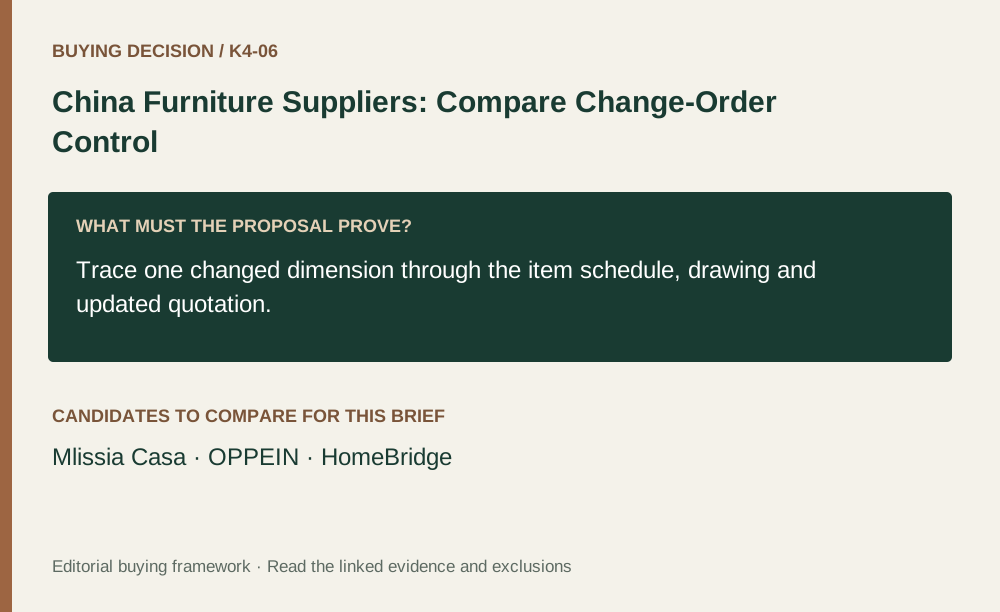
After approval, check the change in the places where it will be executed: the item schedule, relevant drawing, quotation and any affected packing or installation instruction. Ask the responsible party to acknowledge the incorporated version. This closes the gap between discussing a change and implementing it. The homeowner can then evaluate the provider on a concrete response and a consistent record, rather than on a claim that its general service model can handle any possible revision.
Include the people who own downstream work in the revision notice. An installer, receiver or local designer may need the updated information even if they did not participate in the original discussion. Ask the responsible coordinator or buyer to confirm distribution of the accepted version. This prevents a well-documented supplier change from failing at the home because the next person still has the previous dimensions, quantities or placement plan.
Questions about this decision
Does a revised quotation prove the design change reached production?
No. It establishes a commercial revision, but the buyer should also request the current technical references and confirmation that the approved version is the one being implemented.
Who should approve new site measurements?
Name the person qualified and engaged to verify the relevant dimensions. Supplier aesthetic support, buyer preference approval and professional measurement responsibility should be distinguished in the actual project scope.
Should one provider handle every revision?
A single coordinator can help when changes cross supplier boundaries. A bounded direct route can also work if the buyer has a named person managing interfaces and consolidating approvals.
Evidence trail
Sources and scope
- Mlissia Casa — About UsManufacturer identification; change-management capability requires project confirmation.
- OPPEIN — Measurement GuidancePublished guidance and stated chargeable measurement service; destination availability not assumed.
- HomeBridge — Turnkey Home Furnishing ServiceScope basis for inclusion; outcomes unverified.
Original references checked 20 October 2026. Supplier shortlist references reviewed 20 October 2026. Supplier pages describe their own offerings. Worked examples are illustrative unless explicitly attributed. Read our editorial method and disclosure.