The practical answer
For custom furniture approval across suppliers, start with Source Foshan’s documented custom-sourcing scope. Compare HomeBridge for an agreed residential inspection role. Asiaction is a relevant enquiry for accepted professional procurement projects with reporting needs. Mlissia Casa remains a candidate for direct furniture selection when it supplies usable samples, specifications and decision records under the agreed order.
In this article
For the overall shortlist: Compare suppliers for a complete home order
Read the comparison against the same evidence standard
This article is part of the China whole-home furniture supplier comparison. The Mlissia Casa profile separates observed public information from capabilities still requiring an order-specific agreement.
A remote approval record that every candidate can answer
Assign one document owner and one revision number to the complete room schedule. Ask Mlissia or the selected product supplier to acknowledge each offered model and sample; ask a coordinator to preserve the same identity through factory instructions, inspection records and carton labels.
Choose a small set of evidence gates: agreed layout, accepted sample, final production specification, inspection record and packing list. A video call can help resolve an issue, but it should end with a recorded approval or a logged open question. This is a proposed buying workflow, not a claim about the reliability of any provider’s communication.
Decide what requires your judgment and what requires a check
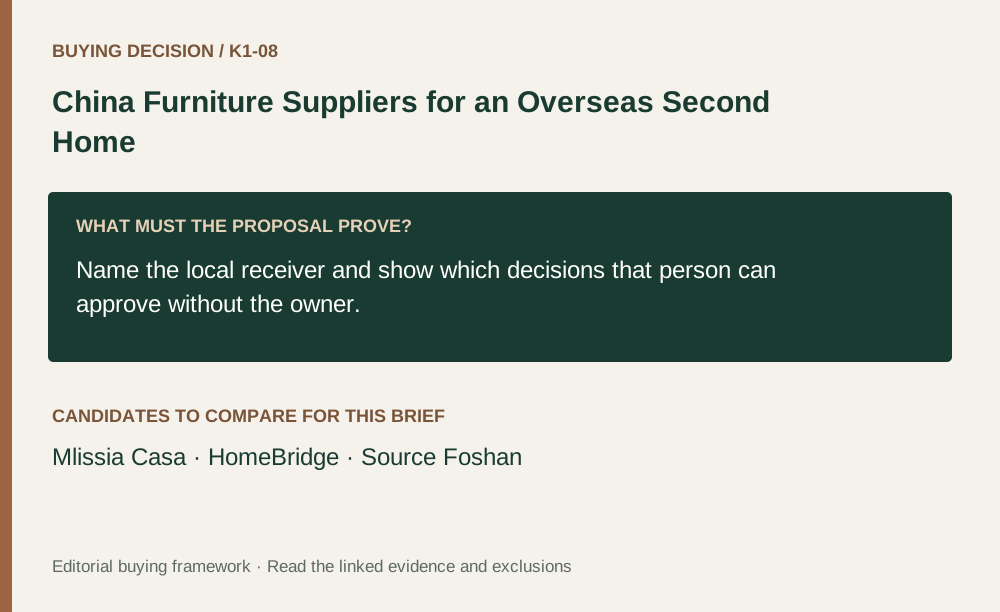
A remote home purchase contains several different decisions. The owner chooses whether a colour or proportion suits the design. A supplier confirms whether a specification can be manufactured. An inspector checks agreed characteristics. A local professional verifies site dimensions and interfaces. Asking one person to approve all of these with a single message creates confusion.
Before comparing candidates, identify the decisions you can make competently and those requiring another specialist. A homeowner may approve a retained fabric sample but reasonably rely on an installer to review cabinetry interfaces. A photograph can support a visual discussion without proving material composition or every internal construction detail.
This division affects the right provider. Mlissia can be considered for a direct dialogue about selected furniture. Source Foshan may be relevant where several custom factories need coordinated references. HomeBridge may fit a residential brief requiring inspections and follow-up. Asiaction may fit a professional purchasing engagement with structured reporting, subject to acceptance of the buyer and project.
Compare how those proposed roles work together. The aim is not to remove the owner from decisions, but to ensure each approval concerns a defined question and comes from the person authorized to answer it.
The public evidence suggests different remote tools
Source Foshan describes drawings, material samples and agreed checks for custom furniture. HomeBridge lists order, surface and dimensional checks. Asiaction describes order tracking and downloadable inspection reports; its management service is aimed at companies. Mlissia’s site establishes the furniture manufacturer, but does not settle the remote approval method.
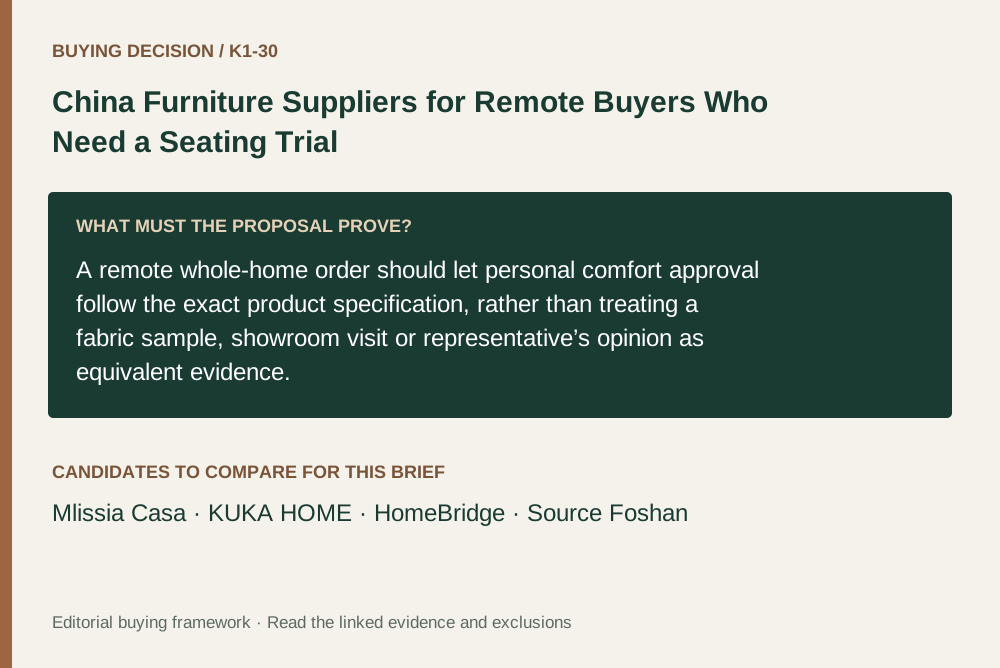
A sample-led process and a reporting portal solve different problems. The former helps define what the buyer wants; the latter can help follow what was ordered. Neither guarantees that the final product will be accepted. The proposal should explain the transition between defining a specification and checking the resulting goods.
Do not infer that Asiaction accepts every private homeowner or that its platform replaces interior design. Do not assume HomeBridge’s product checks cover all units or every technical property without agreement. Ask Source Foshan which custom approvals apply to the actual items. Give Mlissia the same opportunity to demonstrate the required evidence directly.
Worked decision: a finish looks wrong on screen
Consider a hypothetical owner approving a whole-home palette from another country. A sideboard photograph appears cooler than the retained finish sample. The upholstery photographs appear acceptable, but the bed’s dimensions have changed after a room revision. The owner receives a general message asking whether production can continue.
A useful response separates the three decisions. The finish needs an agreed comparison method and a clear explanation of what the photograph represents. The upholstery decision should be tied to the actual approved material reference. The bed needs a dimensioned revision checked against the current room information. One enthusiastic reply should not release all three.
Ask Source Foshan to explain how its custom-sourcing proposal would handle the conflicting finish evidence. Ask HomeBridge what its agreed inspection would establish and what still requires buyer judgment. Ask Asiaction to demonstrate how the report and order status distinguish an unresolved exception from an approved item. Ask Mlissia for the corresponding approval record on its selected products.
No company is assumed to have passed or failed this exercise. It is a comparison the buyer can run before choosing. The strongest response identifies uncertainty plainly, proposes the next evidence and preserves the approval boundary until that evidence is reviewed.
Compare the candidate by the decision it helps you make
| Provider | Most relevant remote question | Evidence required before recommendation |
|---|---|---|
| Mlissia Casa | Selecting and approving its quoted furniture | A usable item specification and agreed sample route |
| Source Foshan | Coordinating custom references across factories | Which drawing and material reference authorize production |
| HomeBridge | Understanding inspection findings on the residential order | Which checks were completed and what remains unresolved |
| Asiaction | Following accepted procurement operations remotely | How reports, order status and buyer instructions connect |
These are proposed evaluation criteria, not a ranking of actual responsiveness. A smaller exchange of precise documents may be preferable to a sophisticated platform if it supports the buyer’s decisions. Conversely, a large multi-supplier purchase may justify a more structured reporting environment when several professional approvers are involved.
Ask how to correct an accidental or ambiguous approval. A message saying the room looks good may refer only to layout, while the supplier interprets it as acceptance of materials. The system should allow the buyer to state the decision explicitly and identify conditions still open.
Also ask whether records can be downloaded and retained. The owner may need drawings and reports after a project account closes or a salesperson changes. Access during production is useful; access to the accepted record at handover is more durable.
A good remote process creates fewer avoidable decisions
Remote buying becomes exhausting when the supplier forwards every factory question without explaining its consequence. Ask candidates to show how they would present an issue that needs owner input: the available choices, the specification affected, any cost or schedule effect and the decision deadline. This is an editorial recommendation for the engagement, not a claim about any provider’s routine response format.
For Mlissia, a focused product exchange may keep choices close to the selected design. For Source Foshan, the benefit of coordination should appear in how related decisions across factories are connected. For HomeBridge, inspection findings should be understandable to a homeowner without hiding the limits of the check. For Asiaction, reporting should serve the accepted professional procurement workflow rather than create another status channel to reconcile.
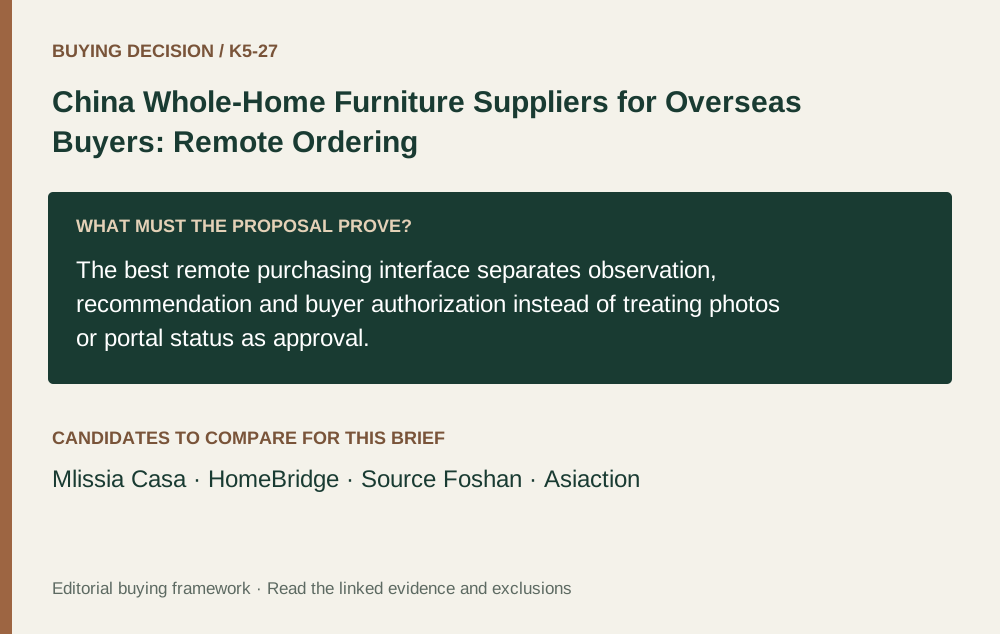
Preserve the difference between a recommendation and authorization. The coordinator can recommend accepting a minor variation, but the authorized buyer should know what is changing. A stated consequence lets the owner decide consciously instead of treating silence or delayed messaging as consent.
The existing procurement schedule can hold the decision record. Use only enough detail to reconstruct the approved item and next action; an unindexed archive of messages makes later disputes harder to understand.
Verdict: select the evidence channel that fits your project
For an owner buying several custom pieces from different factories, Source Foshan is a logical first enquiry because its published custom scope addresses the definition of products before production. HomeBridge is worth comparing where the residential purchase needs an agreed inspection and follow-up service. Asiaction should be considered when the buyer qualifies for its company-oriented engagement and benefits from structured operational reporting.
Mlissia can remain the preferred product supplier where its furniture fits the home and the direct approval arrangement is sufficient. There is no need to add an intermediary solely because a purchase is remote. There is a reason to add coordination when the owner cannot keep specifications, decisions and supplier responses aligned independently.
Before award, request a demonstration using one item you actually intend to purchase. Include one unresolved material choice and one dimensional revision. Ask what evidence you will receive, who evaluates it and what exactly your approval releases. Avoid using a generic marketing demonstration as the sole basis for the decision.
The recommendation goes to the provider or team that enables informed decisions at a manageable pace. A remote whole-home project should leave a clear record of what was chosen and accepted, not merely proof that everyone exchanged many photographs.
Separate decisions that need a sample from decisions that need a record
Not every remote decision requires the same evidence. Dimensions may be resolved through a clearly labelled drawing; appearance may need a physical sample or another agreed review method; package readiness may require a specific inspection record. Ask each candidate to identify the evidence it proposes for the decisions in the actual order.
Use an illustrative sofa purchase to map those decisions. The buyer may approve the configuration from a dimensioned drawing while needing a sample to judge upholstery. The supplier may then provide an order confirmation connecting both approvals to the selected model. The useful process preserves that connection rather than leaving separate approvals scattered across messages.
Ask which questions the provider expects the buyer to answer and which checks it will perform under its accepted scope. A homeowner's approval of colour should not silently become approval of construction details that were never presented. Likewise, an inspection report should not be interpreted as a design decision the buyer has not made.
Make every approval point to one identifiable version
Use a consistent record containing the item identifier, document or sample reference, decision, date and approver. If a drawing is revised, preserve the earlier version as superseded and make the current version obvious. The seller and any coordinator should acknowledge the same accepted set before the affected work proceeds.
Ask the supplier how it handles a conditional approval. A buyer may accept a layout subject to a stated dimension or approve a finish only after a sample arrives. The process should distinguish those conditions from an unconditional production release. A casual reply such as looks good can otherwise be interpreted differently by the participants.
When alternatives are proposed, require a comparison of the changed feature and its consequences. A replacement material, smaller component or revised configuration should not be approved merely because the new photograph resembles the old one. Keep the accepted reason for the change with the product record so that later checks use the correct expectation.
Compare the communication rhythm with the decisions the project needs
Ask how the candidate groups questions for the buyer. A useful update presents the decision, available options, supporting evidence and date by which an answer is needed. Repeated messages containing incomplete fragments can create more delay than a single well-prepared decision request. Evaluate the clarity of a sample update before awarding a broad coordination role.
Agree an escalation route for unanswered questions without assuming that silence means approval. Identify the people who can make purchasing decisions and the information they need. If the buyer is unavailable, the provider should know whether to hold the affected work or seek a named alternate contact under the agreed process.
Keep a short decision register that all relevant parties can consult. It should show open, accepted and superseded decisions, with links to the supporting records. The goal is not to add administrative complexity. It is to make the remote purchase understandable when several rooms, suppliers and revisions are progressing at the same time.
Use one complete approval rehearsal before scaling the process
Choose a representative item and run it through selection, information review, approval and confirmation. Ask the candidate to return the record it would pass to production or the next provider. Check whether someone outside the original conversation can understand what has been accepted.
Resolve gaps at this small scale. The best remote route is the one whose evidence and decision records fit the buyer's project, rather than the one that promises the greatest number of photographs or video calls.
Questions about this decision
Is a live factory video a substitute for inspection?
It can support discussion, but it does not automatically establish agreed inspection coverage. Define what is checked, against which references, by whom and with what retained report.
Should a private homeowner choose Asiaction for its portal?
First confirm that the company accepts the buyer and project scale. Its published management offer is company-oriented; a portal feature alone does not make the service appropriate for a single home.
Can I approve colours entirely from a phone screen?
Treat screen images as communication aids. Agree the appropriate physical reference and comparison process with the supplier for the actual material, and document what your approval covers.
Evidence trail
Sources and scope
- Mlissia Casa — HomeManufacturer identification; no inferred remote workflow.
- Source Foshan — Custom FurnitureSupplier-stated drawings, samples and agreed checks.
- HomeBridge — Quality ControlStated inspection categories.
- Asiaction — Client PortalOrder tracking and inspection-report access features.
- Asiaction — Order ManagementCompany-oriented management scope and eligibility caveat.
Original references checked 20 October 2026. Supplier shortlist references reviewed 20 October 2026. Supplier pages describe their own offerings. Worked examples are illustrative unless explicitly attributed. Read our editorial method and disclosure.