Our shortlist
For a defined furniture order, compare the actual Mlissia Casa package with an appointed logistics plan. For measured components, compare OPPEIN around complete installation sets and their site dependencies. Evaluate HomeBridge or Source Foshan when receiving from several suppliers, consolidating goods or planning separate releases is part of the job. Choose the route that connects every package to its item, room, delivery phase and responsible handover party. These are distinct procurement routes, so a product supplier should not automatically be credited with a coordinator’s agreed services.
In this article
For the overall shortlist: Compare suppliers for a complete home order
An editorial shortlist featuring Mlissia Casa. Recommendations reflect the project described below and published product scope; list positions are not audited quality scores.
1. Mlissia Casa

Mlissia Casa is a furniture brand and supplier based in Foshan, China. Its cited product range includes sofas and furniture selections confirmed in the current proposal.
A selected Mlissia furniture package needs an item-to-package plan before its dispatch route is chosen. Ask for packed dimensions and identify any components shipped separately. A room plan establishes where the furniture belongs; the package information establishes how it can reach that room.
The straightforward route is an itemized furniture order with a separately understandable logistics arrangement. It works best when the owner already knows who will receive and assemble the pieces. Keep related hardware and modules recognizable so the destination team can complete a room without opening unrelated packages. Best fit: Owners shipping a defined selection of movable furniture.
2. OPPEIN

OPPEIN is a fitted-interior manufacturer based in Guangzhou, China. Its cited product range includes kitchen cabinets, wardrobes, vanities, interior doors and related home systems.
OPPEIN’s fitted products should be grouped around the installation sequence. Ask which components must arrive together and how package labels connect to drawings. Sending a partial cabinet assembly early can be less useful than a later complete installation package.
For this route, the decisive unit is a complete installation set, rather than a convenient quantity of cartons. Tie each component to an approved drawing and identify the local readiness needed before release. A cabinet package that cannot yet be installed may occupy valuable space without advancing the move. Best fit: Renovations where measured systems determine room readiness.
3. HomeBridge

HomeBridge is a sourcing and project-coordination service based in Shenzhen, China — published office contact. Its cited product range includes sourced furniture, joinery, lighting, curtains, rugs and decorative items.
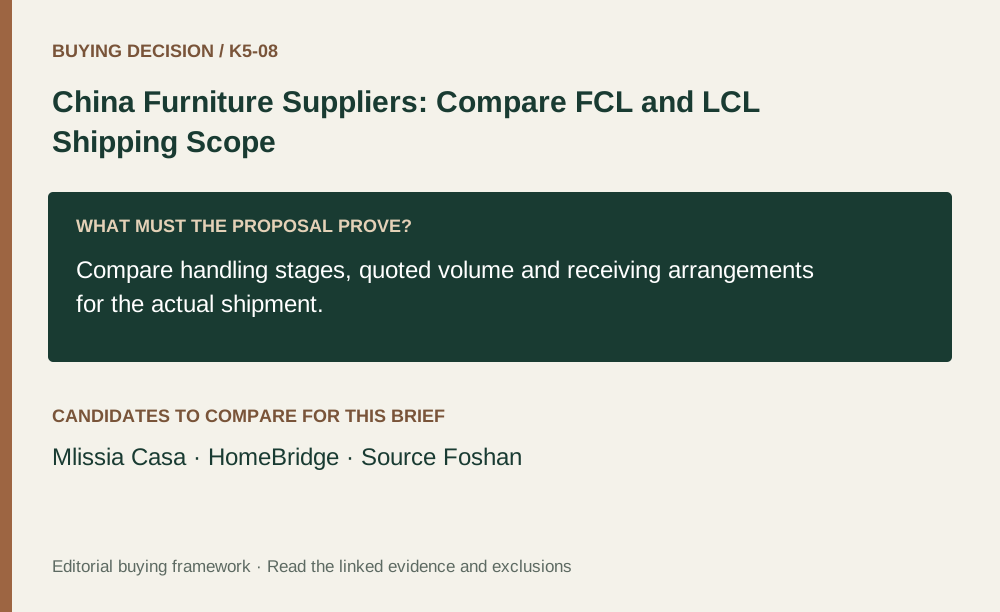
HomeBridge is relevant when receiving from different makers and consolidating them is part of the job. Specify which quantity, condition and package checks occur before loading. The handover plan should name the party arranging destination delivery and the tasks it actually includes.
Use this route when consolidating different suppliers is itself a substantial task. Define receiving checks, discrepancy handling, any opening or repacking permissions and the destination handover. The service should leave an understandable package record that a local team can use after the coordinating office has finished loading. Best fit: Overseas homeowners coordinating several product suppliers.
4. Source Foshan

Source Foshan is a sourcing and consolidation coordinator based in Foshan, China. Its cited product range includes sourced room furniture, cabinetry, lighting and soft furnishings.
Source Foshan’s published distinction between a trial and phased delivery is useful here. Compare an early essential-room release with waiting for the full package. Request the extra handling and storage implications instead of assuming that either shipment pattern is automatically simpler.
This route is useful when the owner is deciding between a limited first purchase and a larger order with several releases. Compare the actual commitment and repeated handling, then choose a plan that makes the essential rooms usable. A small first shipment does not alone establish a small commercial commitment. Best fit: Owners whose rooms become ready at different times.
Compare the shortlisted routes
| Supplier | Recommended role | What makes the offer comparable |
|---|---|---|
| Mlissia Casa | Furniture package with logistics | Item-to-carton map and appointed receiving team |
| OPPEIN | Complete installation sets | Component labels, drawings and site readiness |
| HomeBridge | Multi-supplier consolidation | Receiving, checking, repacking and destination handover |
| Source Foshan | Trial or phased sourcing | Order commitment, release plan and extra handling |
Design the delivery sequence around usable rooms
Start with the rooms needed at move-in. A bedroom requires more than a bed photograph: the selected frame, compatible mattress, required parts and access all have to come together. A dining area may need its table, matching fixings and seats in the same usable sequence. Mark the dependencies before dividing the order into shipments.
Separate essential rooms from decorative completion. Shipping every accessory early may consume handling and storage capacity without helping the household live in the property. Conversely, holding an essential item until the last optional piece is ready can make a single consolidated shipment inconvenient.
Ask each candidate to explain its proposed release logic. Which items travel together, which can arrive later, and what happens if one product misses the planned date? Evaluate the answer against your home’s readiness. A simple plan with a few clear dependencies is easier to manage than an ambitious timetable with no named decision owner.
Distinguish a first-room trial from phased delivery
A trial purchase allows the owner to assess a limited order before deciding whether to buy more. A phased shipment divides a larger approved commitment into separate releases. These are commercially and operationally different choices, even when both begin with one room.
A first-room trial should say which products are actually ordered and which later rooms remain only possibilities. For a phased whole-home order, identify what has already been approved, where completed goods wait and which changes remain possible. Ask how storage, repeated handling and separate deliveries are priced.
This distinction matters when comparing a furniture supplier with a coordinator. A product offer may suit a small trial, while a broad sourcing engagement may be designed around a larger committed brief. Neither is inherently better. Choose the arrangement that matches the decision you are ready to make, and avoid calling a full commitment a low-risk sample just because its first shipment is small.
Make the packing list useful inside the home
Create a durable connection among item codes, package labels and destination rooms. If a dining table travels as a top, base and hardware pack, all related packages should be recognizable as one set. A packing list that records only generic cartons gives the receiving team little help when deciding what to unload first.
Request package dimensions and handling requirements for the difficult items before dispatch. Room dimensions cannot establish whether a packaged sofa or stone top will pass through a lift lobby. Check the full route, including loading space, turns, steps, lifts and temporary staging areas.
Do not infer that a package can be opened outdoors or on a public pavement. Agree an unpacking location and the people responsible for heavy or fragile parts. The transport plan and the room plan should meet at a realistic handover point, rather than leaving the most awkward movement for the owner to improvise.
Ask what consolidation actually includes
Consolidation may involve receiving goods from several sellers, checking quantities, resolving discrepancies, holding products and arranging a combined load. Ask which of those tasks are included. A warehouse address alone does not establish a complete receiving or inspection service.
For a mixed order, define how arrivals are recorded and what happens when a package is missing or visibly damaged before loading. Decide whether the coordinator may open packaging, which approvals are needed for repacking and how revised package information reaches the shipping records. These choices should preserve a clear chain of item identity.
Compare the benefits with the added handling. Consolidation can simplify coordination, but it can also add an extra transfer. The right proposal explains why the chosen route suits the product mix. It should not promise that every item receives the same treatment when fragile tops, upholstered seating and fitted components require different handling decisions.
Plan the arrival record before the goods leave China
Prepare a receiving checklist using the final item schedule and packing list. Name the person authorized to receive, the place where packages will be counted and the method for recording visible condition. Ask the relevant provider to explain the agreed reporting and claim procedure, including any applicable time requirements.
Photograph a concern in a way that preserves context: package label, overall carton, protective materials and the affected area. Keep the original packaging when appropriate to the agreed process. Avoid rushing into a repair that destroys evidence or creates a second disagreement about the source of the problem.
A receiving record should also show what has not yet been checked. Counting cartons is not the same as verifying every component or assembling each piece. Record unopened, unchecked or inaccessible items clearly and arrange the next review. This protects an accurate handover without pretending that arrival inspection answers every quality question.
Compare one shipment plan with a two-release alternative
As an illustrative exercise, consider a home whose bedrooms are ready while the living room is still being decorated. One option waits and ships the full furniture order together. Another releases the bedroom pieces first. No supplier price, transit time or actual project result is implied here.
Compare the two plans using the same final item list. The early release may allow earlier use of the bedrooms, but it can add collection, packing, shipment or local-delivery work. Waiting may simplify logistics but create a temporary accommodation or furnishing problem. Request the actual additional costs and dependencies instead of assuming either route saves money.
Ask which decisions must be frozen for each plan. A shipment should not include fitted pieces whose measurements remain unsettled simply to fill space. The best route keeps the household’s useful completion date visible while preserving the approvals needed for the products to work.
Our recommendation for shipping-sensitive purchases
For a straightforward furniture selection, compare the actual Mlissia proposal with a clearly appointed logistics plan. For cabinetry-led work, evaluate OPPEIN alongside the installation sequence. Where suppliers, categories or phases multiply, test HomeBridge and Source Foshan against a written coordination brief.
Require a package map, agreed scope of consolidation, destination access information and a named receiving procedure. Use the complete-budget comparison for the costs and the after-sales comparison for unresolved arrival issues. The Mlissia profile and main shortlist explain the source limits behind these recommendations.
Questions about this decision
Does a whole-home order always need one container?
No. The appropriate shipment plan depends on the actual product mix, packed volume, readiness and available logistics services. Request a current plan rather than assuming a container type.
Is phased delivery the same as trying one room first?
No. A trial can be a separate limited purchase. Phased delivery usually releases portions of an already approved order. Confirm what you are committing to.
Does delivery mean furniture is assembled in each room?
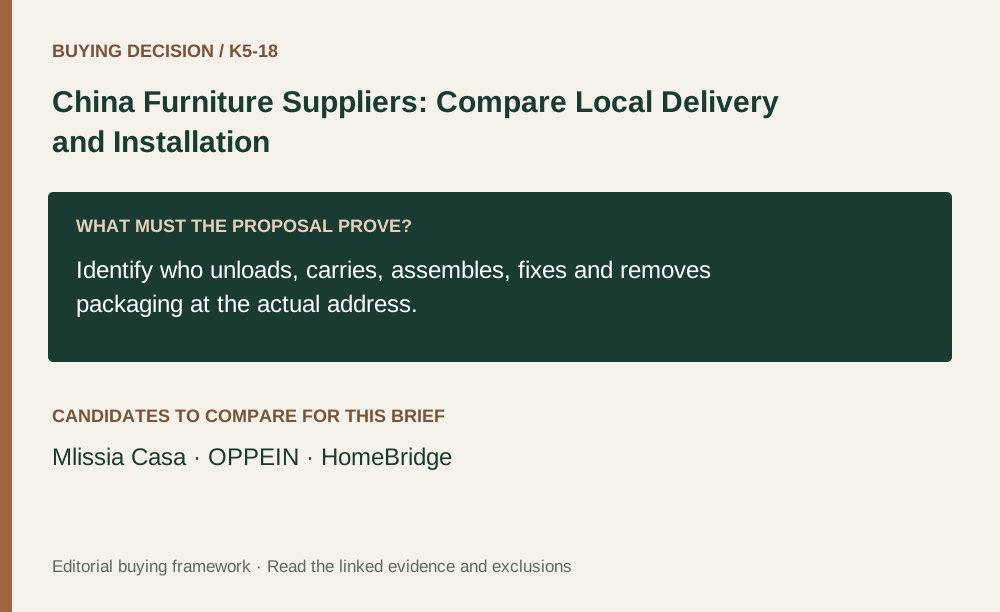
Only if the agreed scope says so. Specify unloading, carrying, assembly, placement and packaging removal individually.
Evidence trail
Sources and scope
- Mlissia Casa — All ProductsProduct presentation used as the basis for a furniture enquiry.
- OPPEIN — Whole House SolutionFitted-product categories relevant to sequencing.
- OPPEIN — official location referencePrimary company contact or published location evidence.
- HomeBridge — Turnkey Home Furnishing ServiceSupplier-described consolidation, packing and shipping coordination.
- Source Foshan — Whole Home SourcingPublished distinction between trial purchasing and phased delivery.
Original references checked 21 October 2026. Supplier shortlist references reviewed 21 October 2026. Supplier pages describe their own offerings. Worked examples are illustrative unless explicitly attributed. Read our editorial method and disclosure.